"Gillespie and I," by Jane Harris
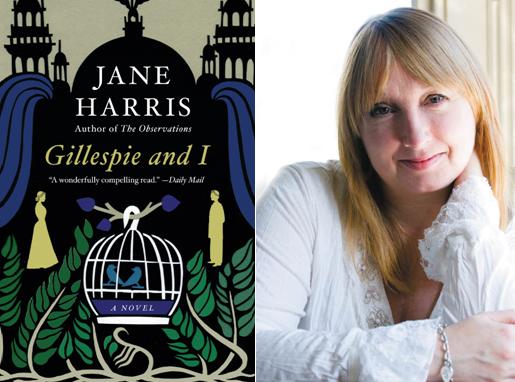
Jeff Glor talks to Jane Harris about "Gillespie and I," a follow-up to Harris's award-winning novel "The Observations."
Jeff Glor: What inspired you to write the book?
Jane Harris: I had known for a long time that I wanted to write something about an artist in Glasgow at the end of the 19th century. Originally, I had thought that the novel might feature a female painter and her struggles to be accepted as a serious artist alongside her male contemporaries. However, very soon after I began researching this idea, I came across an article in a newspaper. The article gave the details of a court case that had just taken place in a seaside town in Britain. This was about six years ago. The piece in the newspaper was very short and gave only the most tantalising details about the case, which concerned a family, their daughter and a neighbour. The crime was so bizarre, and involved such incomprehensible cruelty, that it haunted me. I realised that there was no reason why this crime, (which happened in about 2004), couldn't have taken place over a century earlier. And so I began to work on a different kind of story, one that, ultimately, became more of a psychological mystery than a character study of a female artist.
JG: What surprised you most during the writing process?
JH: Interesting and lovely question. I'm having to think hard about it. *author walks away from computer, strolls to another part of house, potters a bit, returns*
I suppose the most surprising thing about this novel is that I ever managed to finish it. I can't say too much here about the story, because there is a mystery at the heart of this book and I don't want to spoil anything for potential readers, but there are certain elements of the narrative that made it a technically complicated book to write. There was a sort of balancing act or magic trick that had to be accomplished. This was difficult to achieve and, at times, I just didn't feel capable of it. I'm actually still amazed that I finished it and that I seem to have got away with it.
JG: What would you be doing if you weren't a writer?
JH: I'd have been a supermodel or a porn star. Possibly. But (more likely), I'd still be teaching English as a Foreign Language somewhere. Or perhaps I might have ended up as an embittered, passive-aggressive librarian. In fact, yes, that's the most likely option. I'd be sitting behind the issue desk in my cardigan, swiping library cards, and imagining that the swiping action made each customer in front of me explode. Kaboom!
JG: What else are you reading right now?
JH: Mainly, I'm reading books that are related in some way to the novel I'm currently working on. So, right now, I'm reading an old book called "Obi," or the "History of Three-Fingered Jack" by William Earle. It's set in18th century Jamaica and tells the story of a slave who rebels against his masters.
JG: What's next for you?
JH: I'm determined to write a short, straightforward novel. Both "Gillespie and I" and my first novel "The Observations" turned out to be big books with fairly complex narratives. That means they took a while to write. I'm hoping to do something that's still rewarding for the reader, but not quite as long. I'm trying to remember the K.I.S.S. rule - that is: KEEP IT SIMPLE, STUPID.