Germany's AfD won a state election in a landslide, sounding an alarm for centrist politics
Berlin — Sunday's election results did not give Germany's controversial AfD party automatic control of the state of Saxony-Anhalt, but what the far-right party achieved wasn't just an election victory. It was a political landslide.
Alternative for Germany (AfD) won 43.8% of the vote in the legislative election, and while that may not be enough to form the next state government, it was the best result the party has achieved in any contest in its 13-year history.
Compared to the last state election in 2021, it more than doubled its share of the votes.
The result was even more dramatic for German Chancellor Friedrich Merz's center-right Christian Democratic Union. The CDU garnered only 17.2% of the votes in Saxony-Anhalt — plummeting from the 37.1% achieved in the last state election. The CDU, which has led every Saxony-Anhalt state government since 2002, now trails the AfD by more than 26 percentage points.
The results of the election show how fundamentally Germany's political system is changing. The AfD is no longer a fringe, anti-European Union protest party.
Does the AfD still have a path to power in Saxony-Anhalt?
In Germany, winning an election does not automatically mean a party gets to run the government — whether it's a state or the nation.
If the AfD had won just another percentage point or two of the vote on Sunday, it may well have garnered the absolute majority required in the state legislature to name the state's next leader and administration.
Having not met that threshold, AfD Saxony-Anhalt still faces significant hurdles to become the state's governing party — but it isn't out of contention yet.

Following the election, the AfD will hold 39 of the 83 seats in the new state parliament. So, the AfD's leading candidate in the state, Ulrich Siegmund, is three seats short of the 42-seat absolute majority needed to form a new, all-AfD administration.
And that's where complicated German coalition arithmetic comes into play. The other parties that won a decent share of the votes on Sunday, including the CDU, have all flatly rejected joining a coalition government with the AfD.
That collective refusal — a political line of demarcation backed by virtually all parties explicitly to keep a party seen as extremist out of power — is known in Germany as a "firewall."
The firewall has held for decades, but now a left-wing populist party could be poised to poke a hole in it in Saxony-Anhalt.
The Sahra Wagenknecht Alliance (BSW) received 5.3% of the vote on Sunday, giving it five seats in the state legislature. It has also ruled out joining a formal coalition with the AfD. One of its two lead candidates said Monday, however, that the BSW could abstain in a possible third round of voting to elect the state's minister-president, roughly equivalent to a U.S. governor.
In that round, only a simple majority of votes is required to elect the individual to the post, and abstentions are not counted. A BSW abstention alone would not automatically put the AfD's Siegmund into the top job. While the AfD holds 39 seats, the other four parties that took a significant share of the votes, the CDU, SPD, Greens and Left, together also hold 39.
If all four of those parties remain united to maintain the firewall against the AfD, and all five BSW lawmakers abstain from the vote, the result would be a tie, and the AfD would still not be able to form a government.
But a single party defection or other deviation could be decisive, and the AfD's Siegmund has said he'll speak with other parliamentary groups and individual lawmakers, likely hoping to convince just one member to defect from their own party's position behind the firewall.
This is where the AfD's new power lies: Even if it does not form a government, its election result is already forcing other parties to at least consider political arrangements that have long been unimaginable in Germany.
The collapse of Germany's centrist power base
In the 2025 federal election, the AfD won more than 20% of the vote.
This weekend in Saxony-Anhalt, it achieved its best result in a state election with almost 44%, and that came two years after it also finished first in neighboring Thuringia state's legislative election, taking 32.8% of the vote.
That clear trajectory, for the CDU, is a snowballing political crisis.
The Christian Democrats have ruled out cooperation with the AfD for years. However, following the debacle in Saxony-Anhalt, pressure to show some flexibility in that strategy is mounting.
Before the election, Sepp Müller, deputy chairman of the CDU's parliamentary group, had argued that in the event of a clear AfD victory in Saxony-Anhalt, the party should be given a mandate to form a government. Other Union politicians, however, have warned against abandoning the firewall, even a little bit.
Union parliamentary group leader Thorsten Frei said unequivocally on election night: "We do not talk to right-wing extremists."
So the CDU, which has led Germany's national government for 52 of its 77 post-World War II years, is in a dilemma. To keep the AfD out of power, it may need to partner with smaller parties far to the left, including the Left Party, with which the CDU has also ruled out a formal coalition. If, on the other hand, it opens itself up to working with the AfD, it would tear down one of the most important political boundaries in Germany.
And the CDU's crisis has now reached Berlin.
Chancellor Merz had promised to push back against the AfD politically. The party achieving its best result ever on Sunday, while Merz's own CDU sinks to its lowest representation ever in Saxony-Anhalt, has brought a lot of pressure on the national leader.
The first internal call for Merz's resignation came from Tim Brand, a board member of the CDU's youth organization in the state of Brandenburg, who called on him to step down both as chancellor and CDU chairman. The CDU youth union in Saxony-Anhalt has separately demanded the resignation of the party's state leadership.
AfD's unlikely leader sets sights on next federal election
One of the people who stands to benefit most from the AfD's gaining momentum after the Saxony-Anhalt election is Alice Weidel, co-chair of the AfD and the party's candidate to stand as Germany's next chancellor in the 2029 federal election.
Weidel doesn't fit what many may think of as the traditional image of her party. She holds a Ph.D. in economics and worked for Goldman Sachs. She is a lesbian who lives openly with her Swiss partner, a woman of Sri Lankan descent, and their two sons.
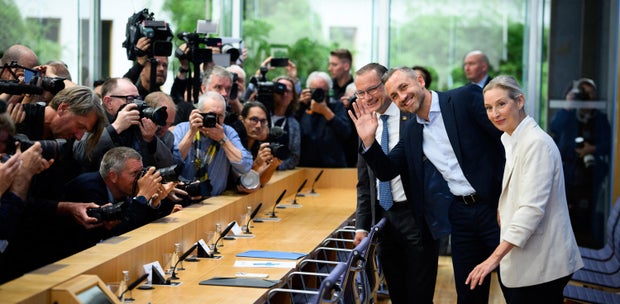
While she spends part of her time in Einsiedeln, Switzerland, Weidel says she's a registered resident in Germany and pays her taxes in the country.
All of those factors appear to contrast with elements of her party's platform: The AfD promotes a traditional view of the family, opposes some policies aimed at ensuring equal treatment of LGBTQ people, and has made drastic limits on immigration a key policy point.
The focus on immigration, in a country where the centrist government's decision to welcome hundreds of thousands of Syrian refugees a decade ago has fueled ongoing anger among many voters, has been a cornerstone of the AfD's success.
In Saxony-Anhalt, among other things, the party is calling for a "deportation and remigration campaign" and restrictions on the display of LGBTQ symbols in schools.
But Weidel seems to have made the contradictions between her personal life and her party's platform a political advantage rather than an obstacle, at least so far.
On Monday, she hailed the vote in Saxony-Anhalt as a "dream result" and made it clear her sights are now set on Berlin. In the next federal election, she aims to bring the AfD's share of the national vote to at least 40%, which would force Germany to grapple with a question that has long seemed theoretical: What happens if the firewall holds, but the party behind it keeps growing stronger?
At what point, in other words, might constitutionally legal political jockeying become fundamentally undemocratic?