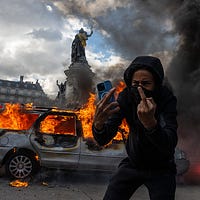
French government extends curfews after riots sweep across the country
French authorities are extending curfews and increasing the police presence in public spaces as President Emmanuel Macron's government tries to regain control after rioters torched buildings and looted thousands of businesses this weekend.
But addressing the problems that have brought students and workers to the streets for the last five weeks will be a tougher proposition.
Protesters are demanding better schools and relief from rising living costs, while the government faces mounting debt and a fractured parliament that makes even passing a budget difficult.
More police and curfews
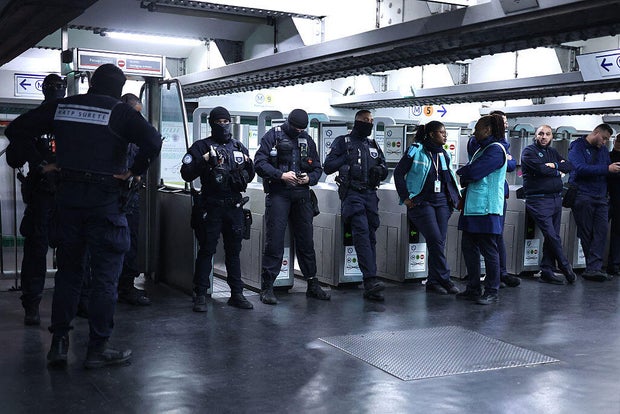
Prime Minister Sébastien Lecornu promised a "massive" police deployment Tuesday ahead of the next demonstrations scheduled for Oct. 24. The announcement followed Interior Minister Laurent Nuñez's acknowledgment that authorities had underestimated the unrest and lost control in some cities during Saturday's protests.
More than 2,500 people had been taken into police custody by Monday evening, Justice Minister Gérald Darmanin said, after violence that included the burning of a historic town hall in Limoges, a city in central France.
Overnight curfews have been imposed around Paris' Place de la République and Les Halles shopping district, with restrictions also introduced in Lyon and other cities. Paris and Lyon reported no major incidents Monday night, and authorities are extending the measures.
In an address Sunday, Macron distinguished between the peaceful protests for better schools and working conditions and the rioters who he said hijacked those protests, saying that the government would both listen to the protesters' demands and punish rioters. He blamed "radical far-left groups" and "criminals" for the violence and said that "those who sought to bring down the republic will be held accountable."
Political gridlock and financial pressure
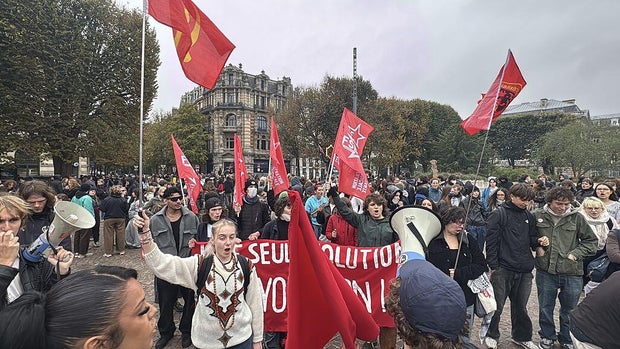
The protests began in mid-September when high school students and teachers in the suburbs of Paris called for changes to overcrowded classrooms, deteriorating buildings and teacher shortages. They have since drawn in trade unions and Yellow Vest activists, a French grassroots organizing group, becoming a broader movement against high living costs and declining public services.
The government has offered some concessions. On Oct. 8, the Ministry of National Education announced plans to deploy more than 3,000 substitute teachers to high schools most in need, and authorized several hundred additional hires.
But worsening financial pressure and political gridlock make more comprehensive changes more difficult. France's public debt stood at nearly 3.6 trillion euros at the end of June, equivalent to 119% of its annual economic output, according to the national statistics agency.
The government expects this year's deficit to reach 5.4% of economic output and is trying to reduce it to 5% in 2027. Interest payments alone are projected to rise by 12 billion euros next year, to 91.2 billion euros, further squeezing the money available for public services.
Macron's allies also lack a majority in the French parliament. This year's budget was adopted only in February, after the government pushed it through without a final vote on the bill, which survived two no-confidence motions.
An Ipsos poll conducted Oct. 7-8 put Macron's approval rating at just 15%. A September Ipsos poll put Marine Le Pen, leader of the far-right National Rally party, well ahead of the field, with 33% to 35% support in different first-round matchups. Former Prime Minister Édouard Philippe and Jean-Luc Mélenchon, leader of the far-left party La France Insoumise, were among those vying for second place.
In April, France will hold presidential elections to choose a successor to Macron, who cannot run for a third term.