Fed watchdog finds no laws broken in $2.5 billion Fed renovations Trump has called "disgraceful"
Washington — The Federal Reserve's inspector general announced Wednesday that the multibillion-dollar renovations of the Fed's headquarters criticized by President Trump as "disgraceful" did not violate federal law, though the office concluded poor project management dramatically increased the cost.
"At no point during our evaluation did we find reasonable grounds to believe that a violation of federal criminal law had occurred requiring a referral to the U.S. Attorney General in accordance with the Inspector General Act," the new 121-page report stated. The IG also did not find fault with features that the White House had complained were "ostentatious" and noncompliant with the approved plans.
Although the report found "deficiencies in the management of the renovation project" that resulted in a series of recommendations from the inspector general, "we did not identify administrative misconduct during our evaluation," wrote Michael Horowitz, the central bank's inspector general.
Mr. Trump wrote Wednesday on Truth Social that he asked Attorney General Todd Blanche "to study the report, and make a determination" about what to do.
The report is the culmination of an internal investigation that lasted more than a year, which the IG says came at then-Federal Reserve Chairman Jerome Powell's request and began in July 2025.
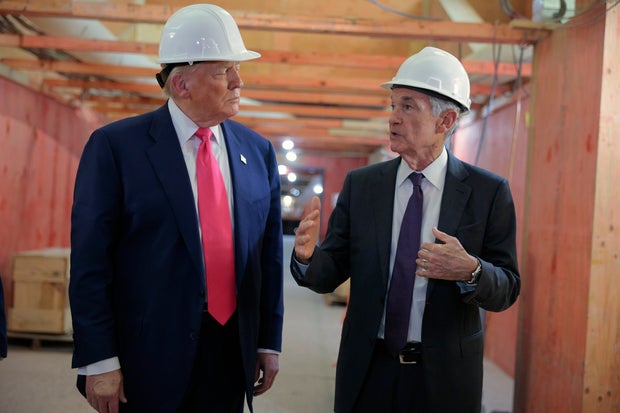
A separate Justice Department probe was announced in January, when Powell revealed in a video message that the Fed had received grand jury subpoenas as part of an ongoing criminal investigation.
The subpoenas threatened an indictment related to Powell's testimony before the Banking Committee in June 2025 about the years-long project to renovate the Fed's offices. Bill Pulte, who leads the Federal Housing Finance Agency, urged Congress in July 2025 to investigate Powell over his testimony about the renovations, alleging he has been "deceptive." He offered no evidence to back up his accusations.
The IG also reviewed Powell's testimony and concluded there had been no criminal wrongdoing.
The criminal probe involving Powell came amid Mr. Trump's frequent airing of frustrations with him for declining to rapidly slash interest rates. The U.S. District Court in Washington, D.C., ultimately quashed the subpoenas issued by D.C. U.S. Attorney Jeanine Pirro, finding they were a pretext to pressure Powell into voting to lower interest rates or resigning.
In January, Mr. Trump nominated Kevin Warsh to succeed Powell as Fed chair — but Warsh's confirmation faced a key hurdle when Republican Sen. Thom Tillis of North Carolina said he would not vote to confirm any nominee until Pirro dropped the criminal probe into Powell.
In April, Pirro announced that federal prosecutors had ended their criminal investigation, clearing the way for Warsh's confirmation.
Pirro said at the time that she expected the inspector general's office to provide her with a "comprehensive report" on its findings and said she was "confident the outcome will assist in resolving, once and for all, the questions that led this office to issue subpoenas."
On Wednesday, Pirro told CBS News that she would review the report. CBS News has asked her office if she plans to reopen a criminal investigation.
After interviews with Fed governors, senior Board officials, staff and contractors, the IG identified four areas that caused the building renovation costs to surge and issued seven recommendations.
Horowitz's report concluded that the Fed did not obtain a construction cost estimate from its general contractor and did not share a stated cost limitation with the contractor at the outset. Also, internal project governance was found to be "insufficient" to manage such a large-scale multibillion-dollar project.
In interviews, the IG found that officials repeatedly pointed to inflation as the chief driver of cost increases. The IG's report assessed that "inflation was clearly a factor," but that the cost overruns surpassed the rate of inflation.
The IG asked the Federal Reserve's Board of Governors for an assessment of inflation on the project. According to the report, the Board did not provide analysis to explain how inflation impacted the overall cost.
"Instead, the Board provided us with an assessment from two of its senior economists, who noted that while they 'agree that the [Producer Price Index] is a good measure of general changes in new office construction costs, using this measure — or any general index of construction costs — to evaluate cost increases for any specific project can be misleading,'" the report reads.
Warsh has received a copy of the report and on Tuesday wrote to Horowitz to inform him the General Services Administration, which manages federal buildings and property, had been retained to advise the Fed on the project, reporting to both Warsh and the Board.
Warsh also said the Board would initiate a full audit of the construction in order to "determine the value of any services not received, and pursue appropriate remedies." He said the Fed would seek to be reimbursed or credited for any work that it paid for but that was not performed.
The Fed declined to comment beyond Warsh's letter.
According to the report, as of July, the Board had not established a guaranteed maximum price — four years after construction began and after almost all of the construction awards had been issued.
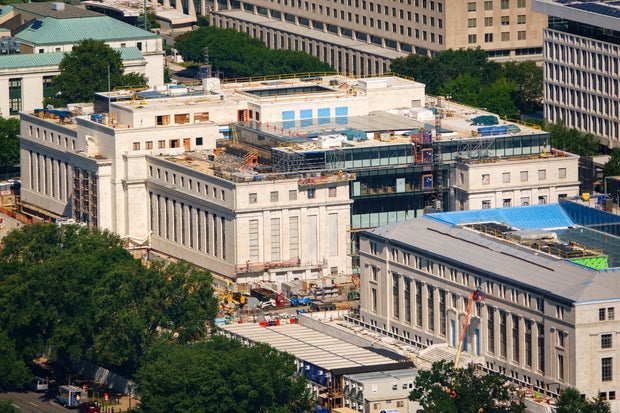
The renovations of the central bank's headquarters were first approved in 2017 and are set to be completed in 2027. The estimated cost of the project — which encompasses two buildings — has risen from $1.9 billion to nearly $2.5 billion. The Fed has said the cost increases are a result of changes to the original building designs after consultations with review agencies; a rise in the cost of material, equipment and labor; and unforeseen conditions like soil contamination and the discovery of more asbestos than was initially expected.
The inspector general at the central bank has twice conducted audits regarding renovation projects that experienced cost overruns, and Powell told the Senate last year that he had asked the internal watchdog to "take a fresh look at the project."
Those audits, which Wednesday's IG report references at length, identified previous challenges including lack of proper preplanning, unreliable cost estimates, unimplemented cost-control measures and incomplete oversight. However, one of the audits, in 2022, examined the Fed's contract modification process and found it to be "effective," offering no recommendations because the Fed's manual framework for modifying contracts was changed to an electronic system during the audit.
White House Office of Management and Budget Director Russell Vought wrote to Powell in July 2025 to take issue with plans for the renovation that "called for rooftop terrace gardens, VIP private dining rooms and elevators, water features, premium marble, and much more." President Trump has referred to the renovations as a "very luxurious situation" and said that spending $2.5 billion on the upgrades is "disgraceful."
But Horowitz concluded that some design features — like a private elevator for the Fed chairman, the extensive use of marble, a garden terrace and skylights — "did not materially contribute to the construction cost increases."