Duncan: "We can't afford to wait" for education reform
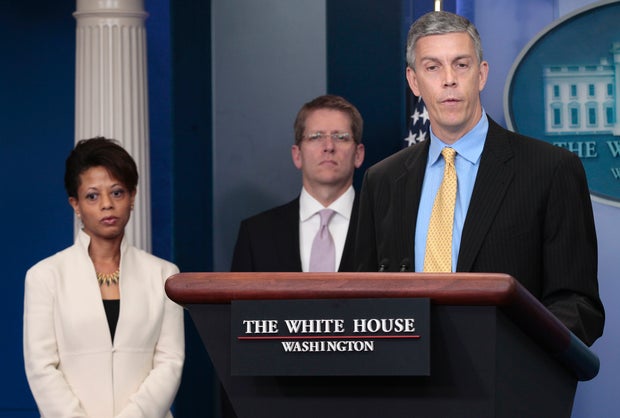
Education Secretary Arne Duncan on Monday unveiled a system that will allow states flexibility from mandates in the Bush-era "No Child Left Behind" education law, arguing that "we can't afford to have the law of the land be one that has so many perverse incentives or disincentives to the kind of progress we want to see."
Speaking to reporters at a White House press briefing on Monday, Duncan outlined a plan to grant waivers to states seeking freedom from the current law, which he described as impeding progress and reform in the educational arena.
"At a time when we have to get better, faster education than we ever have, we can't afford to have the law of the land be one that has so many perverse incentives or disincentives to the kind of progress we want to see," Duncan told reporters. "No Child Left Behind, as it currently stands, is four years overdue for being rewritten. It is far too punitive. It is far too prescriptive. It led to a dumbing-down of standards. It led to a narrowing of the curriculum."
Duncan said it was dysfunction among Congress that was forcing the White House to act of its own accord.
"We would have loved to see Congress act; no question that it should have happened," Duncan said. "We hope it happens at some point down the road, but it hasn't, and we can't afford to wait."
He added: "Right now, Congress is pretty dysfunctional. They're not getting stuff done. And this is something that's long overdue."
Under the "No Child" law as it currently stands, schools are graded on a pass-fail scale based on the results of standardized tests administered to students. Failing schools - many of which serve low-income communities - are punished, and often shut down altogether or turned over to a charter operator or private firm.
The law has long faced criticism that it imposed stringent, inflexible federal guidelines on schools and teachers, and abandoned institutions determined as "failing." Many argue that the legislation's required achievement goals are unrealistic and label schools as failures even if they are making relative progress.
"Everywhere I go, teachers, parents, principals, school board members, state superintendents are asking for the flexibility to do the right thing," Duncan said on Monday.
"I've talked to probably 25 to 30 governors over the weekend, Saturday, Sunday, today, Republican, Democrat, all over the country, Mississippi, Montana, Maryland. Everyone is asking for more flexibility. Everyone is asking for the space to do the right thing by children."
Duncan reiterated that the waiver system would enforce high standards, but that states would be able to use "new and improved accountability systems focused much more on growth rather than on absolute test scores" in order to improve student achievement.
"What we're asking states -- again, where they're raising standards, where they're thinking creatively around teacher and principal effectiveness, and where they're taking on those bottom performing schools, not just to save one or two children but to turn those entire schools around," Duncan said. "This is tough, tough work, but it's hugely important."