Despite more enforcement, piracy will get worse
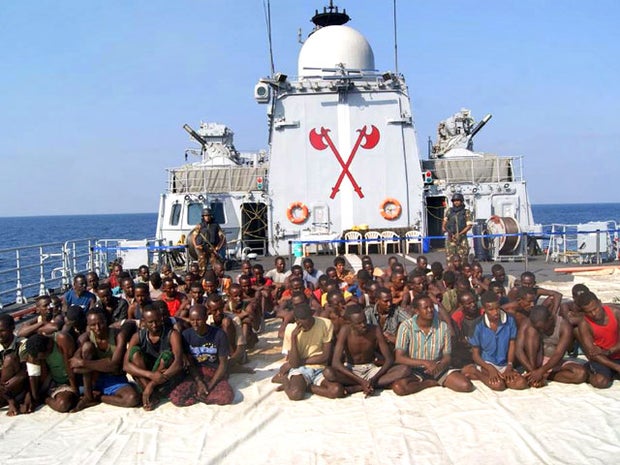
Several of the world's militaries spend a lot of money patrolling pirated waters, and shipping costs rise as insurance gets more expensive and shipping companies are forced to take extra security measures and longer routes around dangerous seas using more fuel.
Add those expenditures to the frequent multi-million dollar ransoms paid pirates, and piracy costs the world $8 billion a year, a figure that is projected to double by 2015, The Independent newspaper reports.
So it was with a sense of urgency that the first international counterpiracy conference wrapped up in Dubai on Tuesday.
Diplomats and shipping industry officials ended the conference by calling for a stronger public-private effort to tackle Somalia-based pirates preying on international shipping, the Associated Press reports. However earnest the call may have been, a relatively measly $5 million was pledged to a United Nations trust fund aimed at fighting piracy and other development projects in Africa.
The reason that $5 million anti-pirate donation is so relatively small is that 70 percent of the record high 142 piracy attacks worldwide in the first quarter of this year were committed by Somali pirates, who operate from a country with an unstable-at-best government, security force and economy, the AP reports.
Pirate gets 30 years for failed Navy assaultIndia captures 16 pirates after 3-hour battle
U.S. Navy foils pirate attack in Arabian Sea
Somali pirates earn an estimated 150 times more committing crime on the high seas than they would be earning doing legit work at home, according to The Independent. A pirate's annual income can add up to as much as $80,000 per year, a veritable fortune in the Horn of Africa.
Given the situation, it is little wonder that Somalia's foreign minister, Mohammed Abdulahi Omar Asharq, lashed out at the world community during the conference. The Wall Street Journal wrote: "He doubted the international community had the will to tackle piracy and said his country's people felt "abandoned" by the world."
Asharq pointed out that world powers do not get deeply involved tackling Somalia's instability, all while mounting aggressive interventions in Afghanistan, Iraq, Libya and the Ivory Coast to address international threats, the Journal reports.
The navies of the U.S. and several other nations patrol the waters off Somalia, particularly along the strategic shipping lanes leading through the Gulf of Aden, the AP reports. While their presence acts as a deterrent, it has also pushed pirates to operate further out at sea off so-called "motherships," which are usually large, previously hijacked ships used to base small, fast raids from.
There are an estimated 1,500 or so Somali pirates at the moment, but with the alleged success of the motherships, the number of Somali pirates is projected to rise by as much as 400 per year, the Independent reports. While rising deaths and costs force the international community to engage the problem more, it is little wonder that Asharq denigrated the world's approach to the problem.
"In Somalia, where the consequences of state fragmentation and incapacity have produced two global threats of the first order - religious extremism and piracy - the world has so far responded only with containment," Asharq said, according to the Financial Times. "This is not productive, effective, practical or morally defensible."