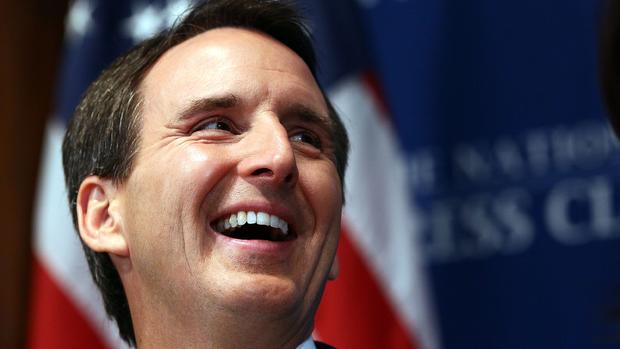
Can Tim Pawlenty win the GOP presidential nomination?
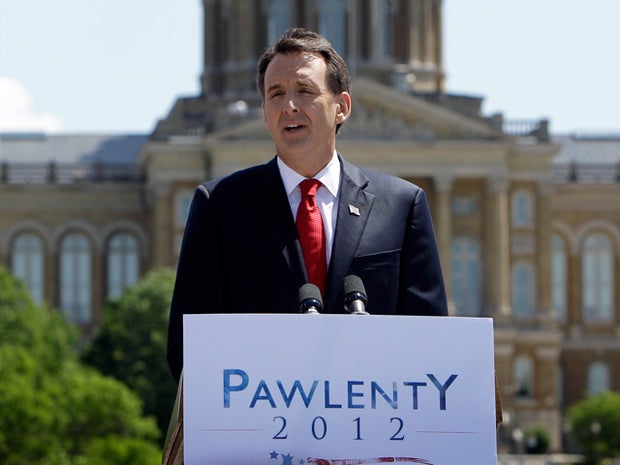
All things considered, things are shaping up pretty well for Tim Pawlenty.
For more than a year, the former Minnesota governor has effectively been the Potential Republican Candidate Most Likely to Elicit a Shrug. While none of the party activists or politically-active Republican faithful had much bad to say about him, they weren't exactly thrilled with the idea of Pawlenty as their standard-bearer against President Obama.
Pawlenty's image is one of the nice guy down the street - the solid family man with the firm handshake who might sell you a very reasonable insurance policy. He tried, tentatively, to change that perception as he traveled the country laying the groundwork for his campaign, offering up more forceful and provocative rhetoric that seemed outside his comfort zone. But it didn't really take, and by the time Pawlenty appeared in Iowa to formally announce his presidential campaign Monday, he had settled on his campaign theme: I may not raise your blood pressure, but at least I won't lie to you.
"Fluffy promises of hope and change don't buy our groceries, make our mortgage payments, put gas in our cars, or pay for our children's clothes," he said, in an obvious shot at Mr. Obama. "So, in my campaign, I'm going to take a different approach. I am going to tell you the truth."
Pawlenty went on to back up that claim by calling for reforms to entitlement programs and opposing ethanol subsidies, an position not likely to be popular in Iowa. "Conventional wisdom says you can't talk about ethanol in Iowa or Social Security in Florida or financial reform on Wall Street," he said. "But someone has to say it. Someone has to finally stand up and level with the American people. Someone has to lead."
Pawlenty's presentation wasn't particularly dynamic. But his Minnesota-nice persona may play well with Iowa caucus voters, who may respond positively to Pawlenty's straightforward, flash-free delivery.
Pawlenty's gotten two big gifts in recent weeks: First, 2008 Iowa caucus winner Mike Huckabee decided to pass on the race, greatly improving Pawlenty's chances in Iowa. And then Mitch Daniels, perhaps Pawlenty's biggest challenger in the race to become the GOP establishment's preferred alternative to Mitt Romney, did as well.
Romney is unlikely to make a big push in Iowa, where he was embarrassed by Huckabee in the 2008 cycle. And likely GOP candidate Jon Huntsman appears poised to essentially skip it. That leaves the door open to Pawlenty to take the caucuses - and get a big boost in media coverage, donations and momentum if he does.
Pawlenty's decision to hold his campaign kickoff in Iowa - on his 14th trip to the state - speaks to just how important the first-in-the-nation contest is for him. Former Congressman Vin Weber, who is co-chairing Pawlenty's campaign, said in an interview with CBS News that while Iowa is important for Pawlenty, he could potentially take the nomination even if he doesn't win the state - if the people of Iowa cast their ballots for "somebody not seen as a potential president of the United States."
Weber didn't elaborate on who that might be, but it's pretty easy to take that as a reference to controversial Tea Party Caucus founder Rep. Michele Bachmann, who is strongly considering entering the race. Bachmann, who like Pawlenty hails from nearby Minnesota, is expected to perform well among the Iowa GOP electorate, 60 percent of which identified in 2008 as "born-again Christian."
The idea is that if Bachmann were to win the caucuses, Iowa would effectively be dismissed and Pawlenty could survive so long as he put up a respectable showing. (Also strongly contesting Iowa are former House Speaker Newt Gingrich and Herman Cain, the former CEO who won over a Fox News focus group after the first Republican presidential debate. One could argue that at least one of them is in the same category as Bachmann.) The reality, however, is that Pawlenty's odds of taking the nomination decrease considerably if he doesn't take the Hawkeye state.
Pawlenty's biggest strength may be the fact that he doesn't have a big disqualifier on his record. While he previously supported cap-and-trade energy policy, that's relatively small potatoes compared to Romney's passage of an "Obamacare"-like health care law as Massachusetts governor or Gingrich's disastrous broadside on Paul Ryan's Medicare plan.
And with President Obama looking strong, his potential opponents have been running for the exits. In addition to Huckabee and Daniels, establishment favorite Haley Barbour has decided to forgo a run, and Chris Christie and Jeb Bush are strongly resisting pressure to throw their hats in the ring. All that means that the Republican establishment may be primed to finally - if reluctantly - accept Pawlenty to lead their party in 2012.
Weber noted that in 1980 - when Ronald Reagan won the presidency - Republicans were also casting about for stronger candidates. He suggested that Pawlenty's stature will grow as his campaign flourishes.
"It's hard, particularly when you have an incumbent in the White House, it's very hard to look at anybody and say that person is able to go toe to toe with the president of the United States," said Weber, who argued that "people grow to that stature" by campaigning and winning the nomination and facing off with the president.
Pawlenty's pitch - that he, unlike the president, is a grown up willing to deal with problems - doesn't quite have the ring of "change you can believe in." But without an obvious star in the GOP race, it might be the best the Republicans can hope for. He may not be Huckabee, but he seems to be someone social conservatives can stomach; he may not be Daniels, but the fiscal conservatives are willing to get on board.
Pawlenty, in other words, might well emerge as the Just Good Enough candidate in the GOP field. And this year, that might be enough to carry someone all the way to the nomination.