"Bunker Hill: A City, a Siege, a Revolution," by Nathaniel Philbrick
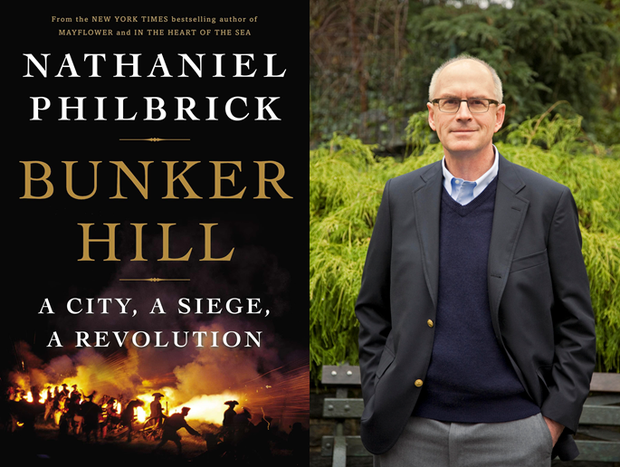
Jeff Glor talks to Nathaniel Philbrick about "Bunker Hill: A City, a Siege, a Revolution."
Jeff Glor: What inspired you to write the book?
Nathaniel Philbrick: Like a lot of kids, I read Edith Forbes's "Johnny Tremain" in elementary school. It had a big impact and I've always been curious about what the city of Boston was like during the Revolution. After finishing my book "Mayflower," which ends with the terrible English-Native conflict called King Philip's War in 1676, I realized I wanted to continue the story, so to speak, and tell about what happened a hundred years later in Boston.
JG: What surprised you the most during the writing process?
NP: I was surprised to learn that most of the Founding Fathers we associate with the Revolution in New England -- John Adams, John Hancock, and Sam Adams -- were in Philadelphia at the Continental Congress when events were unfolding in Boston. A 33-year-old doctor named Joseph Warren was the one who ordered Paul Revere to alert the countryside that the British were coming. Warren was the President of the Provincial Congress and was the one leading the on-the-ground revolution until he died tragically at the Battle of Bunker Hill.
JG: What would you be doing if you weren't a writer?
NP: I'd probably be a teacher of some sort -- in fact, that's what I always assumed I'd be doing until I ended up becoming a writer.
JG: What else are you reading right now?
NP: I'm in the middle of two books -- the second volume of William Manchester's biography of Winston Churchill, "The Last Lion," and F. Scott's Fitzgerald's "Tender is the Night."
JG: What's next for you?
NP: Not sure at this point, but I really found the Revolutionary War period fascinating. We'll see!
For more on "Bunker Hill" visit Viking.