Boston Dynamics is training an AI-powered humanoid robot to do factory work

With rapid advances in artificial intelligence, computer scientists and engineers are making progress in developing robots that look and act like humans. A global race is underway to develop humanoid robots for widespread use.
Boston Dynamics has established itself as a frontrunner in the field. With support from South Korean carmaker Hyundai, which owns an 88% stake in Boston Dynamics, the Massachusetts company is testing a new generation of its humanoid robot, Atlas.
This past October, a 5-foot-9-inch, 200-pound Atlas was put to the test at Hyundai's new Georgia factory, where it practiced autonomously sorting roof racks for the assembly line.
Today's AI-powered humanoids are learning movements that, until recently, were considered a step too far for a machine, according to Scott Kuindersma, who is the head of robotics research at Boston Dynamics.
"A lot of this has to do with how we're going about programming these robots now, where it's more about teaching, and demonstrations, and machine learning than manual programming." Kuindersma said.
How Atlas is trained
When 60 Minutes visited Boston Dynamics' headquarters in 2021, Atlas was a bulky, hydraulic robot that could run and jump. Back then, Atlas relied on algorithms written by engineers. The Atlas of today is sleeker, with an all-electric body and an AI brain powered by Nvidia's advanced microchips, making it smart enough to master hard-to-believe feats.
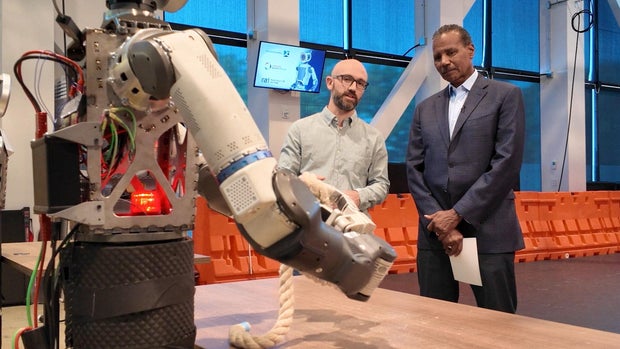
Atlas learns in several ways. At Boston Dynamics, machine learning scientist Kevin Bergamin demonstrated an example of supervised learning. Wearing a virtual reality headset, Bergamin took direct control of the humanoid and guided its hands and arms through each task until Atlas succeeded.
"That generates data that we can use to train the robot's AI models to then later do that task autonomously," Kuindersma said.
Another teaching technique involves a motion capture body suit. 60 Minutes correspondent Bill Whitaker wore the suit while performing jumping jacks.
Since Atlas' body is different from Whitaker's, the robot was trained to match his motions. Data collected by the motion capture suit was fed into Boston Dynamics' machine learning process.
More than 4,000 digital Atlases trained for six hours in simulation. The simulation added challenges for the avatars — like slippery floors, inclines or stiff joints – and homed in on the best way for Atlas to perform the jumping jacks.
The Boston Dynamics team then uploaded the new skill into the AI system that controls every Atlas robot. Once one was trained, they were all trained. At the end of the process, Atlas performed jumping jacks that looked just like Whitaker's.
Having learned from the same technique, Atlas demonstrated the ability to run, crawl, skip, and dance.
There are limitations, Kuindersma said. Atlas isn't proficient at performing most of the routine tasks that people do in their daily lives, like putting on clothes or pouring a cup of coffee.
"There are no humanoids that do that nearly as well as a person," Kuindersma said. "But I think the thing that's really exciting now is we see a pathway to get there."
The future of humanoids
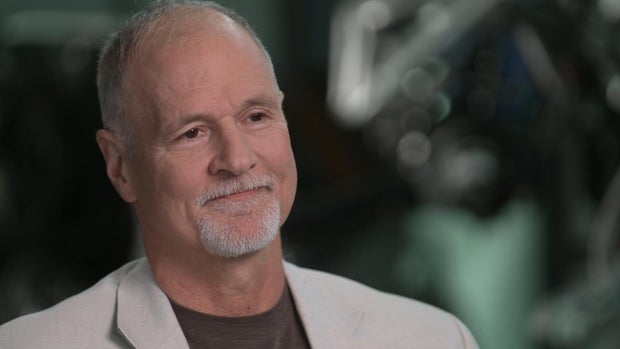
Boston Dynamics CEO Robert Playter spearheaded the company's humanoid development.
"There's a lot of excitement in the industry right now about the potential of building robots that are smart enough to really become general purpose," he said.
Goldman Sachs predicts the market for humanoids will reach $38 billion within the decade. Boston Dynamics and other U.S. robot makers are fighting to come out on top. State-supported Chinese companies are also in the race.
"The Chinese government has a mission to win the robotics race.," Playter said. "Technically I believe we remain in the lead. But there's a real threat there that, simply through the scale of investment, we could fall behind."
Should humans be worried about humanoids?
As fears grow that AI will displace workers, humanoid robots are learning to perform human tasks. Boston Dynamics is training Atlas to do a job that human workers currently handle at Hyundai's Georgia plant.
Playter said it could be several years before Atlas becomes a full-time worker at Hyundai, but he predicted that humanoids will change the nature of work.
"The really repetitive, really backbreaking labor is really, is going to end up being done by robots. But these robots are not so autonomous that they don't need to be managed. They need to be built. They need to be trained. They need to be serviced."
Playter said there are benefits to creating robots like Atlas, which can move in ways that humans can't.
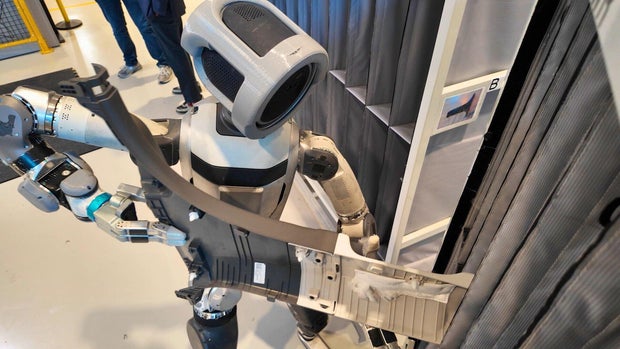
"We would like [robots] that could be stronger than us or tolerate more heat than us or definitely go into a dangerous place where we shouldn't be going," he said. "So you really want superhuman capabilities."
Still, Playter said there's no reason to worry about a future like the one depicted in "The Terminator."
"[If you] saw how hard we have to work to get the robots to just do some of the straightforward tasks we want them to do, that would dispel that worry about sentience and rogue robots," he said.