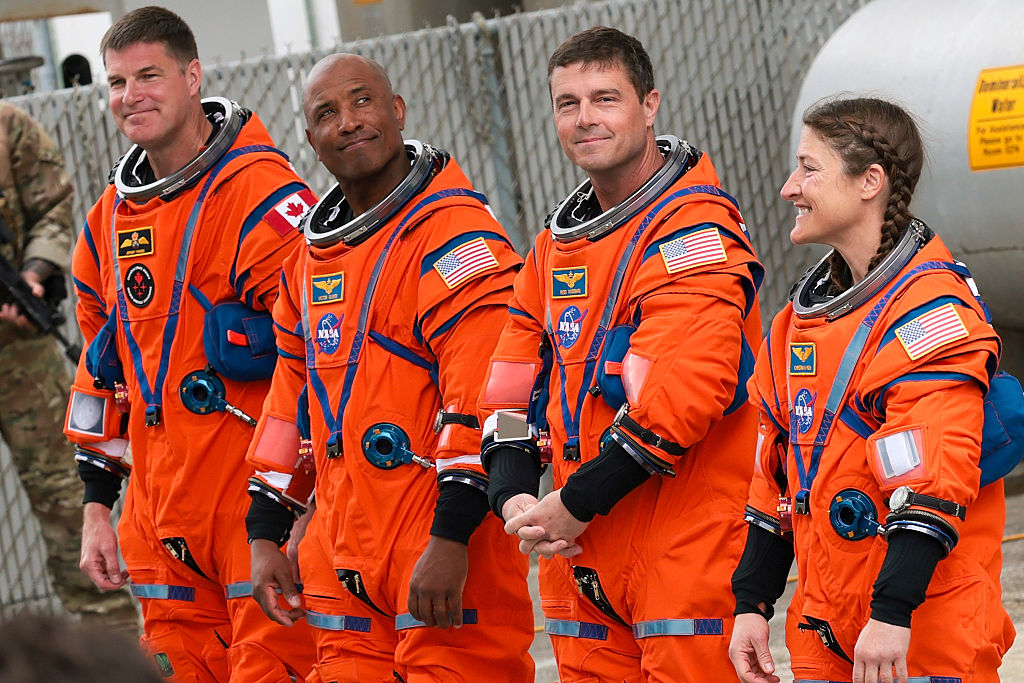
Artemis II crew on historic moon mission and what it means for Earth: "We can do amazing things"

It's been a little less than a week since the Artemis II crew splashed down off the coast of San Diego, and as the four astronauts adjust to life back on Earth, they've also had time to reflect on the scope of their trip around the moon, what their favorite parts of the mission were and what it all meant.
Speaking with "CBS Evening News," commander Reid Wiseman, mission specialists Christina Koch and Jeremy Hansen, and pilot Victor Glover, shared vivid memories of seeing the striking features of the moon up close.
"For me, it was the terminator," Glover said of his favorite part of the mission, referring to the barrier between night and day on the moon. He spoke about how the transition from light to dark highlighted the topography of the moon in a way he wasn't expecting. "I could have spent just the entire time describing that part," he said.
Koch said the best thing she saw was the outline of the mountains of the moon on its horizon.
"Because there's no atmosphere, you could see the outline of terrain, you could imagine yourself climbing it, adventuring and exploring there, it was truly awesome," she said.
Hansen, meanwhile, described what he said looked like a "handprint" on the far side of the moon, telling CBS News, "Reid and I spent a lot of time talking about this handprint on the backside of the moon."
For Wiseman, it was seeing a solar eclipse from space.
"It was the most unique thing and the most unexpected thing I think that I saw for sure on this entire mission," he said. "It was beautiful and just completely unexpected. My brain could not process what I was looking at out the window. The entire moon in a dark matte black sphere right outside our window."

But despite all those fantastic, once-in-a-lifetime sights, the crew is still thrilled to be back home.
"I don't think you appreciate home and gravity and plumbing and showers until you leave the comfort of those things," Glover said, adding, "I mean, my favorite thing to do is to just go home and sit in my sweatpants."
"We have been doing lots of science and medical and strength training," since returning, he said. "So we've actually been pretty busy since we've been back. And when I do get home, it's just nice to walk in the door and see my dog and see my wife and my kids and just plop down on the couch."
For Koch, she said the everyday has "taken on a new light for me."
"When I go to the beach now, I look up at the blue sky and imagine what it looks like from really, really far away, where it wasn't an absolute, it wasn't just a background of everything we see, it was small, compared to the universe around it," she said.
The crew also reflected on what their trip around the moon meant to the U.S. and the rest of the world, and the optimism it brought them and how they can hold onto those feelings.
"We have waited, this nation and the world, has waited a long time to head back to the moon," Wiseman said. "And to create something with human hands, to bend all of that metal, to fuel that up with all of the propellant, and then to actually have the courage to light the engines and go, it is an overwhelming moment."
Hansen says it's about "fighting the sense that we're powerless."
"I feel that," he said. "There's things happening in the world, and I feel powerless to affect them. But really, if we just remember that inside every human being is an innate desire to do good, to lift one another up to help one another, that makes you feel good."
"If we just remember that, and every day we get up and just try to do a little bit, just do our best to make the world around us a better place, that's really all it's gonna take," he said.
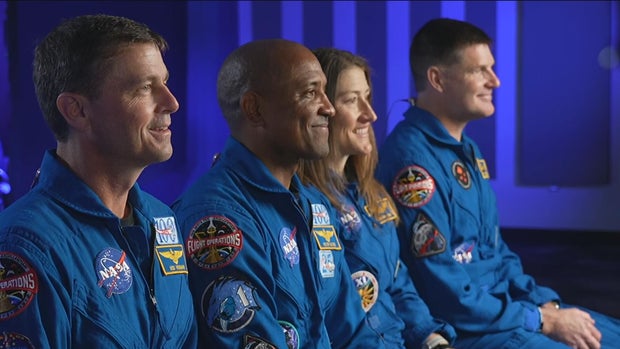
Koch said we should "never forget what it was like to let someone and a mission carry your hopes, your heart, and your dreams with it. And to trust in that process. To trust that we humans decided to do this, to do something so great, and that we are carrying back everything we learned, not only about where we went but ourselves."
Wiseman conceded both the world and the Artemis II crew will eventually "go back to normal."
"The color of this mission will mute out over time, but the thing that will never mute out is that we did come together as a world and we did celebrate, and no one asked the world to celebrate this, the world did that, they all stood up, they all came together, they all got motivated by one thing," he said. "And what that tells me is we still have it. We all still have it. And if we need to come together and execute, we can come together, and we can do amazing things on this planet."
Glover recalled, "We started this journey back in April 2023, talking about how this was not a marathon or sprint, but a relay race. ... We can't wait to hand off those batons."