Are sanctions "tightening the noose" on Qaddafi?
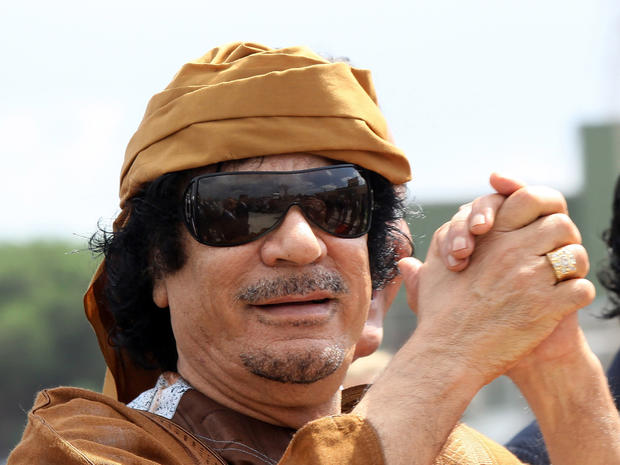
After the United States and international community began imposing sanctions on Libya in February, President Obama said that the world was "slowly tightening the noose" on leader Muammar Qaddafi.
However, as the Obama administration expands the sanctions to include five additional Libyan officials in Qaddafi's inner circle, it remains unclear how much effect the measures have had on the dictator.
The new sanctions include the prime minister and the ministers of oil and finance. Qaddafi's chief of staff and a security director are also included. The Treasury Department said Friday that the sanctions also apply to two entities owned or controlled by Qaddafi's children.
The Treasury Department said it has already frozen more than $34 billion in assets. David Cohen, who has been nominated to take over as the Treasury's undersecretary for terrorism and financial intelligence, told the Senate Finance Committee Thursday that the exact amount the European Union has frozen remains elusive, Reuters reported.
"It is actually quite hard to get a precise figure because of potential double counting and some lack of clarity in the European system," Cohen said. "I think it is probably not quite as great a number that we have frozen in the U.S., but I think it is approaching that."
Cohen said that the frozen assets could possibly used for humanitarian aid to citizens of the north African country.
In February, the U.N. Security Council moved to impose sanctions and a travel ban against Qaddafi, his five children and 10 top associates. As of Friday, 19 individuals associated with the Qaddafi regime are under U.S. sanctions.
Qaddafi's Swiss bank accounts were also frozen in February, but it's unclear if Qaddafi, his family or senior Libyan officials have any assets in Switzerland any longer. Libya withdrew most of its money from Swiss banks two years ago after the two countries became embroiled in a spat over the arrest of Qaddafi's son Hannibal in a Geneva hotel.
Qaddafi is no stranger to international isolation.
U.N. sanctions were slapped on his country after suspected Libyan agents planted a bomb that blew up Pan Am Flight 103 over the Scottish town of Lockerbie in 1988, killing 270 people, mostly Americans.
Libya accepted responsibility for the bombing in 2003 and pledged to end efforts to develop weapons of mass destruction. The U.S. and Libya in 2009 exchanged ambassadors for the first time in 35 years, after Libya paid about $2.7 billion in compensation to the families of the Lockerbie victims.
The rebel movement in Libya has worked to exempt oil sales from sanctions in order to fund their movement. The United Nations has said the sales are exempt as long as they are not sold through Qaddafi-held companies.
Earlier this week, the administration lifted financial and travel sanctions on Libya's foreign minister Moussa Koussa following his decision to defect and sever ties with Qaddafi.
The sanctions have caused confusion for some businesses who don't know how to proceed when Libyan businesses own part of a company, the Wall Street Journal has reported.
Meanwhile on Friday, anti-government fighters battled forces loyal to Qaddafi in fierce clashes in the only major rebel-held city in western Libya as international relief efforts were stepped up for civilians caught in the crossfire.
Heavy shelling was heard at nightfall outside the city, where some neighborhoods have been nearly abandoned after residents fled to safer areas during weeks of fighting. Nearly all buildings were pockmarked from gunfire.
It was unclear which side had the upper hand. But a witness said rebel forces were trying to keep Qaddafi's troops from taking full control of a route linking central Misrata to its port, a critical lifeline for ships carrying humanitarian supplies into the battle zone just 100 miles southeast of the capital Tripoli.
In the rebel stronghold of Benghazi in eastern Libya, meanwhile, angry crowds fired into the air and chanted against Qaddafi's regime as militiamen killed in an accidental NATO airstrike were carried for burial.
"The martyrs' blood is not shed in vain!" cried some of the thousands of people gathered in central Benghazi to pray and mourn some of the dead from the attack on rebel tanks and vehicles.
The main clashes appeared in Misrata, where the outcome is symbolically significant for both sides. Rebels want to retain an important foothold in Qaddafi's territory and his government seeks to consolidate its control over the west with NATO airstrikes bearing down.
But NATO has been cautious about waging bombing runs in Misrata because the fighting in mostly within civilian areas. Growing indications of a drawn-out conflict in an OPEC nation pushed oil prices to levels not seen in more than two years ago.
The Associated Press contributed to this report.