Arab World: Egypt's Muslim Brotherhood
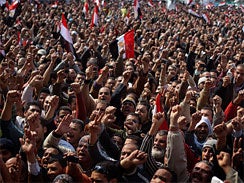
ISLAMABAD, Pakistan - At least three Arab countries have sent private messages to leaders of Egypt's Muslim Brotherhood movement, urging the group to embrace a "constructive dialogue" to pave the way for greater democracy in Egypt rather than use the opportunity to push the imposition of Islamic norms, senior diplomats from the Arab world have told CBS News.
The move highlights a widespread nervousness over the Brotherhood eventually pushing for the introduction of Islamic provisions under a future government, following the end of President Hosni Mubarak's three-decade rule.
"The underlying message is mainly for the Brotherhood to act like a reasonable political force, not necessarily anti-U.S. or anti-Israel but a contributor to a government which is a popular representative of the Egyptian people," a senior Arab diplomat from one of the three countries told CBS News on condition of anonymity. "If the Muslim Brotherhood becomes reckless, we will all have to live with the consequences. Even if [the Muslim Brotherhood] behave nicely till elections [in Egypt], the concern will really be over the long term future of the Muslim Brotherhood finally getting an opportunity to join mainstream politics," he said.
Complete Coverage: Anger in the Arab World
Queen Noor: Don't Exclude Muslim Brotherhood
A second Arab diplomat from one of the three countries speaking on condition of anonymity told CBS News there were rapidly mounting concerns across Arab countries in the Middle East and North Africa "over the Brotherhood suddenly seeing itself as the flag bearer of an Islamic political rise in Egypt. [The Brotherhood] may then to seek to spread their ideology outside Egypt."
The second diplomat said even if leaders of the Muslim Brotherhood were to guarantee restraining their movement in support of a smooth transition, "the big unknown is, in fact, how far do these people control their grass roots and how effective is their control. In other words, is there a danger of the grass roots which supports them, just going out of control?"
The two diplomats confirmed that they knew of a third Arab country that also sent private messages to leaders of the Muslim Brotherhood, urging them to show restraint.
But supporters of the Muslim Brotherhood said the movement will only seek to promote democracy in Egypt after Mubarak is forced out of power following several days of widespread public protests.
"There is unfortunately a smear campaign going on right now about the Muslim Brotherhood. People must recognize that [the Brotherhood] are reasonable people," said Khurshid Ahmed, a prominent Pakistani scholar of Islamic affairs. Ahmed, with an active past as an Islamic politician, has supported the Muslim Brotherhood for years.
"The Muslim Brotherhood was launched in 1928. It has been in crisis since 1954. Some of their top leaders were even hanged in Egypt. Yet this repression has not destroyed them, so you can see that the Muslim Brotherhood are and will remain key elements of Egypt's political mainstream," he said, adding, "I believe there is an effort underway to indulge in scaremongering by spreading the image of a group which will become very radical. So far, the Muslim Brotherhood has moved very cautiously. They only want to exercise their due political representation for their constituents."
Western diplomats have said since the protests in Egypt kicked off it is too early to reach a final conclusion on the Muslim Brotherhood's future mood. In the past, the movement has sought the introduction of Islamic laws in Egypt. But equally, analysts of Egyptian affairs say the Brotherhood movement will most likely emerge as a member of a wider coalition where they will have to reconcile with the views of other more liberal political groups.