Amazing harpoon readied to snag comet samples
File this one under the heading "work in progress" but engineers at NASA's Goddard Space Flight Center are thinking big. Really big.
The idea is to build a space harpoon that can bust beneath the surface of a rotating comet to bring back soil samples as the mother craft hovers above the target region. The technique is being touted because it would allow sample collection from areas deemed too rugged or dangerous to allow the landing and safe operation of a spacecraft.
"We're not sure what we'll encounter on the comet - the surface could be soft and fluffy, mostly made up of dust, or it could be ice mixed with pebbles, or even solid rock," said Donald Wegel of NASA Goddard, lead engineer on the project. "Most likely, there will be areas with different compositions, so we need to design a harpoon that's capable of penetrating a reasonable range of materials."
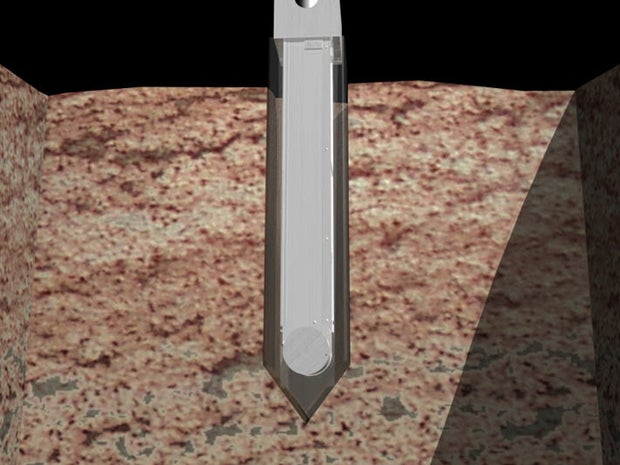
Goddard's labs already have a working prototype: a six foot crossbow with a bow string that can generate a a level of force up to 1,000 pounds. For obvious safety reasons, engineers keep the bow pointed towards the floor. If it was angled upwards, the test harpoon has the potential to fire a test tip about a mile.
The currently planned NASA mission to return a sample from an asteroid is called Osiris-Rex, an acronym for Origins, Spectral Interpretation, Resource Identification, Security -- Regolith Explorer. The launch is scheduled for 2016. It will take the craft about three years to reach its destination, an asteroid designated 1999 RQ36. But that mission is only charged with collecting collect surface samples by moving near the chosen site, and then extending a mechanical arm to collect about two ounces of material for return to Earth in 2023.
Coincidentally, the European Space Agency is planning a mission called Rosetta where harpoon will grapple a probe to the surface of comet "67P/Churyumov-Gerasimenko" in 2014. That harpoon is not being engineered so as to collect samples but Wegel said that NASA intends to piggyback on their work to beter comprehend "the complex internal friction encountered by a hollow, core-sampling harpoon."