Accelerated primaries might not preclude late GOP entries

As the Republican presidential candidates await the inevitable chain reaction that will result from South Carolina's decision to move up its primary date to Jan. 21, the potential White House hopefuls still on the sidelines are left to wonder if their window has been slammed shut.
After all, the GOP contenders will now have only three months to make their cases to voters before Iowa caucus day, which will likely fall in the first week in January, as it did in 2008.
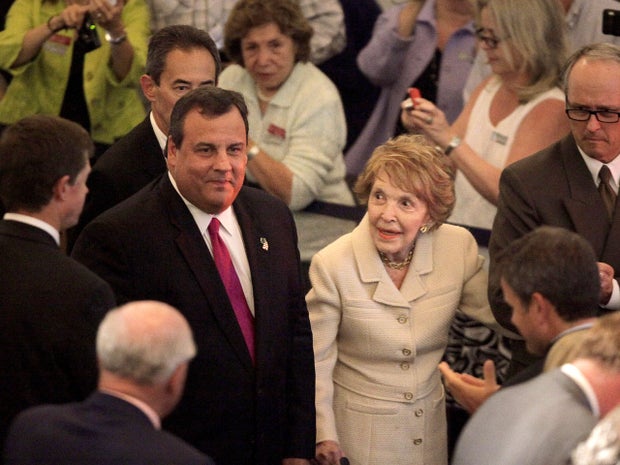
For New Jersey Gov. Chris Christie and former Alaska Gov. Sarah Palin, the calendar shift may indeed serve as compelling evidence that it is too late to enter the fray. But in an early nominating fight that has been especially unstable, the front-loaded schedule alone might not prohibit a potential late entry by either would-be candidate.
For one thing, the competition is not as far ahead of the game in the Hawkeye State as it might have been.
According to Iowa GOP strategist Steve Grubbs, none of the official candidates who have been for months operating in the nation's first voting state have anywhere near the level of organizational prowess that past campaigns had established by this time in previous presidential cycles.
"I don't know if that's the nature of the year or the nature of fundraising, but I don't see the strongly developed organizations I've seen in the past," Grubbs said. "In order to be successful, you have to organize between 1,300 and 2,000 precincts, depending on how aggressive you want to be, and that's a lot of work -- a lot of field staff. And I haven't seen anybody get that done this year."
Indeed, the candidate who had established the most extensive Iowa network was former Minnesota Gov. Tim Pawlenty, who dropped out of the race in August after finishing a disappointing third in the Ames Straw Poll.
Pawlenty's failure to catch fire in Iowa seemed to indicate that grass-roots buzz has become increasingly important to being viable in the state, while expensive and time-consuming early organizing may be less vital than was once thought.
In the 2008 GOP caucuses, after all, the under-financed and freewheeling Mike Huckabee cruised to victory over the much better organized and deep-pocketed Mitt Romney.
"If a guy were to time it correctly, you could almost get in late and ride the popularity wave before the attacks really sink in, because there aren't going to be a lot of debates over the holiday," Grubbs said.
Neither Christie nor Palin has done the early-state organizational legwork that has typically been required of competitive candidates, but if either were to enter the race at this late stage, he or she would likely try to write a new rulebook on how to run for president in the second decade of the 21st century.
If he were to get in, Christie would rely on an eager lineup of big-money financial backers, while likely taking advantage of the unusually broad pool of experienced operatives who remain unaligned in the early voting states.
Palin, on the other hand, would turn to her team of self-appointed Iowa volunteers who have been organizing on her behalf for months, while hoping that her prominent social media presence and unique ability to generate free press would help her raise enough money and visibility to remain competitive.
"Waiting until the last minute to jump in is not unheard of, so I don't think it's going to negatively impact a Palin or a Christie," said former Dallas County GOP Chairman Rob Taylor, who is now running for an Iowa House seat. "As a matter of fact, it might give them the advantage of being new and shiny."
Whether either one gets into the fray, the shifting calendar will likely have a more immediate impact on the race in New Hampshire, where election law mandates that the state hold its first-in-the-nation primary "seven days or more immediately preceding the date on which any other state shall hold a similar election."
New Hampshire Secretary of State Bill Gardner has broad authority to determine whether Nevada's caucuses -- which the Nevada GOP has determined will be held four days after whenever New Hampshire holds its primary -- would qualify as a "similar election."
But Gardner has threatened to move the New Hampshire primary all the way up to December of this year if Nevada does not back down on its timetable.
While a December primary remains unlikely, Granite State voters will almost certainly head to the polls no later than mid-January.
This compressed time frame is almost certainly an advantage for New Hampshire front-runner Mitt Romney, who owns a home in the state and has essentially been campaigning there for the past five years.
"It really reduces the window of opportunity for [Jon] Huntsman and for [Rick] Perry," said University of New Hampshire political science professor Dante Scala. "It gives Huntsman fewer weeks to make things happen."
More from RealClearPolitics:
Obama's Fundraising Pitch: Buddy, Can You Spare $3 . . . or $38,500?
Poll: Brown Edges Warren in Massachusetts
Scott Conroy is a National Political Reporter for RealClearPolitics and a contributor for CBS News..