Cold front brings temperatures in the 50s to South Florida. Will it be cold enough for "frozen" iguanas?

South Florida residents are experiencing a chilly weekend as a cold front moves through the region, bringing temperatures into the 50s by Sunday morning and raising a familiar question: Will it be cold enough for "frozen" iguanas to start falling from trees?
The NEXT Weather team says the front will bring another round of cooler air Saturday night into Sunday, with temperatures dropping into the low 60s overnight before dipping into the 50s by sunrise.
Despite the cooler conditions, the weekend will remain sunny and dry, with afternoon highs reaching the low 70s Saturday and the mid- to upper 70s Sunday.
Temperatures will remain below South Florida's seasonal average of 81 degrees for at least the next week.
South Florida wakes up to chilly temperatures
Residents across Miami-Dade and Broward counties woke up to a noticeable chill Saturday morning, with temperatures running as much as 11 degrees cooler than the same time Friday.
Early morning readings included 64 degrees in Weston and Miami Beach, while Fort Lauderdale, Miramar, Doral and Florida City reported temperatures around 66 degrees.
Across the Florida Keys, temperatures ranged from the upper 60s to the low 70s.
The cooler weather comes as another cold front sweeps through the region, reinforcing the chilly conditions already in place.
Saturday will feature plenty of sunshine and no rain, making it an ideal day for outdoor activities.
However, anyone heading out Saturday night may want to bring a sweater or light jacket, as temperatures will fall into the 60s before dropping further overnight.
By Sunday morning, some South Florida communities will wake up to temperatures in the 50s.
Will it be cold enough for "frozen" iguanas to fall from trees?
Whenever temperatures plunge in South Florida, residents begin looking for one of the region's most unusual cold-weather phenomena: iguanas falling from trees.
But while Sunday's forecast calls for temperatures in the 50s, that generally isn't cold enough to trigger the phenomenon.
According to longtime wildlife expert and former Zoo Miami communications director Ron Magill, iguanas begin to become sluggish when temperatures drop below 50 degrees. Once temperatures fall into the mid-40s, the reptiles can enter a dormant state known as cold-stunning, causing them to lose their grip on branches and sometimes fall from trees.
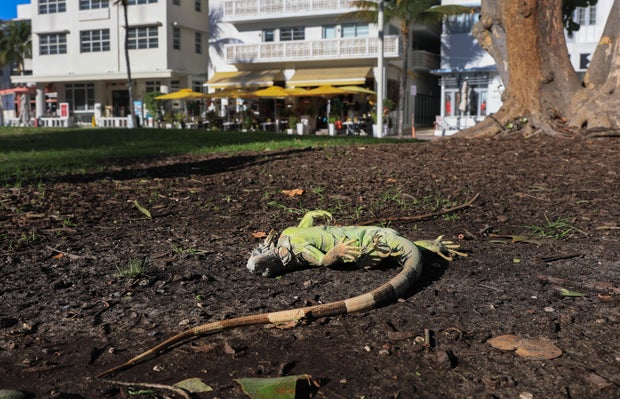
Research and guidance from the University of Florida's Institute of Food and Agricultural Sciences support that explanation, noting that iguanas can become cold-stunned when temperatures drop into the 40s, particularly during prolonged exposure.
Because iguanas are cold-blooded, they rely on external heat sources to regulate their body temperature. When temperatures fall too low, their bodies slow down, sometimes leaving them temporarily immobile.
Although they may appear dead, cold-stunned iguanas are often still alive and can recover once temperatures rise.
The effects of cold weather also depend on the animal's size and how long it remains exposed to low temperatures. Larger iguanas generally tolerate colder conditions for longer periods than smaller ones.
With Sunday morning lows expected to remain in the 50s, widespread cold-stunned iguanas are unlikely during this latest cold front.
Rain returns to South Florida next week
While the weekend will remain dry, the NEXT Weather team is tracking a significant change in the forecast beginning Tuesday.
Monday will bring increasing cloud cover and slightly warmer temperatures before rain chances rise sharply Tuesday.
The unsettled weather is expected to continue through Friday, with several days of potentially significant rainfall across South Florida.
Despite the return of rain, temperatures are forecast to remain below the seasonal average for much of the week.
Coastal flooding possible in the Florida Keys
Meanwhile, a coastal flood statement remains in effect for the Upper Florida Keys, where higher-than-normal tides could lead to flooding in low-lying areas Saturday afternoon.
Residents and drivers should be cautious around roads prone to tidal flooding, particularly during high tide.
The NEXT Weather team will continue monitoring the approaching front and the potential for several days of wet weather next week.