21 Air, operator of plane in Miami crash, had prior safety complaints by former employees
The Amazon Prime Air Boeing 767 cargo plane that crashed off a Miami runway on Sunday, killing five people, was operated by a North Carolina company that has been accused by past employees of violating safety regulations, legal documents reveal.
The cargo airline hired by Amazon, 21 Air, is controlled by Houston Astros owner Jim Crane through an LLC. The company has faced a string of safety complaints from senior staff who claim they were fired for raising concerns, CBS News has learned from records and interviews.
"Unfortunately, 21 Air has a long established history of safety problems," said Karl Seuring, a pilot with more than 30 years of experience who filed a legal complaint alleging that when he raised safety concerns he was told by a 21 Air manager, "It's not going to change."
The Occupational Safety and Health Administration (OSHA) rejected Seuring's complaint over his alleged retaliatory firing by 21 Air. His appeal led to a 2023 Department of Labor tribunal — a hearing in front of a federal judge — where the case is still pending.
Seuring and other former 21 Air pilots claimed managers suppressed safety reports, pushed crew to fly without proper rest, staffed pilots who could not communicate safely in English, and put faulty planes in the sky, documents show.
Executives were accused of "paying lip service" to safety procedures "then doing exactly nothing," according to a resignation letter written by a former fighter pilot reviewing safety policy for the company and sent to 21 Air owner Crane in 2021.
Former 21 Air chief pilot Bruce Joseph testified in the Labor Department tribunal that he had "personal knowledge of people being discouraged" from logging safety concerns in the company system "on numerous occasions."
He alleged in his tribunal testimony that the firm's then-director of safety told him "don't put anything" in the safety management software before speaking to the company's then-CEO, Mike Mendez. Asked whether reports eventually got filed, he replied: "Most of it did not."
"There were a couple of occasions where it actually did, only because I would press," Joseph told the judge in March 2024. "If I put it in, I would have the wrath of Mike."
Mendez testified that Joseph "was fired from 21 Air and left under very bad circumstances" and that he believed the former chief pilot was trying to "make up" damaging claims.
The former 21 Air CEO denied any retaliation and said he followed safety procedures. "My responsibility is to make sure we run a safe airline, not to hurt people and not to hide anything," he testified.
Mendez declined to comment further when contacted by CBS News.
Seuring's attorney, Michael Anello, told the judge that another 21 Air pilot, Johnny Salmonson, "was being pressured to fly in periods of time that were too short to comply with the proper amounts of rest, and that implicated safety. The layovers were too short."
"The management was pushing the pilots, and the result was he was retaliated against," Anello said.
When Seuring questioned whether flight plans with safety attestations — including how long pilots had been on duty before they started another flight — were accurate, he was told to "just sign it," his legal complaint claimed.
The pilot testified that he was in the jump seat of a 21 Air Boeing 767 on April 13, 2022, when a mechanical problem made the plane continue sharply accelerating after takeoff from Newark, New Jersey, causing it to exceed speeds that could damage its wing flaps and leaving him "concerned for my own safety."
He alleged in tribunal testimony that there was a "breakdown of communication" between the captain, David Norgren, and the first officer after the incident.
"We had no debrief. No discussion. Assume it didn't happen," Seuring told the judge.
Norgren did not respond to a request for comment.
Seuring also testified about an 21 Air plane flying from Alabama to Trinidad in the spring of 2022 that allegedly had a pressurization problem forcing it to make an emergency diversion to Puerto Rico.
He claimed the captain, then-21 Air fleet manager Amir Anoshiravani, had an "inability to take command of the operation," saying "the first officers had to jointly intervene to get the airplane safely on the ground."
Anoshiravani denied any such incident and told CBS News he had "never come in contact" with Seuring. "I don't believe in lies," he said. "He has anger at the company because he was fired."
21 Air did not respond to CBS News' requests for comment. The company has posted a statement on its website saying it is "cooperating fully" with the NTSB investigation.
"Our deepest condolences are with the families and loved ones of those who lost their lives," the statement said.
An Amazon spokesperson told CBS News, "We'll defer to the NTSB regarding the circumstances of their investigation and to 21 Air regarding these allegations that pre-date our relationship with the company."
A spokesperson previously said the company was "heartbroken" at the deaths and that it is cooperating with authorities.
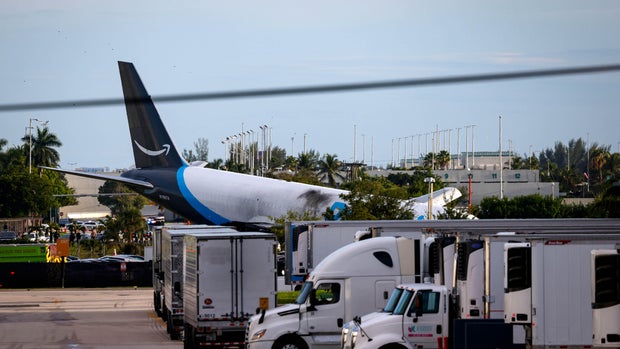
Retired 21 Air pilot Tony Bless, who testified in Seuring's case, told CBS News that for him, Sunday's crash in Miami did not come out of the blue.
"It's something a lot of us ex-21 Air pilots have been anticipating for a while," he said, citing "maintenance safety issues, the pressure out of the chief pilot's office, and the quality of pilots they would hire."
Bless claimed the company would routinely defer maintenance, and that things would often go wrong on its aging converted passenger planes.
In one notable incident on a flight from Bermuda to New Jersey in 2022, he claimed his 21 Air plane's radar stopped working just as they navigated the worst turbulence of his 40-year career.
"I let the company know in no uncertain terms that I would not fly that plane again until they put a new radar in," he said.
"We've had fuel leak issues. We've had radar problems and circuit breakers, smoke in the cockpit," Seuring told CBS News. "Pilots were coached on how the write-ups should be done."
Seuring, who served as president of the 21 Air union, said pilots had to fend for themselves when trying to get sleep on long flights.
"None of these airplanes had good crew rest on board," he said. "My vice president of the union actually bought sleeping bags for airplanes to give the pilots a reasonable way to get some crew rest on long nighttime flights."
Former fighter pilot Don Helmig wrote a resignation email to 21 Air majority owner Jim Crane in June 2021, warning him of safety issues at the company.
"After three months, everywhere I looked there are issues," he wrote. "In my opinion, what they wished me to do is say nothing, but that is not how Safety is supposed to operate, by paying 'lip service to SMS' [Safety Management Systems] then doing exactly nothing."
Attached to the email were seven documents with titles concerning scheduling, training, communications, emergency response and culture at the firm.
"Now you know every Core Issue I have placed on paper. I think you will surround yourself with competence and figure out the rest," he wrote.
The National Transportation Safety Board is conducting an investigation into Sunday's crash, and there has been no determination yet about its cause. It is not known whether past safety issues had any connection to the Sunday incident in Miami.
The pilots have been identified as Captain Joseph Carroll, 55, and First Officer Jaime Felipe Silva Molina, 37 — both hospitalized after the crash but since released.
The five people killed in the crash were members of a cleaning crew in a van hit by the plane, Miami-Dade County Sheriff Rosie Cordero-Stutz said.
Flight tracking data obtained by CBS News shows that 4 miles out from the 9,360-foot-long Miami runway, the plane suddenly leveled out and stopped its descent for about 25 seconds.
The deviation meant the plane approached the airport while still too high. Instead of calling off the landing, it then took a steep decline around twice the normal rate.
Mary Schiavo, a former inspector general for the Department of Transportation, told CBS News the answer may lie in the plane's black box, with cockpit audio recordings and logs of any mechanical failures.
"What was going on in that cockpit?" she said. "Fighting a bunch of turbulence and wind shifts, or lack of crew resource management?"


