Miami mob con man James Sabatino ordered to remain silent, attorney says. But is that legal?

Watch enough "Law and Order" or any other police drama, and the first thing you learn is that everyone has the right to remain silent. But can the government order a prisoner to remain mute?
In the latest twist of the bizarre and often complicated world of Miami mob con man James Sabatino, it appears the Federal Bureau of Prisons may be trying to do just that.
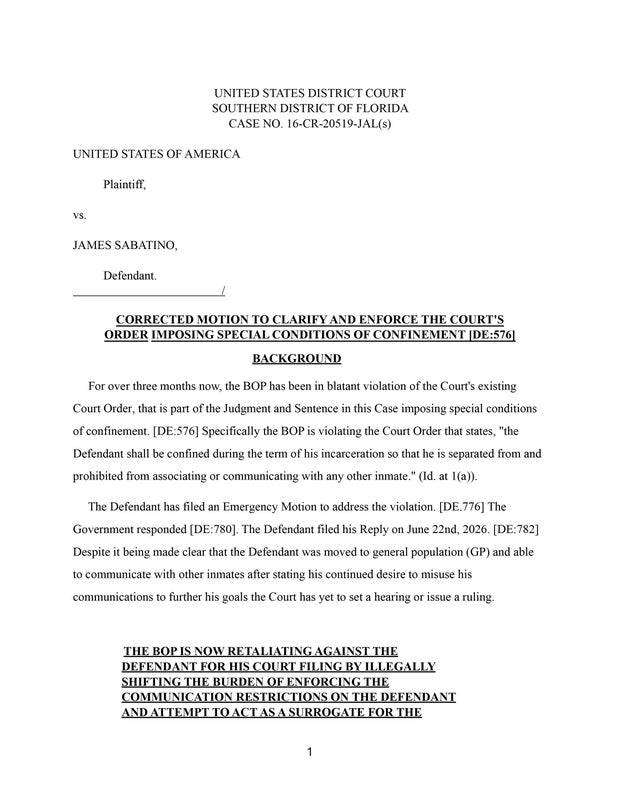
According to a complaint filed earlier this month in Miami federal court, Sabatino has reportedly been ordered not to speak to any other prisoners, even to say "hello."
"The Defendant cannot be expected to, nor will he, comply with the order of not communicating with other inmates," wrote Israel Encinosa, Sabatino's attorney.
Court-ordered restrictions
This all stems from a unique set of court-ordered restrictions placed on Sabatino at his sentencing nearly 9 years ago. Sabatino, convicted of stealing millions of dollars in diamonds and other high-end items by posing as a music industry executive, was able to commit many of his crimes while in custody.
While in custody, he would bribe guards and use both legal and illegal phones within the facility to call various jewelry companies, convincing them he was working on music videos for Beyonce, Justin Timberlake, Jay Z, and others. He would then trick them into shipping him diamond necklaces, rings, bracelets, watches, and other items by claiming they would be featured in the video.
Federal authorities estimate he stole more than $20 million while sitting in the federal detention center in Downtown Miami. Only a small fraction of the jewels was ever recovered.
Click on the image below to read the full motion.
To prevent Sabatino from committing additional crimes from his cell, the federal Bureau of Prisons assigned him to the Supermax facility in Florence, Colorado, believed to be the most secure prison in the world.
Under the restrictions ordered by the court, Sabatino is only allowed to contact his attorney and one member of his family, his stepmother. His twice-monthly calls with her are monitored by the FBI.
Based on the judge's order that he should be isolated and not permitted to communicate with other prisoners, officials within Supermax initially decided to place Sabatino in a highly restricted portion of the prison known as "The Suites." The only other person in that section of the prison was Joaquin "El Chapo" Guzman, who spoke little to no English. Guzman was also restricted in who he could speak to outside the prison.
For most of the last 8 years, Sabatino and Guzman were in neighboring cells.
Several months ago, for reasons that are not clear, Sabatino was moved to another portion of the prison, where he now has daily contact with a wide array of inmates, including known terrorists, gang leaders, and convicted spies.
Encinosa claims moving Sabatino into the prison's general population violates the judge's order, which requires the BOP to keep Sabatino segregated. But the BOP's response, according to Encinosa, is to shift the responsibility from the prison to the inmate, and prison officials say it is now up to Sabatino to simply stop speaking for the remainder of his 25-year prison term.
"To be clear, there is no BOP rule or policy that prohibits inmates from communicating with each other," Encinosa wrote. "Indeed, the Defendant is the only inmate who has been given this Order. Other inmates are free to [speak to] the Defendant, who is now expected to ignore them."
The attorney points out that in prison, not acknowledging or responding to another inmate would be seen as a sign of disrespect and would therefore endanger Sabatino's safety. They also claim it is a violation of his First Amendment rights.
Encinosa argues the Bureau of Prisons is violating the judge's order to keep Sabatino segregated and if federal prison officials want to move Sabatino into general population, they would have to appear in federal court in Miami and ask U.S. District Court Judge Joan Leonard to modify her order. Encinosa also argues that if the segregation requirement is changed, Sabatino has a right to withdraw his guilty plea and demand a new trial.
"Four-point restraints" after overheard speaking
Encinosa noted Sabatino's treatment by prison officials has reached a critical and dangerous point.
After one recent incident, in which Sabatino was overheard speaking to another inmate, the captain overseeing Sabatino's confinement "ordered an 'extraction team' to enter Mr. Sabatino's cell and place him in four-point restraints" as punishment for talking.
The four-point restraint places the inmate on a bed, where their wrists and ankles are tied tightly to all four corners of the bed. Federal BOP guidelines say it is not to be used for punishment and that the prisoner must be checked regularly because of the serious risk of injury.
"For three days, Sabatino was repeatedly four-pointed in metal restraints to a bed," according to a memo that was included in the complaint.
"To avoid reporting requirements, which kick in after eight continuous hours in restraints, [the captain overseeing Sabatino's confinement] would order Sabatino released just before the hours ended, then a little while later he would order staff to place him back in the 4-point restraints," the complaint alleges. "During that three-day period, Mr. Sabatino was placed in four metal restraints four times. During which he was physically assaulted and told that in no uncertain terms that this was coming from the captain."
Encinosa claims the captain ordered this treatment in retaliation for an earlier complaint Sabatino filed against the captain. Encinosa claims that the original complaint is currently being investigated by BOP's Inspector General. The motion filed last week also states the captain has a history of serious abuse at other federal prisons.
CBS News wrote William Marshall, the director of the federal prison system, regarding the allegations contained in the complaint. A prison spokesperson responded, "The Federal Bureau of Prisons (BOP) does not comment on pending litigation, nor do we discuss the specific conditions of confinement for any individual in our custody, including housing assignments, internal security measures, or court orders."
"More generally, the BOP takes its responsibility to provide safe, secure, and humane conditions of confinement for all individuals in its custody, and to operate its institutions in accordance with applicable laws, regulations, policies, and court orders," the statement continued. "We have no additional information to provide."


