It's not an alligator or a crocodile. But this invasive predator is moving into their territory in South Florida
For decades, South Florida's waterways have been home to two native giants: alligators and crocodiles. But a third large reptile has quietly been moving in, and researchers say it's spreading into more corners of the Everglades.
Invasive spectacled caimans are becoming increasingly widespread across South Florida, expanding beyond canals and developed areas into natural habitats where they could compete with native alligators and crocodiles, according to a recent University of Florida study.
Researchers who reviewed more than four decades of data on the species found that spectacled caimans, which are native to Central and South America, have steadily spread across South Florida since becoming established in the wild in the late 1970s. The reptiles have now been documented from Miami-Dade County north to Port St. Lucie, with recent observations placing them in marshes and sloughs within or near Everglades National Park.
The study, titled "The invasive spectacled caiman in Florida, United States: invasion timeline, insights, and implications for Everglades restoration," was originally published in April in the journal Frontiers in Amphibian and Reptile Science and later updated in early June.
Researchers warn that the species' continued expansion could complicate Everglades restoration efforts and increase the risk of impacts on native wildlife.
"Recent observations suggest that spectacled caiman distribution may expand further within protected areas and natural habitats," the researchers wrote.
Scientists say spectacled caimans have been particularly successful in South Florida because they can thrive in a wide variety of habitats, reproduce at relatively small sizes and tolerate many of the same environmental conditions that support native alligators and crocodiles.
Researchers have documented habitat overlap between spectacled caimans and native American alligators in wetlands in western Miami-Dade and Broward, Biscayne Bay and portions of Everglades National Park. While overlap with American crocodiles appears less common, scientists say the possibility of competition remains a concern, especially as Everglades restoration projects create new freshwater habitat.
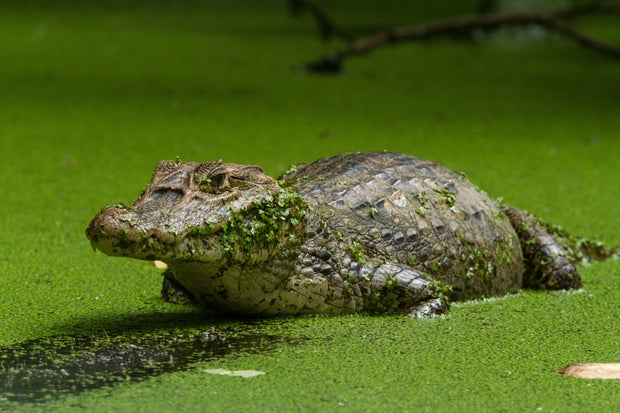
The study notes that large caiman populations have been linked to competition with native crocodilian species elsewhere in the Americas. Although no Florida study has yet measured the extent of competition between caimans, alligators and crocodiles, researchers say the possibility warrants closer monitoring.
"As Everglades restoration proceeds two concerns are preeminent," the researchers wrote. "How will spectacled caimans respond to restoration activities and how will this response affect valued ecological components such as American alligators and American crocodiles?"
The concern is especially significant for restoration projects designed to improve freshwater flow into coastal wetlands. Scientists say those projects are expected to benefit American crocodiles by reducing salinity levels, but the same changes could also make those habitats more attractive to caimans.
Caimans may affect South Florida's aquatic food web
Researchers say spectacled caimans are opportunistic predators with an extremely broad diet, allowing them to adapt to a wide range of ecosystems.
A 2025 study cited in the review found caimans in South Florida prey on at least 36 species, including insects, fish, birds, reptiles and mammals. Adult caimans consume a wider variety of prey than younger animals, further increasing their ability to thrive in different habitats.
While there are no confirmed records of spectacled caimans preying on threatened or endangered species in Florida, researchers say the reptiles could potentially affect sensitive wildlife populations like native water snakes, which have declined in some parts of the Everglades and are known prey for spectacled caimans.
Researchers also warn that caimans may compete with alligators, crocodiles and other predators for food resources, potentially altering aquatic food webs over time.
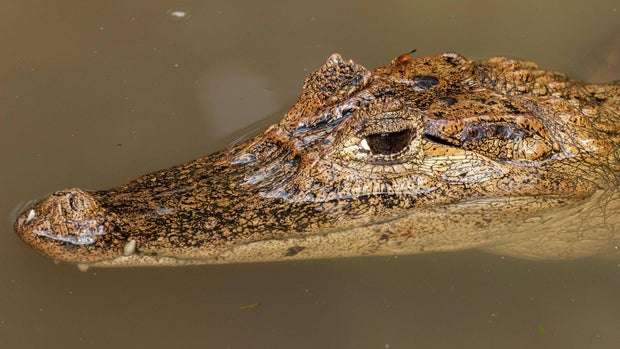
Despite those concerns, scientists acknowledge significant gaps remain in understanding exactly how the invasive reptiles are affecting South Florida ecosystems.
"Efforts should be made to test these hypotheses," the authors wrote, noting that the ecological impacts of spectacled caimans in the Everglades remain difficult to quantify.
Differences between a caiman, an alligator and a crocodile
While Florida is home to these three crocodilian species, only two are native.
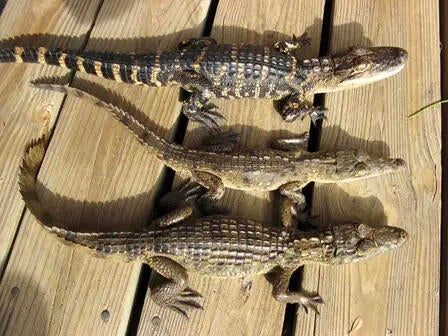
According to the Florida Fish and Wildlife Conservation Commission, the spectacled caiman resembles a crocodile but typically has a shorter, broader snout. Caimans are usually found in freshwater canals, lakes and ponds in South Florida and rarely exceed 5 feet in length.
The American alligator is native to Florida and has a broad, rounded U-shaped snout. It is the most common crocodilian in the state and can be found in freshwater lakes, rivers, marshes and wetlands throughout Florida.
The American crocodile, which is also native to Florida, has a longer, narrower V-shaped snout and is generally lighter in color. Crocodiles are more tolerant of saltwater than alligators and are commonly found in mangrove habitats, bays and estuaries in South Florida.
The study found that spectacled caimans overlap more frequently with alligators than crocodiles, though researchers say both native species could face increased competition if caimans continue expanding into new areas.
How and when did caimans first arrive in Florida?
Spectacled caimans came to Florida through the exotic pet trade, which grew rapidly during the 1950s, according to state officials. Wild populations were first reported in Palm Beach County during the late 1950s, and by 1980 researchers confirmed the species was reproducing in South Florida, U.S Fish and Wildlife said.
Today, the species remains legal to own, breed and sell in Florida.
There's no estimate as to the population size of spectacled caimans in Florida. Since 2017, more than 340 have been removed from active management areas, and earlier studies documented 251 removals over a 10-year period.
The study concludes that continued monitoring and removal efforts will be necessary to prevent further expansion into sensitive ecosystems.
South Florida residents are encouraged to report spectacled caiman sightings through the IVEGOT1 app, the EDDMapS website or by calling 1-888-IVEGOT1.