Attorneys ask Florida judges to halt execution of man who murdered 2 people in 1980s
Attorneys for condemned killer Frank Walls have asked the Florida Supreme Court to halt his scheduled execution next week, arguing he should be spared because he is intellectually disabled and was 19 years old at the time he murdered two people in Okaloosa County.
The request centers, at least in part, on arguments that executing Walls, 58, would violate the U.S. Constitution's Eighth Amendment ban on cruel and unusual punishment. As an example, the attorneys pointed to Walls having IQ scores of 72 and 74 as an adult.
"The record is rich with evidence of Mr. Walls' intellectual disability," the attorneys wrote in a brief Saturday. "Not only does Mr. Walls have qualifying IQ scores, but there is also evidence of his subaverage functioning and issues with adaptive functioning. This (Supreme) Court should not ignore this evidence."
But Attorney General James Uthmeier's office fired back in a response Sunday, saying Walls had an average IQ of 97 on three tests when he was a minor and his average score of 73 as an adult is "not significantly subaverage intellectual functioning."
"Walls is not now intellectually disabled and never was," the state's lawyers wrote.
Walls is scheduled to be executed on Dec. 18 for the murders of Edward Alger and Ann Peterson. If the execution is carried out, Walls could be a record 19th inmate put to death this year in the state. Mark Allen Geralds is scheduled to be executed on Tuesday and would be the 18th person put to death.
Walls was convicted in the July 22, 1987, murders of Edward Alger and Ann Peterson after breaking into their home in the early morning hours.
"Using curtain cords, Walls tied them up," the state's lawyers wrote in the document filed Sunday at the Supreme Court. "Alger managed to get loose, and a struggle ensued. Walls tackled Alger, slashed his throat, and then shot him in the head three times - killing him. Walls then turned his attention to Peterson, who was helpless and in tears. Although Ann Peterson posed no threat to him, Walls shot her in the head from close range. Peterson began screaming and, in response, Walls forced Peterson's face into a pillow and shot her in the head from close range. She died as a result of the gunshot wounds."
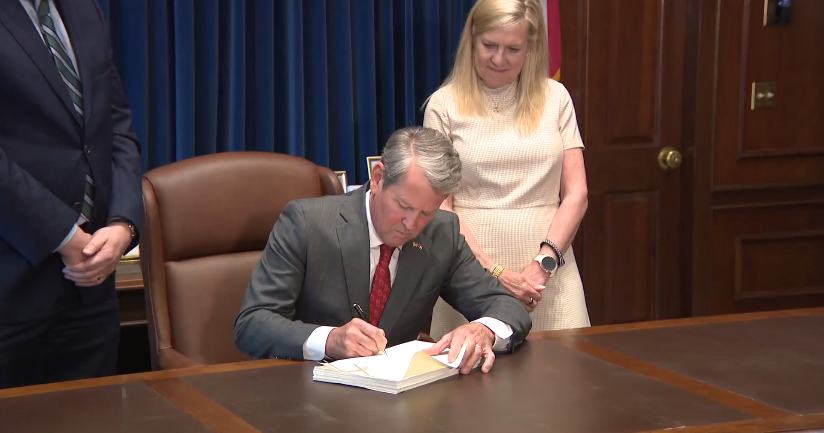
Gov. Ron DeSantis on Nov. 18 signed a death warrant for Walls, whose attorneys went to the Supreme Court after Okaloosa County Circuit Judge William Stone last week rejected a series of arguments aimed at preventing the execution.
The intellectual-disability argument is tangled in more than a decade of court rulings about executing people with such disabilities. In 2014, the U.S. Supreme Court, in a case known as Hall v. Florida, rejected part of the state's tests for determining whether defendants have intellectual disabilities. That part set a cutoff score of 70 on IQ exams. The U.S. Supreme Court said the state could not use such a "rigid rule."
In the aftermath of that decision, the Florida Supreme Court in 2016 ordered a hearing to determine whether Walls was intellectually disabled. But justices in 2020 reversed course on an earlier stance and said the Hall v. Florida decision should not retroactively apply to older cases - such as Walls' case.
A circuit judge in 2021 rejected arguments about Walls being intellectually disabled, and the Florida Supreme Court later turned down an appeal based on the retroactivity issue, according to court documents.
In the brief filed Saturday, Walls' attorneys argued that a "litany of wrongly-decided state court precedents and convoluted procedural hurdles have thus far prevented a merits-determination on whether Mr. Walls is categorically prohibited from being executed."
The brief argued that the Florida Supreme Court should find that the Hall v. Florida decision applies to Walls and that "Mr. Walls is intellectually disabled and barred from execution."
Also, Walls' attorneys contended that he should be shielded from execution because he was 19 at the time of the killings. The U.S. Supreme Court, in a 2005 decision known as Roper v. Simmons, said it would violate the Eighth Amendment to execute people who committed crimes when they were under age 18.
Walls' attorneys contend the prohibition also should apply to people such as Walls who committed crimes as young adults.
"There have been advancements in scientific research to show that adolescents between the ages of 18 and 22 are, developmentally, no different from juveniles under the age of 18," Walls' attorneys wrote in the brief Saturday. "These adolescents should also be categorically exempt from the death penalty, just as juveniles are."
But the state's lawyers in the response Sunday said the Florida Supreme Court has "repeatedly held that it lacks the authority to expand Roper beyond minors to include adults."
"This (Florida Supreme) Court has rejected numerous and sundry attempts to expand Roper beyond the chronological age of 18 years old and opposing counsel offers no reason for this court to reconsider that solid wall of precedent," the response said.