Housing's next big trend: Healthy communities
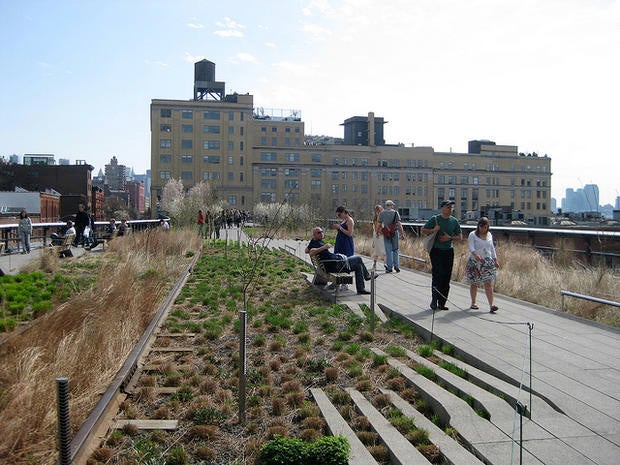
(MoneyWatch) Move out of the way green building, and welcome healthy building.
This isn’t just about making a home with better air quality and more natural lighting (although all that is part of the trend), but about creating healthy communities around those homes. Urban planners, architects, builders, real estate developers and public officials are advocating for new principles in the way they design private and public spaces to cater to the health-minded.
According to a report recently released by the Urban Land Institute, a Washington, D.C.-based land planning research and education nonprofit, 57 percent of comprehensive community plans include projects that increase so-called active living, while only 37 percent are tackling issues of environmental health.
And while the two are linked, it appears that the focus on health has eclipsed the focus on environment -- and that trend is likely to grow.
“The demand for this is coming from consumers: Millennials, those aging and wanting to stay in place, Baby Boomers,” said Patrick Phillips, CEO of ULI. “Employers are faced with increased insurance costs, and so they’re interested. This year was the tipping point. There’s now a tremendous amount of focus on this.”
While the conversation about health and how it intersects with where and how we live has been taking place for a few years, it hasn’t necessarily trickled down until recently, to the people with the money and affected how they make decisions about communities and development.
“The difference is that, with this effort, wellness is the intent, the designated outcome -- not just an additional benefit of thoughtful design and development,” said ULI chairwoman Lynn Thurber, who is also chairwoman of LaSalle Investment Management, which handles both public and private real estate projects.
Now, profit and economic growth may be the additional benefits of intentionally healthy building. Ninety-two percent of developers and planners surveyed by ULI say that a project that supports health and wellness can affect its market success and economic value.
ULI identified some trendy projects and ideas that you’re likely to see spread as health becomes the new buzzword in building and development.
Changing how streets are used
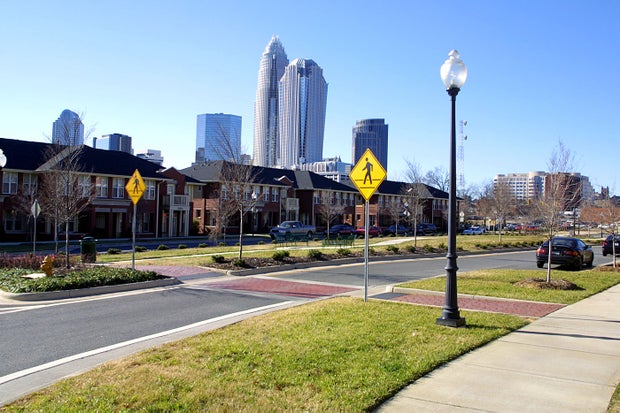
For decades, planners and developers have been designing streets for cars -- and just for cars.
The National Complete Streets Coalition, an advocacy group dedicated to helping communities adopt its street policies, hopes to change that. Formed in 2003 by a group of cycling advocates, the idea was to create guidelines that help transportation officials find room for cyclists, pedestrians, drivers and public transportation users on city streets.
What that really means depends on the neighborhood, but a typical Complete Streets project includes sidewalks, designated bike lanes, on-street parking, frequent safe crosswalks, median islands, narrower travel lanes, street trees and park strips to minimize focus on car traffic.
More than 500 cities have adopted the policy and use it as they rebuild or add new streets. According to the American Public Transportation Association, nearly 40 percent of retailers on Valencia Street in San Francisco reported increased sales after the street took on a Complete Streets revamp.
Revamping shared spaces
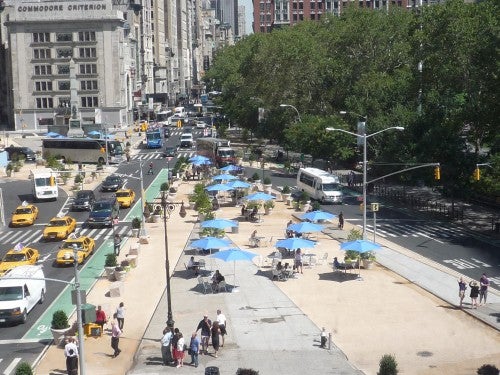
New York City is embracing the concept of “living streets.” That means wide sidewalks, zero-grade separation between sidewalk and street to create the feeling of a plaza; the use of trees, planters and public art; and plazas with street furniture for people to gather.
The city is in the midst of creating more spaces for people to enjoy public life on or near the street, which takes up about 25 percent of the city’s total land area. So urban planners are turning odd parking areas and large concrete swaths into plazas that people can actually enjoy. To date, the city has started work on 26 new plazas, and expects to add three plazas each year for the next 10 years, according to the Urban Land Institute.
New York City’s Department of Transportation found that creating these types of public spaces not only reduced the number of vehicle and pedestrian accidents, but at a specific spot at Union Square North, decreased commercial vacancies 49 percent in the adjacent area, compared to 5 percent borough-wide.
Making healthy choices easier
Indianapolis took a huge step forward in making exercise easier and more fun with the Indianapolis Cultural Trail, which opened this year, bridging the city’s downtown with neighboring cultural districts over 8 miles of protected bicycle and pedestrian path. The project cost $55 million and was supported through both government and private philanthropic funds.
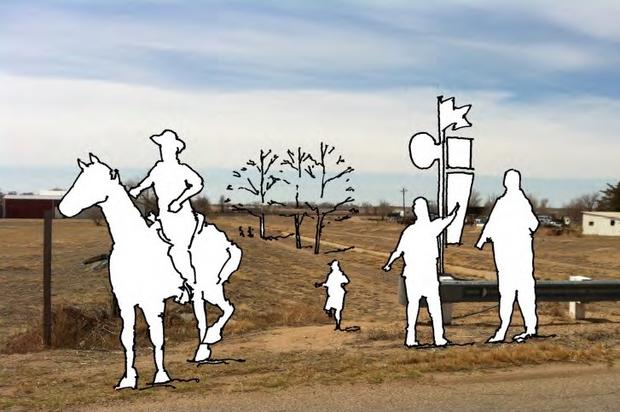
The Urban Land Institute is currently taking this same concept to a small town in Colorado called Lamar.
“The biggest barrier we hear about is the inability to walk or bike to work, to home, or to the grocery store,” said Kane Bryan, a member of Lamar’s Healthy Places Steering Committee and COO of Lamar’s Prowers Medical Center. “There’s nothing connecting the north and south sides of town. You have to cross the railroad tracks.”
To combat this problem (along with the area’s high obesity rates), the committee is working to create a 7 mile path for walking, cycling and horseback riding called the Lamar Loop. It would connect the north side’s Escondido Park with the south side’s parks and recreation facilities and to an existing greenway on the west side and an existing canal trail on the east side of the city.
Revitalizing natural gems
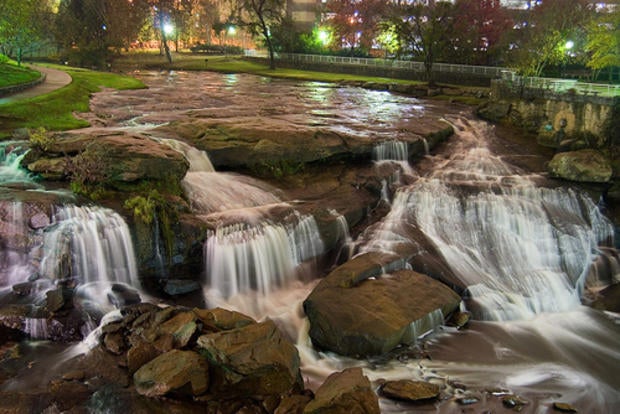
When Greenville, S.C. wanted to revitalize its downtown, it started with a 60-foot waterfall located just off Main Street. Reedy River Falls was once a dirty, polluted area -- so much so that in 1960, the city didn’t think much of putting up a four-lane bridge to block views of the falls. But the city has now removed the bridge and established the $13 million Falls on Reedy Park, using a local hospitality tax. The city replaced the vehicular bridge with a 355-foot pedestrian bridge.
The park has helped revitalize downtown and bring private development interest back into the city, to the tune of $90 million invested, according to ULI.