Did California High-Speed Rail help a consulting giant "manipulate" its bid to win a lucrative contract?

When the California High-Speed Rail Authority awarded a $24 million contract to KPMG, newly obtained records indicate it knew the consulting giant intended to charge more than its unusually low bid for high-level positions.
KPMG's winning bid proposed an average hourly rate of roughly $200, but records reviewed by CBS California show its billed average rate was more than double that.
KPMG did not deny the findings; instead, a spokesperson stressed that California High-Speed Rail had been aware of its plan:
"KPMG's bid in December 2024 detailed the people who would work on the engagement, their job classifications aligned to the state's definitions, and the associated billing rate for each person."
The impact? KPMG billed taxpayers roughly $2 million more in just four months than its winning cost proposal indicated.
In its first year, KPMG has already spent nearly half of its four-year, $24 million contract.
UPDATE | Shortly after this story was first published, the High-Speed Rail Board Chair sent CBS California the following statement:
"I will formally request as Board Chair that the Office of Inspector General initiate an independent review of the contract, the billing practices, and the Authority's oversight procedures.
Our responsibility is to the people of California. I will continue to act decisively to ensure that every dollar spent on the high‑speed rail program is accounted for and aligned with the public interest."
No Comment
CEO Ian Choudri and KPMG Managing Director Thierry Prate, who signed the contract, did not respond to emails.
Choudri also refused to answer questions in person after a recent board meeting.
A public affairs representative asked that we direct questions to his office, but California High-Speed Rail has since failed to respond to our multiple requests for comment. CBS California is also still waiting on public records we requested more than a month ago.
Instead of providing the records, last week, the authority's public relations team demanded a correction to our last story.
They did not dispute the findings; rather, they took issue with "the characterization that the California High-Speed Rail project has fallen further behind since CEO Ian Choudri's appointment."
They called it "inaccurate," adding that, "since his appointment, the program has advanced significantly, turning the corner from planning to implementation, consistent with global best practices."
We declined to add a correction, noting that Choudri's own 2026 Business Plan states the high-speed rail project timeline has been extended by at least nine months since he became CEO. The Inspector General also acknowledged the delay.
As CBS California previously reported, the authority lost $4 billion in federal funding under Choudri because it repeatedly missed deadlines to purchase the trains.
Meanwhile, the project is currently projected to run out of money in 2027, and Choudri has awarded four consultant contracts totaling a quarter of a billion dollars over two years.
Taxpayers continue paying hundreds of millions for consultants who aren't laying track or building trains, but who are at the center of an Inspector General investigation into wasteful and unallowable travel spending.
New records obtained by CBS California indicate that was just the beginning.
Key findings
Higher pay for lower-level positions.
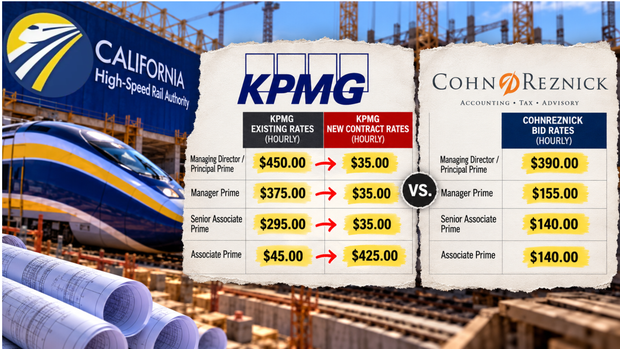
- KPMG's winning bid cut hourly rates for its "Managing Directors," "Managers," and "Senior Associates" from hundreds of dollars per hour under its previous contract to just $35 per hour in its winning bid.
- Then KPMG raised the pay for people in its lowest-experience "Associate" position from $45 to $425 per hour.
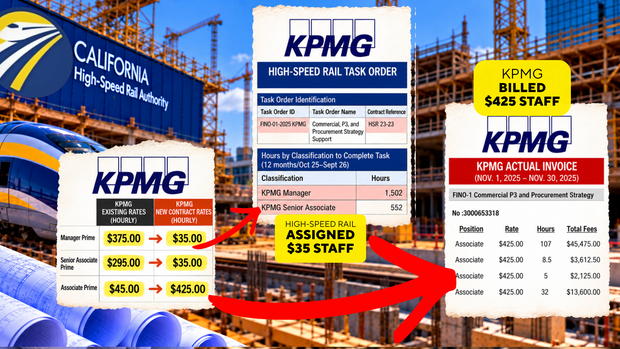
- When high-speed rail assigned work to now $35-per-hour "Managers" and "Senior Associates," KPMG billed them as low-level "Associates" at the new rate of $425 instead.
Allegations of bid manipulation:
- A competing bidder filed a protest with the state, accusing High-Speed Rail of allowing KPMG to manipulate its bid to win the contract. The protest argued KPMG never intended to charge $35 an hour.
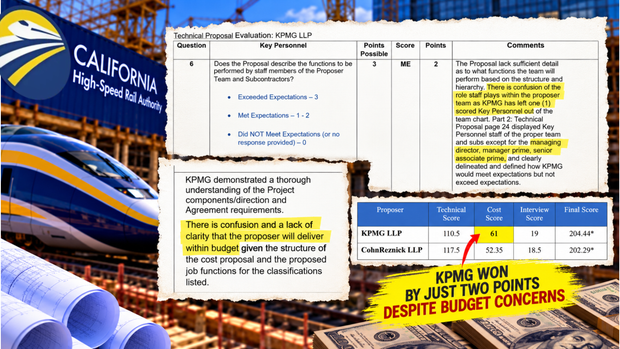
- The runner-up had a higher technical score than KPMG and lost by just two points based on price.
- A year later, CBS California could not find a single KPMG staff hour billed at $35 on the invoices reviewed.
The bid vs. the contract:
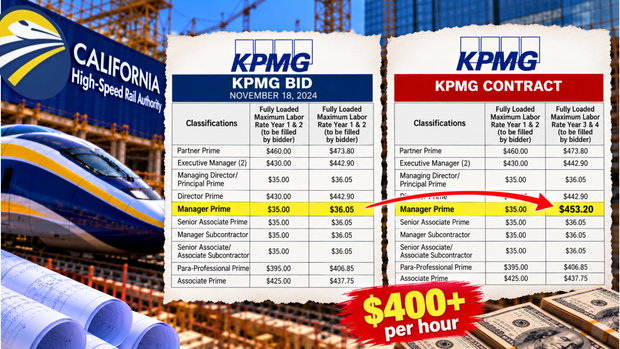
- KPMG bid one price for managers in the winning proposal, but the signed contract lists another price, more than ten times higher.
- Under the legally mandated scoring parameters, the runner-up would have won if KPMG had bid the higher contract rate.
Warnings ignored:
- State officials dismissed the runner-up's protest as "mere speculation," but explicitly warned the authority not to pay higher rates for work assigned to the $35 positions.
- Records show High-Speed Rail did just that.
California High-Speed Rail knew:
- KPMG says the authority knew it didn't plan to staff the $35 positions when it awarded the contract.
- Records show evaluators flagged budget concerns when scoring the winning bid, noting KPMG's proposal didn't assign any staff to the $35 positions. High-Speed Rail awarded KPMG the contract anyway.
- Once the contract was in place, High-Speed Rail assigned work to the $35 "Managers" and "Senior Associates" but allowed KPMG to bill them as less-experienced "Associates" at the $425 rate.
Familiar names:
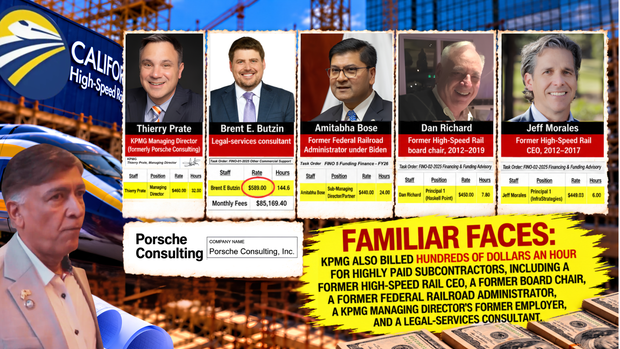
- KPMG also billed hundreds of dollars an hour for highly paid subcontractors, including a former High Speed Rail CEO, a former board chair, a former principal removed from another firm and the KPMG managing director's former employer.
- After legal consultant Brent Butzin spent through much of his initial budget, he began billing under the KPMG contract at $589 per hour. That is well above the highest rate allowed under the KPMG contract.
Denver consultants and the CEO
A recent CBS California investigation revealed that highly paid consultants repeatedly charged taxpayers for late-night rides home from Choudri's house and nearby restaurants, 30 minutes east of their Sacramento hotels.
Those were just a few of the questionable consultant expenses linked to Choudri.
The consultants are KPMG Managing Director Thierry Prate and High-Speed Rail legal-services contractor Brent Butzin, who is also paid through the KPMG contract that Prate administers.
Both are from Denver, where Choudri previously lived. Both were flagged in a recent Inspector General investigation into unallowable travel spending.
Choudri's fiancée also now works for KPMG.
The consulting giant has more than a half-dozen active California contracts across multiple state agencies totaling more than $200 million. CBS California has not reviewed those other contracts.
In response to the Inspector General's investigation into consultant travel spending, the California High-Speed Rail Authority told its board it paid four consulting firms nearly a quarter-billion dollars over two years.
The questionable travel expenses accounted for less than 1% of that.
If the authority can't enforce basic travel and staffing requirements, who's watching the quarter of a billion dollars Choudri agreed to pay just four consulting firms over two years?
The records suggest no one.
The alleged bid manipulation
Another company wanted that KPMG contract.
CohnReznick Advisory scored higher than KPMG on technical qualifications but lost the $24 million deal by just two points on pricing based on KPMG's unusually low pricing for three high-level positions.
The runner-up protested KPMG's winning bid, accusing the California High-Speed Rail Authority of allowing bid manipulation.
CohnReznick accused KPMG of intentionally offering artificially low rates for high-level positions it didn't intend to staff, then planning to bill those employees under different, higher-priced and lower-experience titles.
The runner-up also pointed to Prate, KPMG's Managing Director, who was now listed as a partner at $460 an hour instead of the new $35 managing director rate.
High-Speed Rail defended KPMG's bid, arguing the allegations were speculative and that no evidence showed KPMG wouldn't honor its bid. The authority maintained that KPMG's proposed staffing and job classifications complied with the bidding requirements.
California's Department of General Services (DGS) reviewed the KPMG bid and denied the competitor's protest.
DGS told CBS California it has limited authority beyond reviewing bid requests and contracts for procedural compliance with state law and procurement requirements. DGS added it lacks authority after the contract is signed to oversee the rates an agency actually pays.
In his final decision, the DGS hearing officer said, "Any argument that KPMG intends to charge more than it bid or to substitute an individual to perform work at a higher hourly rate classification is mere speculation"
However, he put High-Speed Rail on notice: "It will be incumbent upon the Authority's contract managers to verify that the work performed by its contractor conforms to the appropriate classification and that no more than that classification rate is paid."
He specified that High-Speed Rail couldn't assign work to a $35-an-hour manager and then pay KPMG a higher rate simply because the employee billed under a different title.
The task orders and invoices reviewed by CBS California suggest that's exactly what happened.
KPMG's lucrative demotions
Here's how it worked.
KPMG was already working for the California High-Speed Rail Authority on another contract when it bid on the new one. The authority's bid request for the new contract mirrored KPMG's existing contract and used KPMG's current job classifications.
Under KPMG's existing contract, managing directors billed $450 an hour, managers $375, and senior associates $295.
Under KPMG's new bid, those three job classifications dropped to $35 an hour. Meanwhile, the lowest-level job classification, associate, rose from $45 to $425.
Why does that matter? California scores bids based on a weighted average of all expected hourly rates. Some positions count more than others.
Based on KPMG's historical billing, managing directors, managers, and senior associates billed the most hours, so those salaries carried more weight.
Lowering those positions to just $35 brought down KPMG's overall average hourly rate, making its bid look cheaper.
KPMG won the contract by just two points based on that lower rate.
Elsewhere in its bid, under the staffing list, KPMG effectively demoted "Managers" and "Senior Associates" on paper, assigning them to the "Associates" classification, which requires the least experience under state definitions.
KPMG also effectively promoted all of its now $35-per-hour "Managing Directors" to "Partners" at $460 an hour.
Different titles. Same employees. Much higher bills.
High-speed rail ordered managers. KPMG billed associates.
Among seven "task orders" (work assignments) CBS California reviewed, High-Speed Rail specifically assigned more than 9,000 hours to "Managers" and "Senior Associates," which required more experience than "Associates" under the state's definition.
The contract required KPMG to bill those classifications at $35 an hour. The DGS hearing officer reiterated that requirement in his protest decision.
Instead, KPMG billed thousands of hours assigned to "Managers" and "Senior Associates" at the "Associate" rate of $425 an hour.
The difference? Roughly $2 million over the four months reviewed.
The task orders specify, "KPMG reports to the Authority's Chief Financial Officer, Jamey Matalka."
The records don't show whether Matalka authorized changes to the assignments or billing classifications, or what work justified the higher rates.
California High-Speed Rail executives did not respond to our questions.
However, the Department of General Services would have had to approve any contract amendment to increase the rates. DGS tells us it has not received an amendment.
Notably, the winning bid that DGS reviewed listed an hourly rate of $36.05 for managers in the third and fourth years of the contract. That rate increased to $453.20 in the signed contract.
Under the scoring parameters, the runner-up would have won if KPMG's bid matched the higher rate later added to the contract.
KPMG's answer: High-Speed Rail knew
KPMG says the authority knew its staffing plan from the beginning.
A review of the original bid proposal confirms that KPMG never assigned any employees to the three $35 positions.
High-Speed Rail's own evaluators flagged the missing staff assignments and questioned whether the firm could stay on budget.
The authority awarded KPMG the contract anyway, giving it the winning price score.
In its response to the bid protest, High-Speed Rail acknowledged that the bidding rules required job titles to closely align with the state's classifications, but argued that KPMG employees' actual job titles didn't have to match the state's contract classifications.
In an email to CBS California Investigates, KPMG said, "We are committed to conducting business with integrity and being responsible stewards of client resources. KPMG is investigating the facts and circumstances related to the proposal process and contract with California High-Speed Rail Authority."
The company added, "Based on our investigation, any identified violations of firm or the Authority policy by KPMG personnel will be addressed appropriately. We will cooperate with the Authority board and management team on these matters to best serve the interests of the people of California."
Who was checking?
CBS California spoke with more than a dozen current and former High-Speed Rail managers, executives and contractors.
Each asked to remain anonymous, citing concerns about retaliation.
"This is bid manipulation," a project contractor argued.
"I would have never approved this," said one former contract manager. "I would have sent the invoice back."
We shared our findings with High-Speed Rail Inspector General Ben Belnap, a former state auditor. His office declined to comment. Notably, the IG cannot legally comment on active investigations.
We also shared our findings with the Department of General Services.
DGS says its review focuses on whether contracts comply with state law and procurement requirements, not whether the winning prices ultimately match the invoices.
That responsibility falls to the agency managing the contract. In this case, the California High-Speed Rail Authority.
High-speed rail's independent auditor had already flagged billing problems.
The authority told its board the auditor identified more than $3 million in questioned costs, overbillings and recommended adjustments over the past two years.
In other words, the agency knew there were billing problems
Following Belnap's recent investigation into travel spending, High-Speed Rail announced it was rebidding KPMG's contract early, telling the board the decision shows how seriously it takes potential overbilling.
That's the same KPMG contract the agency defended when a competing bidder alleged bid manipulation.
Old names, new bills
KPMG's invoices also include payments to former High-Speed Rail CEO Jeff Morales, former board chair Dan Richard, and former Biden administration Federal Railroad Administrator Amit Bose, among others.
Morales billed through InfraStrategies for funding and grants work.
Richard billed through Haskell Point and claimed thousands of dollars in travel expenses, including private-plane airfare. The Inspector General previously flagged a private-plane flight reimbursed at a premium fare.
Bose billed for funding and financing advice. He previously worked at the same company as Choudri.
Gary Walker, a former principal at AECOM, another consulting firm referenced in the Inspector General's investigation, is now billing under the KPMG contract instead.
Prate's former employer, Porsche Consulting, is also a subcontractor on the KPMG contract he negotiated.
Then there's Brent Butzin. Rideshare and travel receipts frequently link Prate, Butzin, and Choudri.
Butzin began billing on the High-Speed Rail project shortly after Choudri became CEO. He initially billed through a legal-services agreement with an existing contractor, Nossaman.
High-Speed Rail doubled Nossaman's budget from $1 million to $2.1 million shortly after Butzin joined.
Invoices suggest that after Butzin billed more than $850,000 of Nossaman's budget, he began billing under KPMG's contract instead.
His billing raised another red flag.
KPMG's invoices bill Butzin at $589 an hour. That is well above the highest hourly rate allowed for anyone under KPMG's contract.
Billing at that rate should have required a contract amendment and DGS review. DGS says it has not received any amendments.
High-Speed Rail approved the billings, but why?
Neither Butzin, Prate nor High-Speed Rail responded to repeated requests for comment.
Several current and former employees independently alleged executive management pressured lower-level contract managers to sign the questionable consultant invoices.
One former employee recounted what they claim was a conversation between Butzin and a supervisor who questioned his expenses, in front of Choudri.
"Ian wanted me at there; that's all you need to know," Butzin allegedly responded before he walked away laughing with a former executive, the former employee claimed.
The Inspector General's investigation quoted a similar email exchange between Butzin and a contract manager.
According to the email excerpt in the Inspector General's report, Butzin argued that justifying travel wasn't his responsibility when the CEO requested his presence.
Then, Butzin added a perceived threat, noting that questioning the CEO's direction was inappropriate, "as other consultants in other Authority offices are learning the hard way."
Belnap found that Choudri lacked the authority under state law to approve Butzin's unallowable expenses.
"It's why they keep running out of money"
One year into KPMG's four-year contract, the company had already billed nearly half its $24 million budget.
What exactly did taxpayers get for that money? Many invoices provide limited descriptions of the work performed.
For example, all 104 hours Prate billed in December carried the same description: "related to the CEO transition as directed by the client."
One former contract manager said it's not uncommon for contractors and contract managers to "manipulate bids" and swap out staff after they win.
"It's why they keep running out of money before the end of their contracts," the former manager said.
The Inspector General found the High-Speed Rail project is on track to run out of money by the end of 2027, without additional funding.
The consultant contracts alone are not the reason for High-Speed Rail's money woes, but the project has fallen further behind since Choudri became CEO and signed the consultant contracts.
The bigger question for California taxpayers
A competing bidder accused KPMG of manipulating its proposal.
High-Speed Rail defended the deal.
State officials dismissed the allegation as speculation.
The hearing officer explicitly warned High-Speed Rail not to pay more for work assigned to the $35 positions.
Records show it did.
A previous CBS California investigation found over a billion dollars in no-bid state contract allocations in this year's state budget alone. Those are exempt from even DGS review.
The KPMG contract findings raise questions that go well beyond California High-Speed Rail:
If companies can win state contracts with low rates for positions they don't staff, then bill taxpayers substantially more for the work assigned, who is protecting California taxpayers?
Who is checking that they're doing the work California is paying for?
Should an outside agency independently review contracts to ensure contractors honor their bids?
Should California require state agencies to publicly post contracts so competing bidders, taxpayers, and watchdogs can flag problems without navigating lengthy public records delays?
CBS California will continue to follow the money.


