Iran War Updates: Tehran proposes 7-day plan to reopen Strait of Hormuz as it seeks deal before U.S. midterms
What to know about the Iran war today:
- Iran wants to make a deal with the U.S. before the November midterm elections, the country's president said Thursday, as its top diplomat said the regime had proposed a 7-day plan to reopen the Strait of Hormuz and restart talks on a wider peace agreement.
- Iran's deputy foreign minister on Friday accused Israeli Prime Minister Benjamin Netanyahu of using his U.N. General Assembly address for "justifying war and aggression," and said mass walkouts during his remarks "spoke louder than any speech."
- U.S. troops hit by a deadly Iranian drone attack on a small Kuwaiti port in the opening days of the Iran war could have been relocated to safer positions in western Saudi Arabia, multiple sources told CBS News, but plans for a move were rejected by the unit's commander despite intelligence warnings.
Qatar says talks were held with Iran on conditions for "dialogue"
Qatari Foreign Minister Sheikh Mohammed bin Abdulrahman Al Thani, a key mediator between Tehran and Washington, spoke Friday with Iranian President Masoud Pezeshkian about deescalation and the conditions necessary to renew a direct dialogue between the two sides, Qatar's foreign ministry said.
The pair met Friday on the sidelines of the United Nations General Assembly in New York, according to a statement posted on X.
Pezeshkian invited Al Thani to the meeting, where they "reviewed the latest developments in the region and the efforts being made to deescalate tensions and create a conducive environment for dialogue," the ministry said.
CBS/AFP
Iraq suspends Iranian airline flights to holy city of Najaf, enforcing U.S. sanctions
Iraq's Najaf airport, a top destination for Shiite Muslims, suspended all Iranian flights Friday, enforcing U.S. sanctions, the airport director told the AFP news agency.
Airport director Hussein Muhanna said "all flights were halted between Iran and Najaf airport following a directive from the prime minister's office to the governor" of Najaf.
The airport in the holy city south of Baghdad is a major hub for Iranian flights.They carry many Iraqi Shiite pilgrims to Iran's holy cities and Iranians visiting sacred sites in Iraq. The flights also serve Iraqi students studying in Iran, and patients seeking medical treatment there.
The bond between Iraq and neighboring Iran, both Shiite-majority nations, runs deep and is shaped by both religion and politics.
Iranian airline flights were suspended at Najaf's airport early Thursday morning, the airport director said.
Several sources, including a senior government official, told AFP earlier this week that Iraq would enforce the U.S. ban on Iranian airlines, joining several other countries in the region, including the United Arab Emirates.
U.S. Treasury Secretary Scott Bessent had said Iranian airlines would "shut down" Wednesday, and he threatened countries that did not comply with expulsion from the U.S. dollar system.
Although land routes are available, Iraq remains one of the top destinations for Iranian airlines, especially after Iraqi airlines stopped flying to Iran at the start of the Iran war in February.
CBS/AFP
Walkouts during Netanyahu's U.N. address were "louder than any speech," senior Iranian diplomat says
Iranian Deputy Foreign Minister Kazem Gharibabadi said Israeli Prime Minister Benjamin Netanyahu came to the U.N. General Assembly to use the podium in front of other world leaders as a "loudspeaker for justifying war and aggression," but he argued the mass walkout by dozens of other delegations "spoke louder than any speech."
"The world is not fooled by narrative-building," Gharibabadi wrote in a post on X Thursday evening. "History will judge crime, occupation and aggression, not propaganda displays in New York."
As Netanyahu took the stage in New York Thursday, many attendees walked out, but CBS News has not confirmed Gharibabadi's claim that 77 national delegations left the chamber.
"If there are any other moral cowards who haven't yet left this hall, please do so now," Netanyahu said as the officials filed out, before launching into a defense of his country's actions in Iran and across the Middle East.
"We will continue to defend our state. We will continue to win because we have no other choice," he said, adding his thanks to President Trump for supporting Israel throughout the interlinked wars in the Middle East.
Iran's president wants a deal with the U.S. before November midterm elections
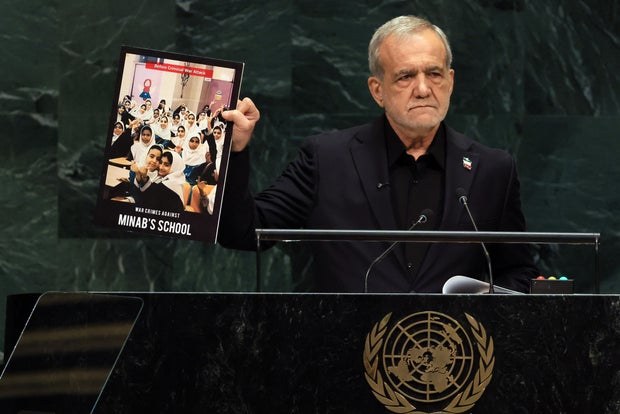
Iran wants to make a deal with the U.S. before the midterm elections in November, Iranian President Masoud Pezeshkian told journalists from several news organizations Thursday in New York on the sidelines of the United Nations General Assembly.
"We don't want it to get to the midterm elections," Pezeshkian said. "We wish Americans to return to the MoU before the midterms," he added, referring to the memorandum of understanding signed between the two countries in June. That agreement formed the basis of a ceasefire that collapsed within several weeks, as Iran accused the U.S. of breaching the deal by keeping its naval blockade in place.
President Trump has said Iran will make a deal "right after the election" because "they're waiting to see how I do in the midterm election."
Pezeshkian also told the journalists on Thursday that Iran was "open" to allowing inspections of its nuclear facilities, and he denied that the regime is seeking to assassinate Mr. Trump or any members of his family.
"This has not been the position of the Iranian government, that we seek to assassinate President Trump or his family members," Pezeshkian said.
Commander rejected plans to rebase farther from Iran before deadly drone strike, sources say
The dozens of U.S. troops bombarded by Iranian drones at a small Kuwaiti port in the opening days of the Iran war could have relocated to safer positions in western Saudi Arabia, multiple sources told CBS News, but those plans were rejected by the unit's commanding general despite intelligence warning of a potential attack on their post.
About one week before the launch of Operation Epic Fury, most American soldiers and Air Force personnel stationed in Kuwait were moved to Jordan and Saudi Arabia — farther away from Iranian missile range. At least two options were scouted, planned and presented to the leadership of the 103rd Sustainment Command, the Army Reserve unit that ran logistics for U.S. Central Command: one was Logistical Support Area Jenkins, a U.S. military base near the southwest port city of Yanbu, and another was Prince Sultan Air Force Base, just southeast of the Saudi capital city Riyadh.
A third option, supported by the commander, Brig. Gen. Clint Barnes, was to follow the playbook from the unit that was previously deployed to Kuwait before the 103rd arrived in September 2025. During the 12-day war between Israel and Iran that July, the active unit briefly moved its home base at Camp Arifjan in Kuwait to Port of Shuaiba, roughly 30 miles south of Kuwait City and just 65 miles southwest of Iran.
"That was a totally different scenario," one service member, speaking on condition of anonymity because he was not authorized to speak with the media, told CBS News. "Missiles and drones were flying overhead between Iran and Israel and we were more worried about one of them being intercepted and falling out of the sky."
Iran delivered 7-day plan to U.S. this week, foreign minister says
Iranian Foreign Minister Abbas Aragchi told a group of reporters in New York City that Iran shared a 7-day plan with U.S. mediators this week. If certain conditions of that proposal are met, the Strait of Hormuz would be opened at the end of the seven days and talks would be restarted to try to get a final deal.
The terms of the proposal mimic large portions of what was in the 14-point Memorandum of Understanding that was signed by President Trump back in June.
A mediator in the talks told CBS News on Thursday that the talks are positive, but still in an early phase.
Earlier this week, Secretary of State Marco Rubio was more circumspect about the diplomacy, saying there had been no breakthroughs. U.S. envoy Steve Witkoff and Mr. Trump's son-in-law, Jared Kushner, have been handling the shuttling back-and-forth with the mediators on the possible terms of a hypothetical truce with follow-on talks.
Israel's Netanyahu addresses U.N. as many leaders walk out
Israeli Prime Minister Benjamin Netanyahu addressed the United Nations General Assembly on Thursday as his country faces broad condemnation and growing isolation.
As Netanyahu took the stage, many attendees walked out.
"If there are any other moral cowards who haven't yet left this hall, please do so now," Netanyahu began.
Netanyahu launched a defense of his country's actions in Iran and across the Middle East.
"With our great American friends, we crushed Iran's army, navy, air force and nuclear facilities," he said, later thanking President Trump for his "bold leadership."
"We will continue to defend our state. We will continue to win because we have no other choice," he said.