Iran War Updates: More ships attacked in Persian Gulf, oil prices rebound slightly after post-midterm plunge
What to know about the Iran war:
- Oil prices fell sharply after the midterm elections, as markets appeared to hope the results might push President Trump toward a deal to end the Iran war and reopen the Strait of Hormuz. Commercial ships in the region continue coming under attack, however, and hitting sea mines, according to Iranian authorities.
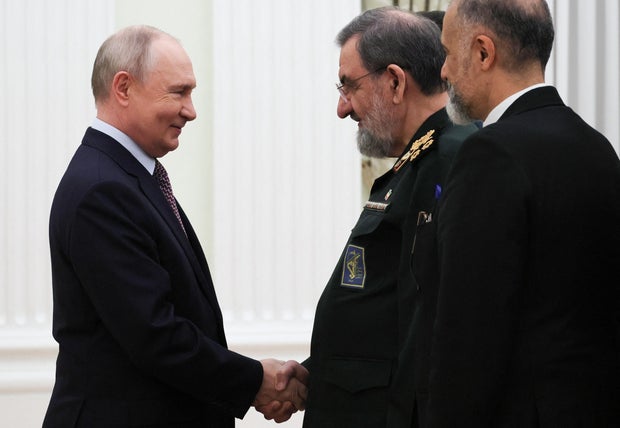
- As a senior Iranian security official met Thursday with Russian President Vladimir Putin at the Kremlin amid uncertainty over Mr. Trump's next move, Moscow warned Russian citizens not to visit Iran, citing the "risk of a new escalation."
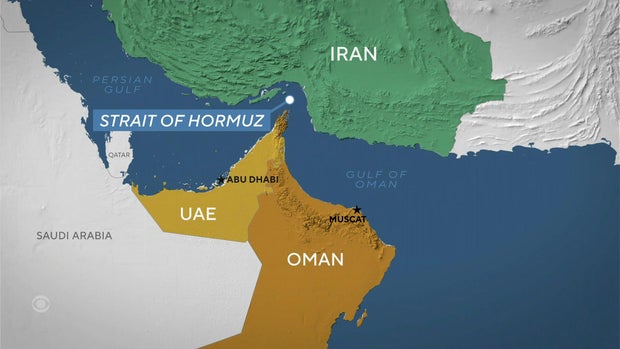
- Oman said Thursday it was still in talks with Iran aimed at creating a system for the nations to jointly control traffic through the vital shipping lanes of the strait, which the Omani foreign ministry said could "end the state of war and prevent renewed confrontations in the region."
Saudis say coalition intercepted 2 missiles launched by Houthis
The Saudi-led coalition said on social media Friday that its air defense systems intercepted and destroyed two ballistic missiles launched by Houthi rebels toward Najran, a major city in southwestern Saudi Arabia.
"Debris fell as a result of the interception, and damage assessment is underway," the statement said.
Iran says 2 tankers hit mines, caught fire in and near Strait of Hormuz
Iran's Revolutionary Guards said in a statement carried by state media Friday that two oil tankers hit mines and caught fire in and near the Strait of Hormuz, a day after Tehran claimed five other tankers had met similar fates.
"Two violating oil tankers — one east of the Strait of Hormuz and the other within the Strait itself — that attempted to transit via an unauthorized route struck mines," Iran's powerful Islamic Revolutionary Guard Corps said in a statement carried by state TV and the semi-official Tasnim news agency.
"These two tankers had deactivated all their navigation and identification systems. Supported by the aggressive and terrorist U.S. military, they attempted to exit the Strait of Hormuz via an unauthorized path; however, upon striking mines, they caught fire and were immobilized," the statement added.
On Thursday, Iranian media reported that five oil tankers and a tugboat caught fire in the Strait of Hormuz in similar incidents.
There has, however, been no confirmation of any of these incidents from maritime officials.
Since the outbreak of the Middle East war on Feb. 28, Tehran has sought to limit traffic through the strategic waterway, which normally carries oil that amounts to one-fifth of global consumption. In response, the U.S. imposed a blockade on Iranian ports and has escorted tankers through the strait. Ships turn off their identification and navigation systems to try to avoid being detected.
The U.S. Central Command said last month that it had helped Gulf countries export 1.5 billion barrels of oil via Hormuz since summer and recently said all mines had been cleared from the vital waterway.
CBS/AFP
Putin, Iran's security chief discuss building oil pipeline from Russia to Iran
Russian President Vladimir Putin received Iran's security chief, Mohsen Rezaei, in Moscow Thursday to discuss strengthening ties between their two countries, including a pipeline to import Russian gas.
Speaking to journalists after their meeting, Rezaei, secretary of Iran's Supreme National Security Council, called it "an extremely important exchange," according to remarks reported by the Iranian embassy.
"During the meeting with Mr. Vladimir Putin, discussions were held regarding the construction of gas pipelines from Russia to Iran," said Rezaei, Iranian state TV reported.
He noted the aim was to enable Iran "to address its own gas shortages while also facilitating the sale of Russian gas to neighbouring countries."
While a major producer, Iran has long suffered shortages of natural gas, essential for powering heating systems, which have been exacerbated by the war with the United States and Israel.
During the most intense phase of the fighting, which lasted nearly 40 days, the U.S. and Israel struck key Iranian infrastructure including natural gas refineries, according to Tehran.
Iranian foreign minister talks to counterparts from several Middle East countries
Iranian Foreign Minister Abbas Araghchi spent much of the day on calls with his counterparts from several Middle Eastern countries, including Pakistan, Saudi Arabia, the United Arab Emirates and Turkey.
In total, Araghchi held calls with nine different countries in the Middle East. Few details were shared about what was discussed on the calls, simply nodding to "diplomatic efforts to maintain stability in the region."
Notably, Pakistan was one of those countries involved as they have been very closely involved as mediators in U.S.-Iran peace talks. Araghchi spoke to their foreign minister, Ishaq Dar, on Thursday evening.
Araghchi also spoke to Saudi foreign ministers Faisal bin Farhan and Sheikh Mohammed bin Abdulrahman, despite accusations of Iranian involvement in attacks on that country by the Houthi militia in Yemen.
Trump administration held talks with Iran on deporting Iranians during the war, AP reports
President Trump's administration held secret talks with Iran on deporting Iranians even as the war there dragged on, court documents obtained by The Associated Press show.
The court documents unsealed Thursday show the Republican administration as recently as mid-October said it had plans to deport the Iranians through an unnamed third country, although it was unclear when it intended to do so. The judge in the case ordered the government to give the court 24-hour notice of any finalized plans to deport Iranians to Iran or to any other country and five days' written notice before any such deportation is carried out.
The documents show the administration maintained contacts with Iranian officials during the war over the removals, specifically for submitting travel documents and figuring out "possible avenues for removal."
"We are at war with a country where the President of the United States has said, as recently as two or three days ago, if not yesterday, that it is essentially lawless ... A country that is an enemy of the United States, according to the current president. A country that, according to our president, murdered tens of thousands of protestors," Judge Ana Reyes said according to the Oct. 15 transcript.
"And what you're telling me is that the United States of America is going to send individuals back to that region, facing what you and I and everyone who would ever look at this would know would be, at a minimum, a serious threat of certain death."
"Yes, your honor," Justice Department attorney Dimitar Georgiev-Remmel said. "The government is executing lawful orders of removal."
The Department of Homeland Security did not immediately respond to a request for comment.
Houthi drone disrupts traffic at Saudi airport, group says
The Houthis took credit for disrupting travel using a drone at King Fahd International Airport on Thursday.
"We targeted King Fahd International Airport in Dammam using a drone and our operation caused a disruption of air navigation at the airport," Houthi spokesperson Yahya Saree said on X.
The city of Dammam, which is located in the oil-rich eastern part of Saudi Arabia, and King Fahd airport have been regular targets for Houthi attacks. Multiple drones have disrupted traffic at the airport this week, according to past announcements.
Two people were killed in a Houthi strike on King Fahd airport on Oct. 22.
3rd U.S. aircraft carrier strike group heading for Mideast to make stop in Singapore, delaying arrival
The USS Theodore Roosevelt aircraft carrier and its associated strike group will make a port call in Singapore Friday and will not reach the Middle East for at least another two weeks, a U.S. official told CBS News on Thursday.
There are already two carrier strike groups in the region and, which officials say is sufficient firepower to execute any commands issued by President Trump.
Mr. Trump has not signaled yet, in the wake of the U.S. midterm elections, whether he intends to order major new strikes on Iran — an option he kept on the table with repeated statements ahead of Tuesday's voting.
Oil prices rebound slightly after huge drop in wake of U.S. midterm elections
The initial knee-jerk reaction to the U.S. midterm election results faded a bit Thursday.
The price of a barrel of Brent crude oil, considered the international standard, rose 2.2% to $96.70, recovering a chunk of its nearly 9% drop from the day before.
Uncertainty still reigns about what will happen in the war with Iran and when the global energy industry can return to normal.
CBS/AP
As top Iranian official meets Putin, Russia warns citizens not to visit Iran, citing "risk of a new escalation"
Mohsen Rezaei, Secretary of Iran's Supreme National Security Council, met Thursday in Moscow with Russian President Vladimir Putin to deliver a message from Iran's supreme leader, according to the Iranian government.
They met amid uncertainty over President Trump's next move on Iran in the wake of U.S. midterm election results that represented a major rebuke of his policies, including, he has admitted, the decision to launch the war with Iran alongside Israel more than eight months ago.
Mr. Trump said repeatedly ahead of the Tuesday vote that he had yet to make a decision on whether to order major new attacks on Iran or to agree a deal to end the war, which Tehran has so far refused to do until the U.S. accepts its core demands to end its naval blockade, ensure a halt to fighting on all fronts in the Middle East, and ease sanctions.
During the Rezaei-Putin meeting in Moscow on Thursday, the Russian Foreign Ministry warned Russian citizens against all travel to Iran.
"Given the continued risk of a new escalation around Iran, our recommendations to Russian citizens remain unchanged," ministry spokeswoman Maria Zakharova told reporters in Moscow. "We recommend temporarily refraining from traveling to that country until the situation is resolved. We also ask our compatriots already in Iran to exercise vigilance and avoid crowds, public events, and areas near military and government facilities."
She said the guidance was "based on the official information disseminated by Tehran," without providing any further detail.
Iran again claims it has no role in backing the Houthis in Yemen's civil war
The Iranian Foreign Ministry renewed the regime's rejection on Thursday of longtime and widely held beliefs that Tehran materially supports the Houthi rebels fighting the Saudi Arabia-backed government in Yemen's decade-long civil war. The conflict intensified a couple months ago and quickly became the most active and deadly front in the intertwined conflicts in the Middle East.
Foreign ministry spokesman Esmaeil Baqaei called the latest accusation of Iranian support for the Houthis, made Monday by European Union foreign policy chief Kaja Kallas, "baseless," and said Iran "strongly denied claims that Iranian military experts were present in Yemen."
The U.S. government, along with many other Western nations and the NATO alliance, have demanded for years that Iran stop supporting the Houthis. The support, according to these nations, includes financial backing, weapons and other equipment, and direct coordination and training.
In July, not long before the Yemen war escalated and the Houthis started launching attacks on Saudi airports in response, the Reuters news agency reported that Iran had flown commanders from its powerful, heavily sanctioned Islamic Revolutionary Guard Corps, along with equipment related to missiles and drones, to Yemen bolster the Houthis' ability to threaten global energy supplies in the Red Sea.
Since then, Houthi missile strikes on Saudi Arabian airports have killed at least 20 people.
In her remarks Monday, the EU's Kallas said "all Houthi military action must end immediately. We call on all actors, including Iran to cease all military support to the Houthis, in violation of several United Nations Security Council resolutions."
Iran has always denied supporting the Houthis.
Oman says still working with Iran on joint control system for Strait of Hormuz "that would end the state of war"
Oman's government said Thursday that, in a phone call between the Omani and Iranian foreign ministers, both men "stressed the importance of moving from the stage of de-escalating tensions to one of establishing sustainable understandings based on practical arrangements to ensure the safety of maritime routes and joint technical mechanisms to secure the smooth flow of international trade and energy, in a manner that would end the state of war and prevent renewed confrontations in the region."
Omani Foreign Minister Sayyid Badr bin Hamad bin Hamoud Al Busaidi and his Iranian counterpart Abbas Araghchi "reviewed the latest developments in communications and discussions aimed at reaching practical, political, and technical understandings that would enable the resumption of unimpeded maritime traffic through the Strait of Hormuz," the Omani Foreign Ministry said in a statement.
Iran and Oman have discussed for months implementing a joint mechanism to control commercial traffic through the strait, over which both Iran and the U.S. insist they currently have dominion. Iran started threatening and attacking ships in the region in response to the U.S. and Israel jointly launching the ongoing war against the Islamic Republic at the end of February, and those attacks continue despite U.S. assertions that the strait is now open safe to use.
According to Oman, the ministers emphasized in their Thursday call that any future "understandings must be based on respect for the sovereignty of states, consideration of the legitimate interests of all parties, and the creation of appropriate conditions for restoring dialogue and negotiation processes and addressing the outstanding issues underlying the escalation."
Another oil tanker hits mine, catches fire near Strait of Hormuz, Iran says
An oil tanker hit a mine, caught fire and was immobilized east of the Strait of Hormuz early on Thursday, Iran's Revolutionary Guard Corp navy said, according to IRNA, Tehran's official news agency.
The navy said the tanker had switched off its identification and navigation systems, a tactic used by vessels seeking to avoid detection by Iran.
The IRGC has declared the strait "unsafe and closed" to vessels trying to go through the vital waterway without coordination with Tehran.
Saudi coalition says it intercepted Houthi missile fired at Medina region
The Saudi-led coalition fighting Yemen's Houthi rebels said on Thursday that a ballistic missile fired by the group at the Medina region — home to one of Islam's holiest cities — had been intercepted.
"Air defense intercepted and destroyed a ballistic missile launched by the terrorist Houthi militia toward the Medina region," coalition spokesman Turki al-Malki said in a social media post.
Tanker hit by 2 projectiles north of Qatar, British military says
A tanker was hit by two unidentified projectiles in the Persian Gulf about 50 nautical miles north of Madinat ash Shamal, Qatar, a British military tracking agency said Thursday.
The United Kingdom Maritime Trade Operations Centre (KKMTO) said the status of the crew, damage assessment and environmental impact weren't known.
Iran says two tankers and tugboat caught fire in Strait of Hormuz
Two oil tankers and a tugboat caught fire in the Strait of Hormuz, Iran's Revolutionary Guard Corps said, local media reported on Thursday.
Since the outbreak of the Iran war on Feb. 28, Tehran has severely restricted traffic through the strategic waterway, which normally carries about one-fifth of global oil consumption.
In response, the United States has imposed a blockade on Iranian ports and helped tankers travel through the strait. The U.S. Central Command said last month that it had helped Gulf countries export 1.5 billion barrels of oil via the strait since summer.
"Last night, in two separate incidents, a large oil tanker attempting to pass through the illegal passageway south of the Strait of Hormuz suffered a fire after striking a mine and was brought to a halt," the Guard told Iran's Fars news agency.
"Another supertanker was halted by a massive fire while exiting the eastern Strait of Hormuz. A tugboat that had approached the supertanker to extinguish the fire also caught fire."
Fars also reported the IRGC navy's electronic warfare unit had taken control of two LUCAS drones, a U.S.-developed model short for Low-cost Uncrewed Combat Attack System.
Reelected Colorado Rep. Jason Crow on Iran after midterms: "The war has got to end"
Colorado Democratic Rep. Jason Crow, who has won his midterm reelection bid, told CBS News how Democrats will address the war with Iran as the party takes control of Congress next year, saying, "The war has got to end."
"Americans never wanted it to begin with. Americans for years have wanted to end this constant cycle of conflict in the Middle East. In fact, Donald Trump even campaigned on that," Crow, a member of the House Armed Services Committee, told Major Garrett on "The Takeout" on Wednesday night.
Asked whether Congress plans to address the war through war power resolutions or
using the power of appropriations to take away funding, Crow replied: "Yes."
"We have voted on seven resolutions and passed two of them so far. We should continue to take votes. Let people stand up," he added. "Appropriations is one of our most powerful tools. We have to be willing to do that too."
When it comes to the future of Defense Secretary Pete Hegseth, Crow said that future "should be short."
"Pete Hegseth is incompetent. He was never qualified to do this, never should have been in the position to begin with. He needs to go," he said.
U.S. sanctions Indian companies over alleged maritime fraud aiding Iran
The United States on Wednesday issued sanctions targeting what it described as a "vast criminal network" run by two Indian nationals that was aiding Iran's shadow fleet of oil tankers in committing maritime fraud.
In a statement, the U.S. Treasury said the network aided Iranian vessels in sailing under false flags and in gaining fake maritime certifications.
The move was the latest in a tightening web of U.S. sanctions targeting Iran since August, when Washington announced it would be seeking the "economic asphyxiation" of the country in conjunction with its military campaign.
"As we have said many times, under Operation Economic Outcast, you are either with us or against us," said Treasury Secretary Scott Bessent, who has in the past threatened sanctions against any country or company that aids Iran, regardless of its relationship with Washington.
Wednesday's sanctions named Indian nationals Suniel Kumar Sharma and his wife Jaspreet Preeti Shahid as operating a large-scale maritime fraud network from their base in Chandigarh.
"Purporting to represent nations from nearly every continent, from Guyana to Eswatini and Laos, Sharma and Shahid have allowed the Iranian shadow fleet ... to evade international restrictions on their operation," the Treasury said in a statement.
Head of Iran's Supreme National Security Council takes shot at U.S. in wake of election
The powerful head of the Iranian Supreme National Security Council gave credit to his country for the rebuke of President Trump in the midterm elections.
"The Iranian nation handed Trump a strategic defeat on the battlefield and in the Hormuz — and a POLITICAL DEFEAT in Washington," Mohsen Rezaei said on X. "Meanwhile, Americans got stuck with the bill for his war."
"Anyone who takes on Iran will pay the price — from the battlefield to their own doorstep," he added.
Vice President JD Vance reportedly reached out to Rezaei last week about discussing conditions for a ceasefire and negotiations on the war. It's unclear how the midterm elections will affect Iran's negotiations to end the war, but President Trump said he did not regret the attacks.
Following Democratic wave, Schumer says war in Iran "must end"
Top Senate Democrat Chuck Schumer said Wednesday that the Iran war "must end" and suggested his party's incoming majority in Congress could use their control over government funding to press for that goal.
"The American people don't know what the heck we're fighting for in Iran," Schumer told journalists. "He's never made it clear he changes his mind day to day and minute to minute. This war must end. It must end."
He later noted the "power of the purse" is "one of the ways of deterring a president who does war without the consent of the American people."
Schumer and Democrats in Congress have been pushing to pass war powers resolutions throughout the war. The bills would force President Trump to remove soldiers from Iran.
The longtime New York Democrat also intimated funding could be pulled in order to force the war to come to an end.
Exit polls showed most think the U.S. made the wrong decision to take that military action, including about a quarter of Republicans.
AFP/CBS
Trump says it's "largely true" the war in Iran cost Republicans in midterms
President Trump said it's "probably true" the war in Iran was responsible for heavy Republican losses in the midterm elections, specifically the cost of gas related to the war.
"Well, I think it's largely true because it drove the gasoline up a little bit short term," he told reporters at an event related to the ballroom's construction. "But at the same time, if I had it to do again, I'd have to do it again. Because long term, it's the only answer. You can't let Iran have a nuclear weapon."
Mr. Trump was responding to a question about Vice President JD Vance blaming the losses on the war in a post on X earlier in the day.
"But I can tell you that as far as that war is concerned, I would have done nothing different," Trump continued. "We've totally broken their military. The navy's gone. Their air force is gone. Their anti-aircraft is gone."
Red Cross delivers first supplies to Yemen's Taiz in over a month
The International Committee of the Red Cross said it delivered medical supplies into Taiz on Wednesday for the first time in weeks since the Iran-backed Houthis surrounded the Yemeni city.
The ICRC "delivered four trucks of essential medical supplies to Taiz city, including surgical kits to help hospitals treat weapon-wounded patients," it said in a statement. "This is the ICRC's first delivery of medical supplies to hospitals in Taiz City since 23 September, just before the intensification of fighting in the area."
Taiz, which is located in western Yemen, has become the focal point of the war between the Iran-backed Houthis and Saudi-backed Yemeni army. In late summer, the Houthis swept through the western part of the country and acquired wide swaths of land up to the Bab el-Mandeb Strait, which forms the southern opening to the Red Sea.
Taiz, the country's third-largest city, was left isolated from international aid groups when the Houthis rapidly took over the territory.
AFP/CBS
Brent crude drops under $100, lowest level since September
Brent crude oil, the international standard, dropped significantly on Wednesday, falling under $100 a barrel for the first time since September.
The price was down over 8% at noon Eastern time, falling to about $94 a barrel. The cost hasn't been under $95 a barrel since Sept. 1.
Brent crude last closed at under $100 a barrel on Sept. 30. The cost then consistently rose to a high of $116 per barrel on Oct. 23. It has dropped since, closing at $103 per barrel on Tuesday.
The decrease comes a day after Democrats won by a landslide in midterm elections, rebuking President Trump and his position on the war with Iran. Democrats, who have already voted several times in the House to restore war powers to Congress, are likely to pursue de-escalation in the conflict.
Trump asking advisers if Pete Hegseth should go, sources say
President Trump has been asking advisers around him and on the phone whether Defense Secretary Pete Hegseth should stay in his job, following Republicans' catastrophic losses Tuesday night, multiple sources familiar with the matter tell CBS News.
Some White House aides have predicted some of the blame for GOP midterm losses will be trained on Adm. Brad Cooper, the head of U.S. Central Command, and Chairman of the Joint Chiefs of Staff Gen. Dan Caine, who both played big roles in guidance on the Iran war.
Still, other sources said the president hasn't decided to replace Hegseth. Before the election, Democrats were already trying to impeach Hegseth, and the likelihood of an impeachment effort could increase with Democrats holding strong majorities in both chambers.
Vance blames Iran conflict for GOP midterm defeats: "The reason we lost is the war"
In his first public comments on the election results, Vice President JD Vance said the reason Republicans were handedly defeated in the House and Senate is because of the war in Iran.
"The reason we lost is the war. The president himself said so last night," Vance wrote in a post on X. "If you'd like to argue it was worth it, that losing the Senate for the next 6 years was worth it, then do so. Argue it was a worthwhile cost to pay. Agree or disagree, that's at least honest. But everyone knows why we lost. And any honest conversation about where we go from here must start there."
The vice president, a possible 2028 contender, said many voters who backed the Trump-Vance ticket in 2024 cast their ballots for Democrats in 2026 for four reasons: to end the war with Iran, focus on the cost of living and inflation, put America first and change the U.S. relationship with Israel.
"Our voters showed up," Vance wrote. "And the above four reasons are why many of them voted for Democrats."
Iran claims to have shot down another U.S. MQ-1 drone over island in Strait of Hormuz
Iran's Islamic Revolutionary Guard Corps said in a statement Wednesday it had shot down a U.S. MQ-1 drone over Qeshm Island in the Strait of Hormuz, claiming it was the 15th of the type downed by Iranian forces during the war.
In September, U.S. officials told CBS News on condition of anonymity that Iranian forces had, at that time, brought down at least two MQ-1s.
The U.S. military has fielded two principal MQ-1 variants: the Predator, which became a fixture of U.S. operations in Iraq and Afghanistan before the Air Force retired it in 2018, and the Gray Eagle, a larger Predator-derived aircraft still operated by the Army, including its special operations forces.
Both the Predator and Gray Eagle were designed for intelligence, surveillance, and reconnaissance missions but they can also carry Hellfire missiles for striking targets. In the Strait of Hormuz, these unmanned aircraft can provide U.S. forces with persistent surveillance over the narrow waterway while also tracking Iranian military activity and monitoring threats to both American forces and commercial shipping.
The Air Force's older MQ-1 Predators have largely been retired, but if Iran has in fact shot down 10 of the aircraft, the loss would still equate to roughly $40 million.
Houthis claim to have struck Saudi Arabian capital's King Khalid airport again with ballistic missile
Iran's Houthi allies in Yemen claimed Wednesday to have struck King Khalid International Airport in the Saudi Arabian capital Riyadh with a ballistic missile, causing "extensive damage."
Saudi Arabia, despite its significant size, wealth and military advantage over the Iran-backed Yemeni rebels, has been unable to stop missile and drone attacks by the group. Previous Houthi strikes on Saudi airports in October killed at least 20 people, most of them at King Khalid.
In a statement shared Wednesday on social media, Houthi military spokesman Yahya Saree warned that the the Riyadh airport was "unsafe" and he renewed the group's "call to all international airlines, employees, and travelers not to travel through Saudi airspace, as it is unsafe, with the exception of the airspace over the holy areas of Mecca and Medina."
There was no immediate comment from Saudi authorities on the Houthi claim to have hit the airport again on Wednesday.
Houthis claim series of successful attacks on Saudi Arabian forces
The Iran-backed Houthis in Yemen claimed Wednesday to have shot down a Chinese-made armed reconnaissance drone operated by Saudi Arabia over Yemen's southern Taiz province.
In a statement shared online by Houthi military spokesman Yahya Saree said it was the 10th Saudi operated drone of the type downed by the rebels during the current escalation of Yemen's civil war, in which Saudi Arabia backs the Yemeni government.
Saree said in a string of social media posts that the Houthis had also "carried out an operation targeting Saudi enemy forces" with six ballistic missiles east of Yemen's al-Jawf province, "leaving dozens dead and wounded and destroying a number of military vehicles."
Other Houthi operations targeted a radar installation north of Jizan, Saudi Arabia, and a Saudi military encampment in Najran, he said.
There was no immediate comment from Saudi authorities on the Houthi claims.
Iranians take to streets of Tehran for pro-regime rally
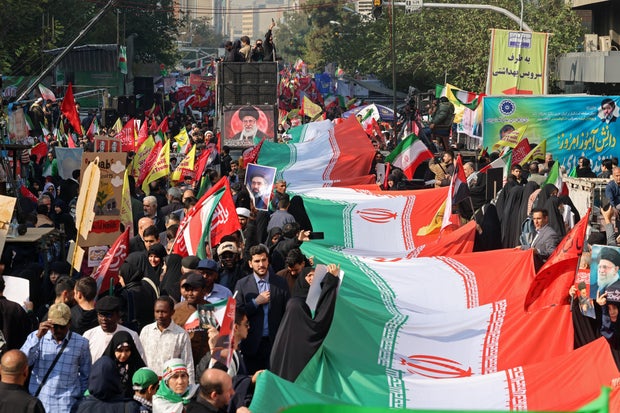
People marched through central Tehran Wednesday in a major pro-regime rally to mark the 47th anniversary of the 1979 takeover of the U.S. embassy in the Iranian capital, chanting anti-U.S. and Israel slogans.
Some held signs calling for revenge for the killing of former Supreme Leader Ayatollah Ali Khamenei at the outset of the ongoing war, while others mocked President Trump.
"We are not happy about the surge in oil prices," said one woman, who gave AFP only her last name, Mahmoudkhani.
"But there is some satisfaction in knowing we are no longer living this torment alone. We, alone, have been suffering under sanctions for so many years," she added.
Some echoed Iranian officials doubts' that the election results would change much for Iranians.
"Whether it is the Democrats or the Republicans, there is no difference for us," Mohammad, a 42-year-old civil servant, told AFP. "The US government's approach toward the Iranian people has unfortunately remained the same over the past 50 years."
CBS/AFP
Statement attributed to Iran's supreme leader plays down hopes of shift in U.S. war policy
A statement attributed to Iran's elusive Supreme Leader Ayatollah Mojtaba Khamenei on Wednesday said anyone expecting a shift in U.S. policy regarding the war with Iran in the wake of the American midterm elections was "seriously mistaken."
"Those who still harbor even the slightest hope that the behavior of the hegemonic system might change through partisan or factional shifts, or who imagine that making concessions to the United States can dissuade it from hostility towards the Iranian nation, are seriously mistaken," said the statement published on Khamenei's website.
Khamenei was named as the successor to his father, former leader Ali Khamenei, soon after the older man was killed in the initial wave of U.S.-Israeli strikes at the outset of the war. U.S. officials believe the younger Khamenei was seriously wounded in the same strike, and he has not been seen or heard from directly at all since being named the new supreme leader.
President Trump has said the war with Iran was partly responsible for the dismal midterm election results for his Republican party this week, but that he does not regret his decision to launch it in conjunction with Israel.
In the message released Wednesday, Khamenei warned that "should such aggressions be repeated, the war's scope will become much wider."
CBS/AFP
Trump says U.S. has no immediate plan to strike Iran, despite being "locked and loaded"
President Trump told the Financial Times newspaper on Tuesday evening that he had no immediate plans to order new strikes on Iran, after keeping the option on the table for weeks ahead of the U.S. midterm elections.
"We seem to be getting everything we want," the FT quoted Mr. Trump as saying, referring to the current stalemate with Iran. While major fighting stopped weeks ago, the standoff has seen the Islamic Republic continue threatening and attacking commercial ships in the Strait of Hormuz, which in turn has kept global oil prices 60% to 70% higher than they were before the war started, driving up consumer costs across the globe.
Asked whether there would be a new attack on Iran later this week, Mr. Trump said "we're locked and loaded if we need to go, but there may be no reason for it."
Despite the impasse, the president claimed the current circumstances were "brilliant," with oil still reaching global markets from the Persian Gulf, including under U.S. military escort through the Strait of Hormuz.
"If you think about it, we haven't really had a war with them in a long time. Six months, maybe more," asserted Mr. Trump.
China says avoiding more conflict in Middle East a "top priority"
China's foreign ministry said Wednesday that avoiding a resumption of the conflict between Iran and the U.S. was a "top priority" in its diplomatic efforts in the region.
"The top priority is to avoid the resumption of hostilities in the Middle East that would bring disaster to the region's people," Chinese Foreign Ministry spokeswoman Mao Ning told reporters in Beijing.
China will "support Iran and the U.S. in resolving disputes through negotiations, promote finding a political settlement to the Yemen issue, to help reach a proper and comprehensive solution for the opening of the Strait of Hormuz," she added.
China is an economic ally of Iran. Chinese purchases of Iranian crude oil amount to nearly 45% of the Iranian government's budget, according to a U.S. government report from March 2025.
Later this month, Beijing will send its Middle East envoy to Iran, Oman and Saudi Arabia for visits "aimed at promoting peace talks (and) easing tensions," the foreign ministry said Wednesday.
CBS/AFP
Lebanese prime minister warns of "risks of renewed war," and of Lebanon being dragged in again
In a message seemingly directed at the Iran-backed group Hezbollah, Lebanon's prime minister warned Wednesday against any moves that could pull the country into renewed fighting between Iran and the U.S. and Israel.
"Faced with the risks of renewed war in the region, I renew my warning of the dangers of dragging Lebanon into a new senseless adventure in service of outside interests," Nawaf Salam said on Wednesday, without explicitly mentioning Hezbollah.
Southern Lebanon has been a major front in the interlinked regional conflicts, with fighting between Iran's Hezbollah allies and Israel's military driving tens of thousands of people from their homes and killing almost 9,000 since Oct. 7, 2023, according to the Lebanese health ministry.
Hezbollah, long a powerful political and paramilitary force in the country, pulled Lebanon directly into the war with Israel by launching strikes on the Jewish state in support of Hamas after the 2023 terror attacks sparked the war in Gaza, and then by firing rockets and missiles in support of Iran after joint U.S.-Israeli strikes commenced on Feb. 28.
The Lebanon conflict has proven to be a major sticking point in negotiations between the U.S. and Iran, as Tehran has consistently rejected any peace deal with Washington that does not also end fighting in Lebanon and Gaza.
A fragile ceasefire agreement reached between Israel and Hezbollah in June has halted most large-scale fighting between the two sides, but Israeli forces still occupy a large section of southern Lebanon, and there are sporadic attacks by both sides.
"We do not accept the country again becoming a theater for the conflict of others," Salam added, saying Lebanon had "already paid a heavy price."
President Trump threatened repeatedly ahead of the U.S. midterm elections to renew strikes on Iran, but he told the Financial Times as the results came in Tuesday evening that he had no immediate plans to order attacks.
CBS/AFP
Four tankers catch fire while transiting Strait of Hormuz, Iran's military says
Four oil tankers caught fire after hitting mines while attempting to pass through the Strait of Hormuz, Iran's military said Wednesday, after it warned no one would benefit from a return to war.
"Four non-compliant oil tankers attempting to pass through the prohibited passage south of the Strait of Hormuz were destroyed after striking naval mines and are still burning," Iran's Islamic Revolutionary Guards Corps said in a statement quoted by state TV.
"Two other non-compliant ships or vessels have also been halted," they said
The attacks come even as a diplomatic push is underway aimed at reaching a deal between the U.S. and Iran. Indirect talks via Qatari, Pakistani and Saudi mediators are understood to be underway.
Although both sides previously expressed some hope of reaching an agreement, Iran's Secretary of the Supreme National Security Council on Tuesday cast doubt on progress toward a deal, calling the U.S. response to their demands "not convincing."
CBS/AFP
Iran says midterm results reflect rejection of war
Iran's chief negotiator said Wednesday the midterm election results mean Americans have rejected the war with his country.
"Americans said NO TO WAR, and we endorse this message," Mohammad Bagher Ghalibaf said in a post on X.
He cited the increased cost of living or "conscience" as two of the possible reasons for the widespread Republican losses in Tuesday's vote.
"If the U.S. govt betrays their public will to serve international paymasters and blackmailers, it will learn our NO comes with a Nightmare," Ghalibaf added.
Trump acknowledges war with Iran partially to blame for GOP's election defeat
President Trump acknowledged on Tuesday night that the war with Iran was partially responsible for the Republicans' defeat in the midterm elections.
In a phone interview with Fox News, Mr. Trump said "part of it was Iran" when explaining the result of the elections, but that "at the same time, people understand the importance of what I've done."
In a separate interview with the The Wall Street Journal, the president reiterated his comments and added that he does not regret starting the war with Tehran.
"I don't think about it. I did the right thing. I would have done it again," he told the newspaper.
Qatar is said to expect feedback from U.S. and Iran on latest peace proposal within 36 hours
Qatari mediators expect feedback within 36 hours from Iranian and U.S. negotiators on new ideas aimed at getting both sides closer to a deal to end the war, Reuters reported Tuesday, citing an official briefed on the talks.
"The mediators came up with a new suggestion to move the process along, and it's currently being studied by the two sides," the official told Reuters.
Efforts to reach a deal to prevent a return to fighting between Iran and the U.S. have ramped up recently. President Trump has said he is still open to an agreement, but has also threatened to resume major U.S. strikes after Tuesday's midterm elections in the U.S.
On the eve of the elections, Mr. Trump again expressed hope that an agreement could still be reached, claiming Tehran wanted a settlement "as soon as possible."
Iranian officials declared Monday that the ball "is in the U.S. court" and they said Iran's core demands to end the war would not be altered.