U.S. concludes 6th consecutive night of Iran strikes as battle continues over Strait of Hormuz
Follow updates on the war in the Middle East for Friday, July 17, here. See earlier developments below.
What to know about the Iran war today:
- The U.S. concluded a sixth consecutive night of strikes on Iran early Friday local time, U.S. Central Command said. White House press secretary Karoline Leavitt said Thursday that President Trump was "not going to sit by and allow these acts of terrorism to take place in the strait without ensuring Iran pays consequences."
- Iran continues targeting U.S. allies in the Persian Gulf in retaliation for American strikes, with state media claiming attacks targeting U.S. military facilities in Jordan, Kuwait and Bahrain early Thursday. There were no immediate reports of weapons hitting American bases.
- Iran's military said Thursday it would target "all infrastructure in the region" if Mr. Trump follows through on his threats to attack Iranian civilian infrastructure, as the U.S. war with Iran continues intensifying.
U.S. completes its 6th consecutive night of strikes on Iran, CENTCOM says
The U.S. completed another round of strikes on Iran early Friday morning local time, U.S. Central Command said in a statement.
This marked the sixth straight night of U.S. strikes on Iran since a fragile ceasefire between the two countries fell apart last week.
Friday's strikes were conducted by fighter jets, aerial drones and warships that targeted "dozens of Iranian military targets such as coastal surveillance and air defense sites, military logistics infrastructure, and maritime capabilities," CENTCOM said.
More than 50,000 U.S. military personnel are currently deployed across the Middle East, CENTCOM added.
Vance blasts claim that Iran sent him private messages accusing Kushner, Witkoff of "abusing" peace talks
Vice President JD Vance blasted a claim as "completely bogus" that alleged Iranian officials had sent Vance a private message during peace talks in Switzerland last month, warning him that President Trump's son-in-law Jared Kushner and U.S. special envoy Steve Witkoff were "abusing" the negotiations and trying to manipulate markets.
"I never received a message like this," Vance wrote on social media Thursday.
The allegation made by the X account "The Hormuz Letter" Wednesday claimed that Iranian officials wrote to Vance that Kushner and Witkoff were "more interested in exploiting insider knowledge to profit in financial markets than reaching a deal."
Kushner and Witkoff have taken part in diplomacy talks with Iran on several occasions, going back to last year, and also brokered peace talks between Israel and the militant group Hamas during the war in Gaza. Vance led the peace talks that were held in Switzerland.
Vance wrote Thursday that "Jared and Steve are trusted members of the president's team and very dear friends. No one has done more than the two of them to work towards peace and prosperity in the region. The idea they're trading on insider information is absurd."
U.S. strikes hit airport, bridges and railway station in Iran, state media says
Deadly U.S. strikes early Friday morning local time hit an airport, a railway station and two bridges in Iran, killing three people, Iranian state media reported.
A U.S. strike on two bridges in the Hormozgan province killed three people and wounded nine, state TV wrote on Telegram, updating an earlier toll.
"Three explosions were heard around the airport and at least one American enemy projectile hit Iranshahr airport," in the southeast, state television agency IRIB said on Telegram.
"A few minutes ago, the Bandar Abbas Railway Junction Station was targeted by the American enemy. According to this report, two Iranians were injured in the attack," the Mehr news agency said on Telegram.
Another U.S. attack wounded one person in the western port city of Bushehr, Iranian state media posted on Telegram.
Marines board commercial vessel in Gulf of Oman
U.S. Marines boarded a commercial vessel in the Gulf of Oman Thursday, U.S. Central Command reported.
CENTCOM said on X that it boarded the M/T Wen Yao "to ensure full compliance" with the U.S. naval blockade of Iranian ports that President Trump reinstituted earlier this week as fighting resumed between the two countries.
According to CENTCOM, since the blockade began on Tuesday, the U.S. has redirected three commercial vessels that tried to dodge it. It has also disabled one oil tanker, the Curacao-flagged M/T Belma.
"The Strait of Hormuz and the surrounding waters remain free and open, except for vessels attempting to violate America's steel wall blockade," CENTCOM said.
U.S. launches another round of strikes on Iran
The U.S. announced a sixth consecutive night of strikes late Thursday in Iran. The strikes began at about 9:30 p.m. Iran time, according to U.S. Central Command.
There was no word on where the strikes took place, but said they were "to further degrade Iranian military capacities."
Loud explosions were heard in Bandar Abbas, in southern Iran along the Strait of Hormuz, according to Iranian state TV.
Just minutes earlier, White House press secretary Karoline Leavitt had wrapped up a briefing in which she was asked about the war with Iran.
"The president is not going to allow them to fire on the ships in the strait," she said. "The president has proved not just to Iran that we can hit them anytime, anywhere, any place."
White House still talking with Iran, doesn't answer if talks are at standstill
White House press secretary Karoline Leavitt would not answer whether President Trump believes the talks with Iran are at a standstill, or even dead, though she did say the administration is still holding peace talks.
"Iran very much continues to talk to the United States of America and express that they want to make a deal with us because they are suffering devastating blows on behalf of our United States military."
Leavitt emphasized the strikes that have occurred every day this week are a direct result of Iran breaking the agreement signed in mid-June.
"The reason for the recent strikes over the course of the last several days is because Iran violated the memorandum of understanding that we struck with them," Leavitt said. "Specifically, in the memorandum of understanding that they signed, they were not to fire on commercial vessels moving through the Strait of Hormuz and unfortunately they have made the tragic decision, for them, to do that."
"President Trump is not going to sit by and allow these acts of terrorism to take place in the strait without ensuring Iran pays consequences for that. And that's what we are witnessing now."
U.S. launches strikes around Iran's Qeshm island, Iranian media reports
The United States has launched new strikes around Iran's Gulf island of Qeshm near the Strait of Hormuz, Iranian news agencies reported on Thursday.
Fars news agency reported an "American missile strike in the vicinity of Qeshm," citing local authorities, while Tasnim news agency said one of its correspondents reported locations around Qeshm "were struck by projectiles from the American enemy."
Qeshm has been a frequent target of U.S. strikes, including multiple strikes in the past two days.
Iranian state TV also reported the port city of Bandar Abbas was targeted by the "American enemy's aggression" on Thursday evening.
AFP/CBS
Iranian ambassador to the U.N. writes letter to human rights commission condemning U.S. attacks
The Iranian ambassador to the U.N. in Geneva, Ali Bahreini, has sent a letter to the U.N. High Commissioner for Human Rights condemning violations by the U.S. in its bombing campaign.
"He warns that the #OHCHR's continued silence in the face of unlawful attacks, civilian casualties, and the destruction of essential civilian infrastructure undermines the credibility of the international human rights system and reinforces perceptions of the selective application of international law," according to a statement from Iran's permanent mission to the U.N.
The letter came as Iran criticized a U.S. strike near Shahid Baqaei Hospital, a children's cancer treatment centre in Ahvaz. The hospital was evacuated late Wednesday, according to Ministry of Foreign Affairs spokesperson Esmaeil Baqaei. He wrote the strike caused "severe suffering and anxiety upon the hospitalized children."
"Those who ceaselessly preach human rights, yet deliberately turn a blind eye to the targeting of hospitals and health centers, have forfeited every shred of moral credibility," Baqaei wrote on X.
Syria says large cache of advanced missiles and drones intended for Hezbollah seized at border
Syria's government said Thursday that state security forces had seized a shipment of "advanced weapons" being smuggled into the country that were intended for Hezbollah in neighboring Lebanon.
In a statement, the Syrian Interior Ministry said "specialized units" "thwarted an attempt to smuggle a large shipment of advanced weapons along the Syrian-Iraqi border, seizing it before it could be brought into Syrian territory."
It said a vehicle parked near the border was "detected under suspicious circumstances" and searched, "resulting in the seizure of a shipment of weapons that included long-range missiles, guided anti-tank missiles, and drones."
"Preliminary investigations, based on the evidence and indications gathered during the operation, established that the shipment was intended to pass through Syrian territory to Lebanon for the benefit of the terrorist Hezbollah militia," the ministry said. "Investigations are continuing to uncover all the circumstances of the case, identify all those involved, and expose the networks linked to it.
The ministry said protecting Syria's borders and safeguarding national sovereignty were "priorities on which there will be no compromise," stressing that it would not allow Syrian territory to be exploited as a transit route or launch point for weapons or activities "that threaten the security of the Syrian Arab Republic or neighboring countries."
Iraq oil ministry denies halt to oil loading operations at southern ports after drone hits ship
Iraq's Ministry of Oil said Thursday that crude oil loading operations at the country's southern ports were continuing without interruption, rejecting reports earlier in the day that all such activity had been suspended following a drone impacting an oil tanker at Basra port.
Oil Ministry spokesperson Salim Al-Rikabi told the Iraqi News Agency (INA) that "the reports circulated by some pages and television channels regarding the suspension of Iraqi oil loading operations from the southern ports due to a drone falling on one of the oil tankers are incorrect."
"Oil loading operations from the southern ports are continuing and there has been no interruption," he said, adding that the State Organization for Marketing of Oil (SOMO) was still investigating the drone incident.
The Reuters news agency, citing four anonymous sources, reported earlier Thursday that a drone hit a tanker at Basra port, shutting down all loading operations at Iraq's southern ports in the Persian Gulf.
INA cited a source with the General Company for Iraqi Ports as saying "the vessel that was targeted by an unidentified drone in territorial waters was outside the scope of Iraqi ports."
Iran planning to impose fees for "environmental damage" on shipping in Strait of Hormuz
Iran's government is preparing to impose environmental compensation fees on ships transiting the Strait of Hormuz, official state news agency IRNA said Thursday, citing the deputy head of the Iranian Environmental Protection Organization.
Ahmadreza Lahijan-Zadeh said the proposed framework would require ships using the strategic waterway to contribute to the costs of repairing environmental damage in the Persian Gulf and Gulf of Oman.
"The government has decided that the cost of compensating for environmental damage caused to the Persian Gulf and the Gulf of Oman will be collected from services provided to ships transiting the Strait of Hormuz," Lahijan-Zadeh said, according to IRNA.
He said a draft regulatory framework — which is still under government review before being submitted to parliament for approval — calculates fees based on factors including the type, tonnage, and cargo of each vessel.
"The amounts received will be used to compensate for environmental damage and restore damaged habitats," he said, adding that more than 22,000 oil tankers typically pass through the strait annually, contributing to pollution in the environmentally sensitive region.
"The Persian Gulf waterway is considered one of the most sensitive habitats in the world, and the presence of mangrove forests and coral reefs increases the importance and necessity of protecting this region," he said.
He also said damage had been caused during recent hostilities, including a roughly 150-mile stretch of coastline he said had been contaminated by oil during the war.
"In some areas where ships were targeted, our colleagues from the Environmental Protection Organization in Bushehr and Hormozgan provinces were present and documented the damages as much as possible," Lahijan-Zadeh said.
India warns shipowners and managers not to send seafarers through Strait of Hormuz
India on Wednesday advised all shipowners, managers and maritime recruitment agencies not to deploy Indian seafarers on vessels transiting the Strait of Hormuz. The order came after two Indian seafarers were killed in suspected Iranian attacks on vessels in the region over the last three days amid renewed fighting between the U.S. and Iran.
"No deployment of Indian seafarers on vessels undertaking voyages involving passage through the Strait of Hormuz until further orders," said an advisory by India's Directorate General of Shipping.
Two Indian seafarers were killed in attacks on two vessels, the MT Al Bahiyah and MT Mombasa, during their attempted transit through Strait of Hormuz on July 14. The vessels were carrying 30 Indian seafarers among their combined crew of 46.
India summoned Iran's senior diplomat in New Delhi on Tuesday to register "a strong protest" over the attacks.
India's shipping agency also ordered "enhanced precautionary measures to safeguard the interests of Indian seafarers serving on board ships operating in the region."
"We strongly condemn these attacks and acts of violence targeting seafarers and disrupting free and safe navigation through international waterways like the Strait of Hormuz," India said in a statement on July 14.
India is the world's third-largest supplier of seafarers, with more than 300,000 sailors working across global commercial shipping fleets, according to government data.
Iran says hospital forced to evacuate due to nearby U.S. strike
Iranian state news agency IRNA said Thursday that U.S. airstrikes targeted several areas across the country's south and east overnight — the fifth consecutive night of American attacks.
Iranian officials said the strikes hit both military and civilian areas, including locations near a hospital in the western city of Ahvaz specializing in the treatment of cancer and blood disorders
IRNA said the Shahid Baghaei Hospital in Ahvaz was evacuated after strikes hit nearby.
"Following the aggressive attack by the criminal U.S. forces near the hospital, we were required to relocate 211 hospitalized patients," hospital director Dr. Majid Bouazar told the agency.
Iranian authorities said several locations around Ahvaz were targeted, while additional strikes hit a wheat storage silo in Hoveyzeh and an area in Dasht-e Azadegan. In Hormozgan province, officials reported explosions in parts of Bandar Abbas, Sirik and Qeshm. Among the sites damaged was a fishmeal factory in Qeshm, according to the report.
Semnan Airport, in northern central Iran, was also struck, but there were no deaths or injuries reported, according to IRNA. Officials said surrounding residential areas were not targeted.
In Tehran, air defense systems were heard operating in several areas early Thursday morning.
President Trump threatened Wednesday to order attacks on Iranian civilian infrastructure. He said he wouldn't issue any specific deadline for Iran to make a deal to end the war before ordering such attacks, but warned the Islamic Republic had "better make a deal," or it would not "have anything left."
Kuwait's army says Iranian drones being intercepted
Kuwait's Army said Thursday that the country's air defenses were "confronting attacks by hostile drones, following the sinful Iranian aggression."
Iran has attacked U.S. allies in the Persian Gulf and wider Middle East repeatedly with missiles and drones this week amid an escalating clash over control of the Strait of Hormuz.
Iranian officials claim the strikes are targeting U.S. military facilities, but most of the weapons are intercepted and there was no immediate confirmation of damage to any American facilities or civilian infrastructure on Thursday.
Iran claims it exported 80 million barrels of oil after signing memorandum of understanding with U.S.
Iran exported around 80 million barrels of crude oil after President Trump and his counterpart signed a memorandum of understanding on June 17, according to the spokesman for Iran's Union of Oil, Gas and Petrochemical Products Exporters (OPEX).
The MoU initiated a ceasefire between the countries which crumbled after less than three weeks amid disagreements over how traffic through the Strait of Hormuz should be managed, resulting in the current escalation of attacks and restoration of the U.S. naval blockade. That blockade is intended to completely halt all Iranian oil and gas sales, and the U.S. military said Wednesday that it had redirected a first ship under the reimposed measures.
OPEX spokesman Seyed Hamid Hosseini said, according to Iran's official IRNA news agency, that the exports helped clear Iranian storage facilities, allowing oil production to resume and preventing potential long-term damage to oil reservoirs.
He said reduced maritime restrictions during the brief ceasefire period improved Iran's export capacity. Previously, limitations on shipping had restricted sales, causing oil storage levels to rise and forcing a reduction in production.
Drone crashes into oil tanker in Iraq's Basra terminal, Reuters says
A drone crashed into a tanker docked at Iraq's Basra oil terminal on Thursday, but there was no damage or fire reported, the Reuters news agency reported, citing four Iraqi oil and security sources.
The officials told Reuters that the flow of crude oil was suspended at all of Iraq's loading terminals after the incident.
Pakistan continues outreach amid "deep concern over the escalation of tensions" between U.S. and Iran
Pakistan is maintaining discussions with Iranian and other regional officials in the hope of drawing the U.S. and Iran back to negotiations, while voicing "deep concern over the escalation of tensions" this week as both countries try to demonstrate control over the Strait of Hormuz.
Foreign Ministry spokesman Tahir Andrabi said during his weekly press briefing on Thursday that "renewed conflict serves no one's interests" and he reiterated the call from Pakistan, which as acted as a key mediator between Iran and the U.S., on "all parties to exercise maximum restraint and refrain from any actions that could further undermine peace and stability."
He said Islamabad "remained actively engaged with key interlocutors across the region in support of efforts aimed at de-escalation, dialogue, and a peaceful resolution," including with a phone calls between Prime Minister Muhammad Shehbaz Sharif and his Iranian and Qatari counterparts in recent days.
During Sharif's call with Iranian President Dr. Masoud Pezeshkian not long after the U.S. and Iran resumed major attacks, the Pakistani leader "called on Iran and all other partners to exercise restraint and refrain from any action that could jeopardize the hard-earned peace achieved over the past two to three weeks."
In a follow-up call on July 12, Pakistan's Deputy Prime Minister and Foreign Minister and his Iranian counterpart, Foreign Minister Seyed Abbas Araghchi, "emphasized de-escalation and diplomacy, and agreed to maintain close communication through diplomatic channels," according to Andrabi.
Tehran threatens regional infrastructure if U.S. attacks Iran's
Tehran warned Thursday it would target regional infrastructure if the United States carried out threats to attack Iran's infrastructure.
A spokesman for Iran's military headquarters said that if the U.S. followed through on the threats, "all infrastructure in the region" would be "crushed under the steel blows" of Iran's armed forces.
President Trump threatened Wednesday to "knock out all their power plants, we're going to knock out all their bridges. Unless they get to the table and negotiate."
CBS/AFP
U.S. strikes, Iran retaliation continuing
The United States intensified its strikes targeting Iran early Thursday, hitting targets farther north as American forces also fired into a ship the U.S. accused of trying to break its naval blockade on the Islamic Republic. Iran retaliated with missile and drone fire targeting Bahrain, Jordan and Kuwait before dawn and warned its attacks may escalate.
Strikes also reached into areas around Iran's capital, Tehran, for the first time in this latest round of violence, showing a widening set of targets for the Americans.
Iran's Revolutionary Guard says it hit U.S. base in Jordan
Iran's Revolutionary Guard Corps said Thursday it struck a U.S. air base in Jordan with ballistic missiles in response to what it described as an American attack near a children's cancer hospital in Iran.
The IRGC said U.S. forces had "used air bases located in Jordan to target various parts of Iran, including the vicinity of a children's cancer hospital" and that its aerospace force responded by "launching two waves of missile strikes" on the bases in Jordan.
Iran says it struck U.S. targets in Jordan, Kuwait and Bahrain
Iranian state media reported that the Iranian military carried out separate drone attacks on U.S. bases and facilities in Jordan, Kuwait and Bahrain on Wednesday.
The army said it targeted the "communication systems and fuel storage facilities of the U.S. military" in Jordan.
The military also said it struck "radar systems, a Patriot air defense system, and fuel storage facilities at Ali Al Salem Air Base" in Kuwait and U.S. military facilities at the Sheikh Isa Air Base in Bahrain, IRIB reported.
Kuwait's military said it intercepted "drone attacks following the nefarious Iranian aggression" and Bahrain's interior ministry urged citizens and residents to "remain calm and head to the nearest safe place."
CENTCOM wraps up latest round of strikes
U.S. Central Command said it has concluded its second round of U.S. strikes on Iranian targets in a single day, hitting air defenses, missile and drone sites, and command centers.
CENTCOM wrote in an announcement on X the wave of evening strikes hit targets in "multiple locations," including the port city of Bandar Abbas.
The military said the goal was to "further degrade Iran's ability to threaten innocent mariners crewing commercial vessels transiting the Strait of Hormuz."
U.S. citizen departs Iran after being barred from leaving for over a year
A U.S.-Iran dual citizen who was trapped in Iran on allegations of espionage and collaborating with a hostile state has departed the country, CBS News learned Wednesday.
The woman, Dena Karari, had been unable to leave Iran since December 2024 due to "bogus charges," her attorney, Jared Genser, wrote on social media. Genser announced late Wednesday that Karari is now free, writing that she is "safe and traveling back to the United States."
Karari was under an exit ban, which means that Iranian authorities refused to let her leave, but did not have her imprisoned.
She was never formally charged by Iran. Although her coercive exit ban expired in April, Iran did not allow her to exit at the time.
She suffered a heart attack on July 8, two sources told CBS News.
Two sources said Karari's name was on a list of Americans that the U.S. State Department had given to U.S. special envoy Steve Witkoff — who is helping to lead U.S.-Iran diplomacy — to press for her release.
President Trump wrote on Truth Social earlier Wednesday that Iran had released a U.S. citizen, but he did not identify the person.
"She is now safely outside of Iran, and in good condition," Mr. Trump said. "The United States of America appreciates this gesture of Goodwill by Iran."
The State Department declined to comment on the situation.
Vance decries Iran "hawks" for trying to "tank the negotiations"
Vice President JD Vance expressed frustration with Iran "hawks" in an interview with Joe Rogan, arguing opponents of diplomacy with Iran have undermined the Trump administration's negotiations.
Vance has long been a skeptic of U.S. military interventions. President Trump said publicly in March that Vance was "philosophically a little bit different than me" on the war with Iran, and was "maybe less enthusiastic about going." In his interview with Rogan, Vance broadly defended Mr. Trump's Iran strategy, but pushed back on some more hawkish voices.
"I'm very frustrated by the Americans and, frankly, by people in other countries who are like, 'You cannot negotiate with the Iranians,'" he said. "Well, then, what is your proposal to get people to stop shooting at ships in the Strait of Hormuz? You can bomb them, you can take away their radar, you can take away some of their drones and some of their missiles, but it's just too easy to fire at ships in the strait. So you've got to actually be willing to talk and to try to figure out the problem."
Vance also argued "hawks" had "misrepresented" and "lied about" the U.S.-Iran memorandum of understanding by arguing it would give Iran much-needed sanctions relief. Vance and other Trump administration officials have insisted that Iran will only get relief it if meets its obligations.
"It's completely made up, and it was done purely in order to politically tank the negotiation," Vance said. "So there's been this interesting dynamic here, where as we've been trying to negotiate, there have been these extraordinarily well-funded efforts to tank the negotiation, to prevent us from reaching a deal, to change American public opinion."
Vance says Iran's "hardliners" and "pragmatists" are in conflict
In an interview on Joe Rogan's podcast, Vice President JD Vance said the Trump administration is doing a "delicate diplomatic dance" with Iran, describing internal tensions between "pragmatists" and "hardliners" that led to the resumption of the war.
"The phase they're in right now is: The hardliners have really, really reacted strongly to all the oil that's coming out of the Strait of Hormuz, and they've basically said, 'We're going to try to shut this thing down, we're scared about losing our leverage,'" Vance said. "Now, the pragmatists in their system are saying, 'This was a mistake, let's keep on talking.'"
Vance — who has helped lead diplomacy with Iran — said "we're trying to talk to the pragmatists, and then, of course when they commit acts of violence, we're responding to it."
Key parts of last month's U.S.-Iran memorandum of understanding are no longer in effect. President Trump declared the two countries' ceasefire "over," and Iran has struck commercial ships, while the U.S. has reinstated a blockade on Iranian ports. The Trump administration also rescinded a sanctions waiver that allowed Iran to export its oil.
The vice president said the memorandum of understanding was "misrepresented more than almost anything that I've ever worked on," and argued the U.S. is still "on the right trajectory."
"It's just going to be really messy, and there's going to be a lot of stops and starts," he said.
U.S. disables ship that allegedly tried to violate Iran blockade
The U.S. military's Central Command says it disabled an unladen oil tanker that allegedly tried to evade the U.S. blockade of Iranian ports, in the first known disabling since President Trump ordered the reinstatement of the blockade on Tuesday.
The Curacao-flagged M/T Belma was "transiting international waters toward Kharg Island," an Iranian island that serves as an export terminal for most of Iran's oil, and "ignored multiple warnings," CENTCOM said in a statement on X.
"A U.S. aircraft disabled the vessel after firing hellfire missiles into the ship's smokestack," CENTCOM said, posting a video that appeared to show a strike on a vessel. "The ship is no longer transiting to Iran."
Trump on Iran: "We'll find out whether or not we settle with them or we just finish it off"
During a defense industry roundtable in Pennsylvania, President Trump said he is still weighing whether to strike a deal with Iran or "finish it off."
"They want to settle so badly. They don't like what we're doing, and they do want to settle," the president said. "We'll find out whether or not we settle with them or we just finish it off."
Emergency sirens sounding in Bahrain
Air raid sirens are sounding in Bahrain, the country's interior ministry said. A key U.S. ally, Bahrain has frequently come under Iranian attack following U.S. strikes on Iran.
The Kuwaiti military also said it has detected four cruise missiles and 21 drones since the beginning of the day Wednesday.
Explosions reported in Bandar Abbas, Iranian state media says
Iranian state media outlets reported that explosions were audible near Bandar Abbas, a port city near southern Iran that has frequently come under attack by the U.S.
U.S. launches second wave of strikes against Iran
The U.S. military's Central Command says it has begun a second wave of strikes against Iran, following a round of attacks Wednesday morning.
CENTCOM did not release details on the extent of the latest wave of strikes.
"The strikes are targeting Iranian military capabilities used to threaten vessels freely transiting through the Strait of Hormuz, an international waterway vital to global commerce," CENTCOM said in a post on social media. "The U.S. military is holding Iran accountable at the Commander in Chief's direction."
President Trump to Iran: "They better behave"
President Trump made brief comments after landing in Pennsylvania for a defense summit, saying he wouldn't give Iran a deadline before the U.S. began strikes on infrastructure like bridges or power plants as he has threatened.
"I don't like giving deadlines, but they pretty much know — they know the story. They better behave," he said, answering a question from a reporter.
Mohammad Ghalibaf, Iran's speaker of the Parliament, issued a strong condemnation of the United States' alleged abdication of the memorandum of understanding. He added the country would not stick to the MOU if they received no benefit.
"A memorandum of understanding is meaningful only when its clauses are valid and in effect," Ghalibaf wrote Wednesday on Telegram. "If Iran is not going to benefit from the memorandum of understanding, we have no reason to adhere to such an understanding. Our armed forces, as always, have complete freedom of action to confront enemy aggression."
Stocks drift on Wall Street as oil prices swing
U.S. stocks are drifting Wednesday following strong profit reports from BlackRock and other big companies and an update on the path of inflation.
The S&P 500 was mostly unchanged. Stocks were nearly evenly split between gainers and losers in the index. The Dow Jones Industrial Average was up 43 points, or 0.1%, as of 1:05 p.m. Eastern time, and the Nasdaq composite rose 0.1%.
Upward pressure on inflation remains because of the war with Iran, which has seen days of back-and-forth strikes by the United States and Iran across the Middle East.
Iran's Revolutionary Guard threatened Wednesday to halt all energy exports from the Middle East because of the U.S. military's blockade to prevent tankers carrying Iranian oil from using the Strait of Hormuz.
"The export of oil and gas from the region will be either for everyone or for no one," the Revolutionary Guard said.
Oil prices swung near their highest levels in a month because of the war with Iran. The price for a barrel of Brent crude briefly topped $86 in the morning before falling back to $84.93 per barrel, up 0.2% from the day before.
U.S. issues sanctions on international network procuring weapons for IRGC
The U.S. Department of the Treasury on Wednesday issued sanctions against seven people or entities "involved in an international network supporting weapons procurement efforts on behalf of the Islamic Revolutionary Guard Corps."
This is the third set of sanctions issued by the Treasury Department targeting procurement networks for the IRGC, the agency said.
Among those sanctioned were two Russian nationals who work for the aviation company Avratek and Iranian national Behrouz Namazi, who is the general director of Nika Jet Company, the department said. Italian national Dounia Ettaib, who was also sanctioned, allegedly helped procure weapons for Namazi.
"President Trump has been clear that Iran must denuclearize," Treasury Secretary Scott Bessent said in a statement. "Treasury will continue to target and disrupt the illicit procurement networks that fund Iran's weapons programs and war machine."
Iran death toll grows to 35, over 300 wounded, health ministry says
The death toll from recent strikes by the United States on Iran has grown to 35, while more than 300 others have been injured, according to Hossein Kermanpour, a spokesperson for the Iranian Health Ministry.
At least 72 people are hospitalized, he added. Kermanpour did not break down the figures between civilians and combatants.
The U.S. military said its bombing campaign hit targets along Iran's southern coast in Bandar Abbas, Khormuj, Ahvaz, Qeshm, Bushehr and Kuh-e Stak — a list that includes several coastal towns and another island near the strait.
Another strike targeted a barracks for Iran's 388th Mechanized Infantry Brigade, which operates tanks and armored vehicles, in Sistan and Baluchestan province, Iranian state television reported.
The report said the Americans fired at least 13 missiles in the attack and that the seven dead included conscripts and career soldiers. A number of troops were wounded.
CBS/AP
Lebanon, Israel conclude two days of "positive" talks: U.S. official
Lebanon and Israel completed a new round of Washington-mediated negotiations in Rome on Wednesday, agreeing to implement the "pilot zones" in southern Lebanon agreed under a recent framework deal, a U.S. official said.
"Talks concluded after two days of productive and positive discussions," the official said, adding the participants "agreed on the structure and guidelines for the pilot zone process, to be finalized and implemented in the coming days."
The U.S.-brokered negotiations took place in the Italian capital over the framework agreement sealed last month after five rounds of talks in Washington, with Lebanese negotiators hoping for progress on an Israeli withdrawal from southern Lebanon.
The deal seeks an end to the war in Lebanon, disarmament of Hezbollah, the deployment of Lebanese troops in the south and for Israeli forces to steadily withdraw from the country, starting with two "pilot zones."
Lebanon and Israel, who have no formal relations, started negotiations after Iran-backed Lebanese group Hezbollah drew its country to the broader Middle East war by attacking Israel in March.
Iran's Araghchi visits Qatar days after Iranian attacks
Iran said Foreign Minister Abbas Araghchi traveled to Qatar on Wednesday to pay tribute to its deceased former emir, days after the Islamic republic launched salvos at the gas-rich emirate.
Araghchi is scheduled to "meet with Qatari authorities and offer his condolences," the foreign ministry said in a statement, following the death on Sunday of Sheikh Hamad bin Khalifa Al Thani, who ruled the Gulf state from 1995 to 2013.
The visit comes amid renewed hostilities between Iran and the United States, which have surged to a scale unseen since an April ceasefire.
Qatar, which hosts the largest American base in the Middle East, said it was targeted by an Iranian attack on Sunday.
Trump to address defense technology gathering as Iran war has reduced U.S. weapon stocks
President Donald Trump is headlining a defense summit at the U.S. Army War College on Wednesday, planning to tout major investments in battlefield technology when the war in Iran has reduced the U.S. supply of Tomahawk cruise missiles and Patriot and THAAD interceptors.
The gathering in Carlisle, Pennsylvania, is organized by Republican Sen. David McCormick.
The White House said the summit is bringing together key leaders in defense and some of the largest global investors to spotlight the importance of national security and identify investment opportunities.
An analysis released in May found that U.S. military contractors will need at least three years to replenish stockpiles of Tomahawks, which are used to strike targets deep inside enemy territory, as well as Patriot and THAAD interceptors, which defend against incoming missiles and drones.
Stocks have dwindled as the U.S. has repeatedly fired strikes on Iran, adding to concerns that American forces would have limited firepower in any potential future conflict with China.
Mr. Trump has sought to correct the shortfall by seeking a historic $1.5 trillion defense budget proposal for 2027. But a package authorizing such spending levels is stalled in Congress, and, even if it eventually moves forward, loads of additional time will still be required to expand production capabilities to accommodate such weapons systems.
2 vessels intercepted by reinstated blockade on Strait of Hormuz, U.S. military says
The reinstated U.S. military blockade on the Strait of Hormuz has intercepted two vessels over the 17 hours it has been in place, according to U.S. Central Command.
President Trump announced he was putting the blockade back in place earlier this week.
"We are reinstating the THE IRANIAN BLOCKADE, so named because it is only stopping Iran's ships or customers from entering or leaving," the president posted Monday morning on Truth Social. "All other countries will have fair and open use of the Strait."
The first blockade ran from April 13 to June 18 and intercepted more than 140 vessels coming into or out of Iranian ports.
Shipping intel firm notes "growing loss of confidence" in Strait of Hormuz route pushed by Trump
There's a "growing loss of confidence" among shippers in using the southern route through the Strait of Hormuz, close to Oman's coast, business intelligence firm Kpler said Wednesday. President Trump has repeatedly urged vessels to use the route despite Iran's threat to fire on any ships that approach the passage.
Kpler said there was a slight increase in strait transits (21 in total) on Tuesday, but that all of the ships used the northern shipping lanes close to Iran, which Iranian officials had urged vessels to take in coordination with its military until Tehran declared the strait completely closed early this week.
But despite the small number of ships getting through, Kpler said, "the security outlook deteriorated further as three additional attacks off Oman were verified, bringing the reported toll to 56 confirmed incidents and 17 seafarer fatalities."
"The absence of Omani route transits highlights a growing loss of confidence in that corridor, while shipping continues to favour Iranian approved routing," it said, adding that while the strait remains passable, "the operating environment is becoming increasingly complex and unstable."
Iranian state TV insists Strait of Hormuz "remains closed to all vessels," says warning shots fired at 2 ships
Iran's IRIB state TV network reiterated the regime's insistence on Wednesday that the Strait of Hormuz remains closed to all vessels, and it said two commercial ships attempting to pass through the strait "illegally" — without coordination with Iran — were targeted with warning fire and stopped.
The report claimed all ships in the area were stationary at various anchorages in the strait, the Persian Gulf and the Gulf of Oman, with no movement toward the strait.
As he announced a resumption of the U.S. naval blockade of Iran's ports and vessels on Tuesday, President Trump also reiterated his assertion that the strait "is open to ALL Ship traffic except for Iran."
While the White House and Iran argue over whether the strait is open or closed, in practical terms, Iran's ongoing attacks and threats have kept traffic through the vital waterway virtually gridlocked. Recent days have seen no vessels transiting the strait with their location transponders switched on, though some have made the passage previously without broadcasting their locations.
There was no immediate confirmation of new attacks targeting vessels in the strait on Wednesday, but Iran has struck at least four ships since Mr. Trump and his Iranian counterpart signed a memorandum of understanding aimed at reopening the waterway in mid-June.
The ceasefire agreed to as part of that MoU has broken down over the last week.
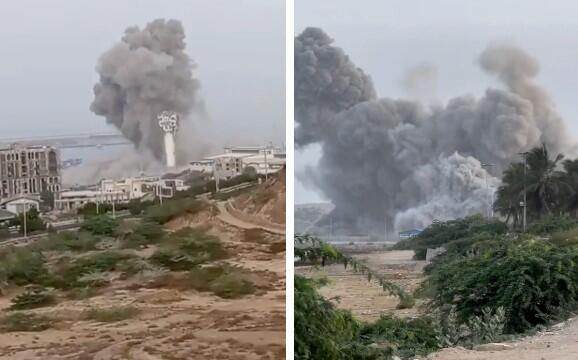
Video shows explosions at southern Iranian port as U.S. announces new attacks
Video verified by CBS News shows a thick column of smoke rising from the Iranian port town of Chabahar on Wednesday.
Iranian state media reported American strikes on the city Wednesday, as U.S. Central Command announced a new wave of strikes.
Chabahar is home to a commercial port about 200 miles east of the Strait of Hormuz, in far southern Iran.
European aviation authority warns airlines not to fly over Persian Gulf region as war intensifies
The European Union Aviation Safety Agency warned airlines Tuesday not to fly through some Persian Gulf states' airspace amid stepped up attacks by the U.S. on Iran, and Iran's retaliatory fire at American allies and commercial vessels.
EASA issued an advisory that it said would remain in place at least until July 29 warning carriers to avoid the airspace of Bahrain, Kuwait, Qatar, the United Arab Emirates and parts of the Gulf of Oman.
It notes that implementation of the U.S.-Iran ceasefire agreed in mid-June - which President Trump declared "over" a week ago, "has been subject to recurrent and significant violations, creating again, a high level of risk across the Gulf region."
"The heightened readiness and activation of national and U.S. air-defense systems increase the risk of misidentification, unintended engagement and collateral effects affecting civil aircraft," the EASA notice says, adding that "unpredictable military developments, combined with the possible use of missiles, drones, combat aircraft and air-defense systems, create a high risk to civil flights at all altitudes."
Price of oil remains over $85 a barrel as war intensifies
International benchmark Brent crude oil was still trading over $85 a barrel Wednesday as intensified strikes in and around the Strait of Hormuz continue hampering the flow of oil and gas through the vital shipping lanes.
Brent crude shot up to $86 a barrel Tuesday, a one-month high, after President Trump announced the U.S. would reimpose its naval blockade of Iran's ports and associated vessels.
Brent was trading early Wednesday at $85.50, while U.S. benchmark Texas Intermediate was selling for just under $80, both still significantly higher than pre-war levels, but below the peak of almost $120 per barrel that Brent hit at the height of the conflict.
U.S. military announces new strikes on Iran
The U.S. military's Central Command announced a new wave of strikes on Iran Wednesday morning, following a seven-hour barrage overnight.
"The strikes are designed to further degrade military capabilities Iranian forces have used to attack commercial shipping in the Strait of Hormuz," CENTCOM said in a statement posted on social media.
The new strikes were announced just hours after the fourth consecutive nighttime assault, with the pace of attacks increasing since President Trump declared the ceasefire over on July 8.
Iranian officials report at least 30 killed, 260 injured in recent strikes
The latest round of overnight U.S. airstrikes on Iran injured more than 260 people, an Iranian health ministry official said Wednesday.
The comment by Hossein Kermanpour, a spokesperson for the ministry, did not include fatality statistics.
In a separate statement, an Iranian government spokesperson claimed at least 30 people were killed in "recent days," without specifying exact dates.
Jordan, Bahrain and Kuwait report incoming attacks from Iran
The Kuwaiti military said early Wednesday morning local time it is confronting "hostile drone attacks" from Iran, hours after announcing it had shot down dozens of drones and missiles and reporting an Iranian strike on a Kuwaiti warship.
Bahrain also said its alert sirens were sounding.
Meanwhile, Jordan's army said Wednesday it had shot down three missiles from Iran, as Tehran pressed attacks on U.S. allies in response to American strikes.
U.S. reimposes blockade on Iran, carries out more strikes
The U.S. military reimposed a naval blockade on Iran and intensified its airstrike campaign early Wednesday.
U.S. Central Command (CENTCOM) said Wednesday morning it had completed a seven-hour wave of attacks across Iran "to further degrade Iran's ability to threaten commercial shipping and civilian crews."
Days of retaliatory strikes across the Middle East by Iran and the U.S., and both nations' attempts to assert control over the Strait of Hormuz, threaten to push the region back to all-out war.
U.S. wraps up 4th consecutive night of strikes, CENTCOM says
U.S. Central Command said it struck dozens of Iranian targets over the course of seven hours Tuesday evening, including missile and drone sites and "coastal defense systems."
The goal was to "further degrade Iran's ability to threaten commercial shipping and civilian crews," CENTCOM said in a post on X after the strikes were completed.
CENTCOM has struck Iran for four consecutive nights.
Trump says U.S. will hit Iranian power plants, bridges next week unless Iranians "get to the table and negotiate"
President Trump told Fox News the U.S.'s strikes against Iran could get "really bad" next week, with attacks on Iranian bridges and power plants.
"We're going to hit them very hard tonight. We're going to hit them very hard tomorrow night. We're going to hit them very hard the night after," he said. "And then next week, it gets really bad for them, because next week comes the power plants, next week comes the bridges."
The president continued: "We're going to knock out all their power plants, we're going to knock out all their bridges. Unless they get to the table and negotiate."
Mr. Trump has threatened to hit Iranian bridges and power plants in the past. Experts say attacks on civilian infrastructure can constitute a war crime, though the Trump administration has said it will hit legitimate targets used by the military.
The president also told Fox News' Trey Yingst his representatives delivered a message to Iran earlier Tuesday, urging them to "make a deal."
"We're being very careful with the civilian population, as you know. But I said, 'You better make a deal, you're not going to have anything left,'" he said.