Why does the air smell weird for some areas in Michigan?

If you stepped outside Thursday morning, took a deep breath, and immediately wondered if a neighbor was burning tires, you aren't alone.
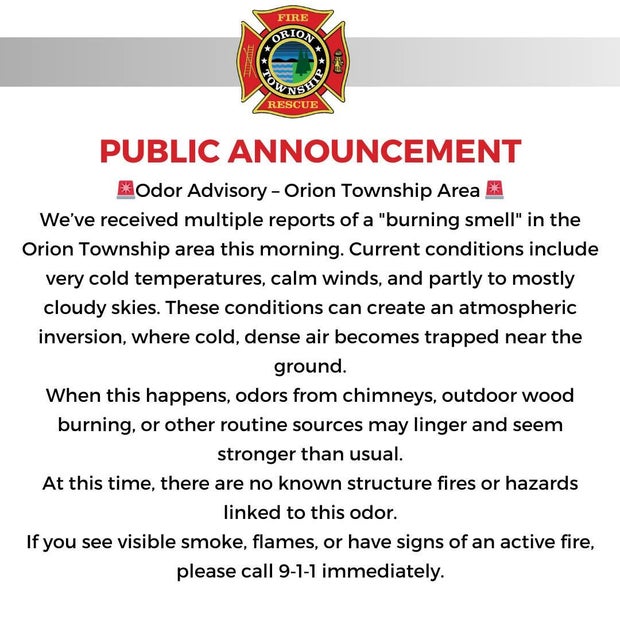
A notice from authorities in Orion Township stated there were multiple reports of a "burning smell" in the area. Officials said there were "no known structure fires or hazards linked to this odor."
We've seen dozens of posts online mentioning a slight stench hanging in the air, especially within a couple of miles of a garbage dump in areas that normally don't smell it.
It's unpleasant, it's noticeable, and you want to know why it's happening. The culprit is actually a weather phenomenon caused by our recent deep freeze.
It is called a "temperature inversion," or atmospheric inversion. To understand why it smells, we have to look at how air normally moves.
Under normal conditions, the air near the ground is warmer than the air high up in the sky. Warm air is lighter, so it rises, acting like a natural conveyor belt that carries car exhaust, chimney smoke, and garbage stink up and away from us. Because of the recent cold spell, the ground in Southeast Michigan has become incredibly cold. This cools the air right near the surface.
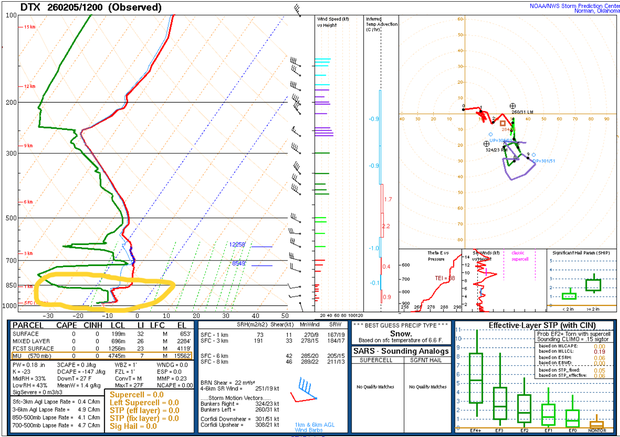
Meanwhile, a layer of slightly warmer air has moved in above us. This warm layer acts like a lid on a pot or a heavy blanket. It traps that cold, dense air right here at the surface where we live and breathe.
You can see it in the image below of a weather balloon launch, called a Skew-T diagram, where the temperature and dewpoint lines are close, then make a sharp jog to the sides.
Because the "lid" is on, nothing can escape. Exhaust from morning traffic, smoke from fireplaces, and emissions from local factories or dumps are currently trapped in the bottom few hundred feet of the atmosphere.
Instead of drifting away, those pollutants and smells are concentrating right in your neighborhood. The longer the inversion lasts, the more concentrated and stinkier the air becomes.
The good news is that this is temporary.
Atmospheric inversions usually break when a weather system moves through to "mix up" the atmosphere.
The good news is that it is soon, and we should see a pattern shift starting over the next two days.
Until then, the air quality might remain a bit lower than usual, and those smelling the stink may smell it still for a little while longer.