Maps show what happened in the 1975 storm that sank the Edmund Fitzgerald 50 years ago

November is a month well known for being a transition month on the Great Lakes.
Powerful storms, intense winds, arctic air and even bursts of warmth all play a role in creating the tumbler of weather the region experiences. The gales of November would go down as another annual weather phenomenon if it weren't for the ship and crew we remember every year on the 10th of November.
The Edmund Fitzgerald is a legend on the lakes, the Queen of the Lakes at the time, and the largest freighter to ever go down.
Unpacking the November storm season
In the month of November, the state of Michigan is in a corridor of higher activity as we transition from summer to winter.
The jet stream aligns well to act as a highway for low-pressure systems to roll through.
Arctic air begins to intrude into the U.S., and these areas of low pressure will ride the edge of these air masses into the region.
While the air is colder, the Great Lakes have not fully cooled from their summer heat and are therefore far warmer, thus providing a "shot in the arm" to storm systems as they arrive.
Side effects of this can be a combination of lake-effect precipitation, strong winds, and significant waves.
What happened during the storm of November 1975
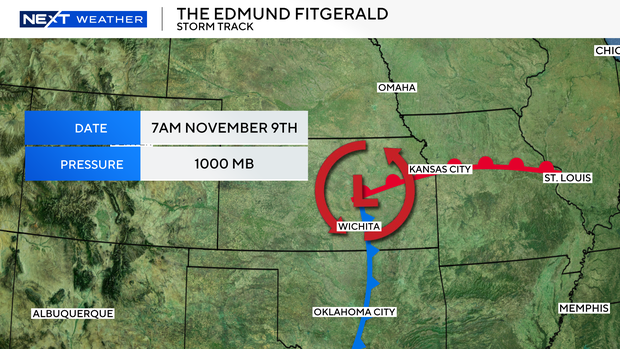
Low pressure began to form to the east of the Rockies on Nov. 8. By the morning of Nov. 9, it had organized over Kansas and begun a trek northeastward.
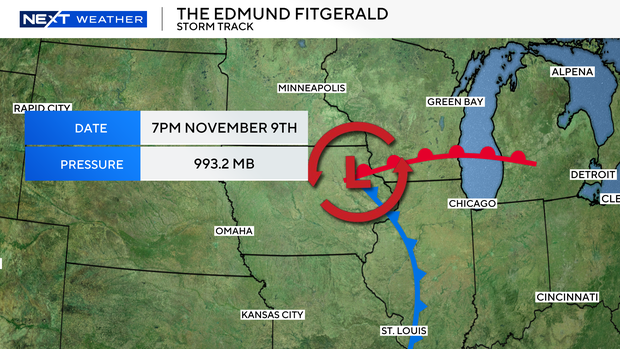
By the evening of Nov. 9, the storm system had strengthened with a pressure of 933 millibars.
As the low travelled northeast over a warm Lake Michigan, it continued to strengthen.
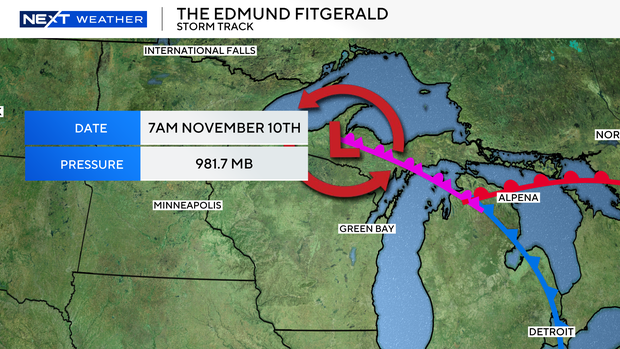
On the morning of Nov. 10, pressure was down to 982 millibars after undergoing rapid intensification.
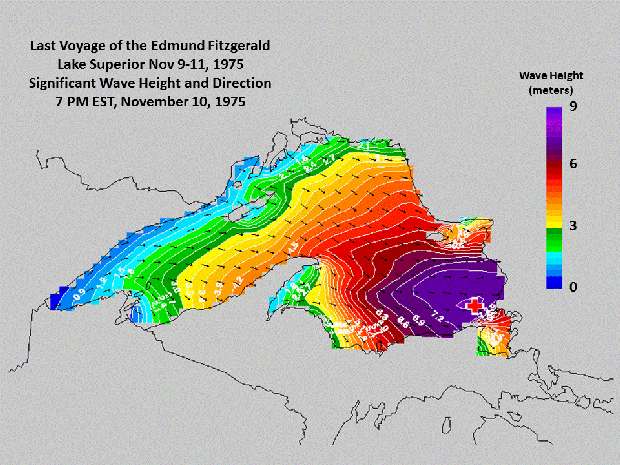
The occluded low pressure brought with it strong gales and intense wave heights that caused significant issues with shipping and would eventually lead to the sinking of the Fitzgerald.
Winds and waves mounted against the Edmund Fitzgerald
Wind speeds of 50 knots were recorded on eastern portions of Lake Superior at the time, approximately 58 mph.
Continual wave heights of 16 to 18 feet were recorded by multiple crews, but peak waves are much larger when they occur.
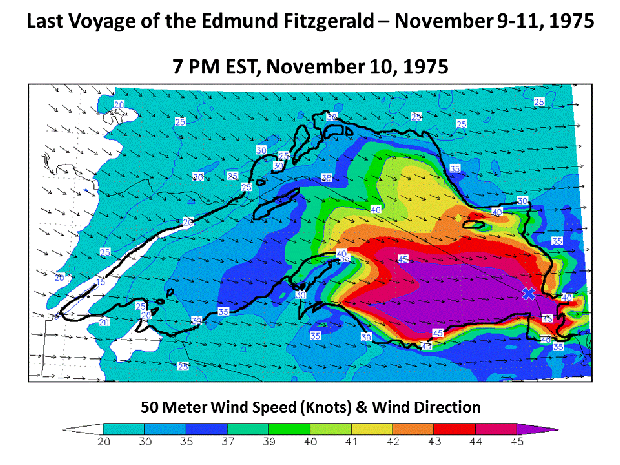
Wave heights 35 feet above the water line battered the Arthur M. Anderson, the freighter famous for being the last to communicate with the Fitzgerald.
Peak waves of 20 to 25 feet were also likely in that area throughout the evening hours.
This storm would be enough to batter other ships on the lakes, but it proved too much for the Edmund Fitzgerald to handle that night.
Improvements with forecasting, monitoring, and emergency alert and response drastically improved on the lakes in the years following.
Forecasts for the different Great Lakes regions on the water can be found on the National Weather Service's website.
For more information on the Edmund Fitzgerald, you can visit the Great Lakes Shipwreck Museum as well as the State Historic Preservation Office.


