Ice coverage surges across Great Lakes; Lake Erie over 95% covered in ice

Winter has officially tightened its grip on the Great Lakes.
The latest numbers released on Feb. 3 confirm what many Michiganders have felt. Ice coverage across the Great Lakes has surged, driven by a recent blast of Arctic air.
As of Tuesday afternoon, total ice coverage on the Great Lakes stands at 48.42%. It's a significant jump that places this year well ahead of historical averages for early February.
While the system-wide average nears 50%, the amount varies wildly depending on which shore you're standing on.
The shallowest waters are nearly solid, while the deep basins are just beginning to catch up.
Here are the official ice coverage statistics as of Tuesday afternoon:
- Lake Erie: 95.33%
- Lake Huron: 77.49%
- Lake Ontario: 37.23%
- Lake Superior: 34.31%
- Lake Michigan: 33.33%
The standout is undoubtedly Lake Erie. With coverage now at 95.33%, the lake has effectively transformed into a frozen sheet.
This extensive ice cover acts as a "lid" on the lake, which will likely shut down the heavy lake-effect snow bands that have plagued western New York and Pennsylvania.
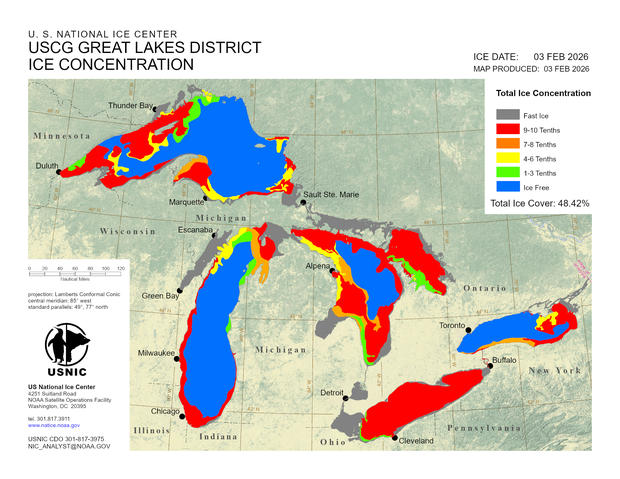
Lake Huron is also posting impressive numbers at 77.49%, likely shutting down lake-effect into the Thumb. Meanwhile, Lakes Superior and Michigan are lagging but growing steadily.
Lake Superior sits at 34.31%, and while this percentage is lower, the sheer volume of ice on Superior is massive.
Historically, Great Lakes ice cover typically peaks in late February or early March, often averaging around 53% for the season.
To be sitting at nearly 48.5% in early February suggests this winter could go down as a "high ice" year, but only if our cold continues.
This stands in stark contrast to the volatility seen in previous years, including the record lows recorded in early 2024.
Looking ahead, we are watching a potential shift in the jet stream that could bring milder air into the region by next week.
If temperatures moderate, we could see some of this thinner ice, particularly on Lakes Michigan and Ontario, break up or retreat.
Please remember, no ice is 100% safe ice. With currents shifting beneath the surface and temperatures fluctuating, people should exercise extreme caution before venturing out.