Residents in Colorado foothills plan for possible evacuations as dry conditions raise wildfire concerns

With no snow cover, the idea of a catastrophic fire is on a lot of minds in Colorado's foothills. In Evergreen, where tiny storms have long melted off, the idea of a fast-moving fire is enough to have some residents preparing in case an evacuation becomes necessary. Getting out is not as easy as getting a go-bag in a car and driving off.
"It's no way to live, basically waiting for the hammer to fall," said Evergreen resident Chris Hanson. Hanson lives on one of the more difficult roads to navigate on a good day, twisting and narrow two-lane Brook Forest Road.
"The Brook Forest area has two paved exits," explained Hanson. Burn piles sit close to the road, left during mitigation efforts by Denver Mountain Parks, which owns a lot of land in the area. However, the piles cannot be burned due to a lack of snow cover. They are a fire risk that ironically were created in an effort to reduce fire danger.
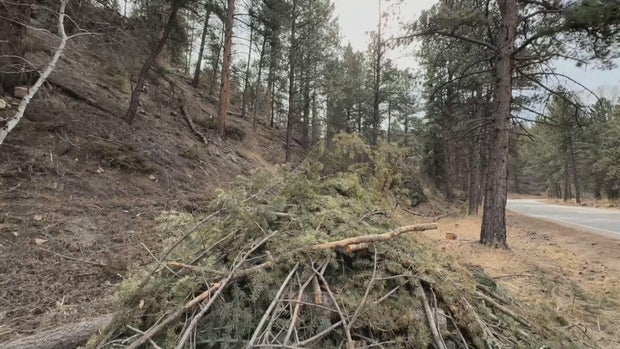
"The key difficulty is how close this is to this road. This is the one escape route for hundreds, if not thousands, of houses up that way," Hanson said.
Brook Forest Road is just one of several areas that top the concern for Evergreen Fire Rescue's Division Chief of Wildland Fire, Jason Puffett.
"We have thousands of piles that need to burn. And we need the weather to cooperate to get that done," said Puffett.
Puffett focuses on risk in all of the 126 square miles of Evergreen covered by Evergreen Fire Rescue. It can take well over thirty minutes to drive from one part of Evergreen to another. The fire department serves 26,000 people, and getting all of those people out in a district-wide fire is certainly a challenging scenario.
"It's probably going to start from outside the district in Forest Service lands and carry through based on wind and terrain," said Puffett.
The main roads out are mostly one lane in either direction, with the exception of Highway 74, from an area just north of Evergreen Lake to Interstate 70. Puffett says it's difficult to predict how long such an evacuation would take, citing the variables involved.
"Our entire district's going to be a challenge. Our entire district is going to take time to get out," said Puffett.
He says the chances are very low, given the large area Evergreen covers. Evergreen's fuel is ripe, and its forests are only partially mitigated. But there has not been a fire over 100 acres in over 100 years.

The Elephant Butte Fire in 2020 was the most recent major fire. Evacuations then proceeded slowly, and only a small portion of Evergreen was evacuated. Puffett said they learned some lessons from the fire.
"One thing we've learned is we need to be more proactive with evacuation orders. We're going to call for pre-evacuations sooner than we have historically," said Puffett.
Partial evacuation is far more likely, he says. To prepare, they have divided the district into 26 plan units. They then looked at the escape routes.
"We looked at evacuation modeling. So we try to build in capacity, number of cars, based on some assumptions. We looked at not necessarily time of evacuation, but impact of evacuation," Puffett explained.
They coded the units red, yellow and green.
"Within that tool, we actually have a roadway prioritization table and we can actually work right down that table and that's our project list for the next five or ten years," said Puffett.
This year, Evergreen Fire Rescue is working along Stagecoach Road and County Road 65 up to Fire Station Number 7.
Some escape routes, like four-lane Highway 74 near Elk Meadow Open Space, appear to be at risk. But with fewer trees along the highway and more grassy areas, flame heights are kept well below seven or eight feet, which would threaten evacuation.
"Elk Meadow has a grass shrub fuel model. What that means is we're going to have flame lengths of about two to three feet, and then it's going to be done," said Puffett. "So I'm not as concerned about that area as I am about other areas with dense large timber that could pose a larger challenge for us and getting folks out in a safe manner."
Getting people to change evacuation habits is another component of a multi-pronged strategy. On May 2, they will conduct an evacuation drill for Beaver Brook, Witter Gulch, and Echo Hills, which has only one exit. Another road out is not serviced by Clear Creek County. It's a two track dirt road on which only the best of four wheel drive vehicles might make it out. Vegetation is extremely heavy.
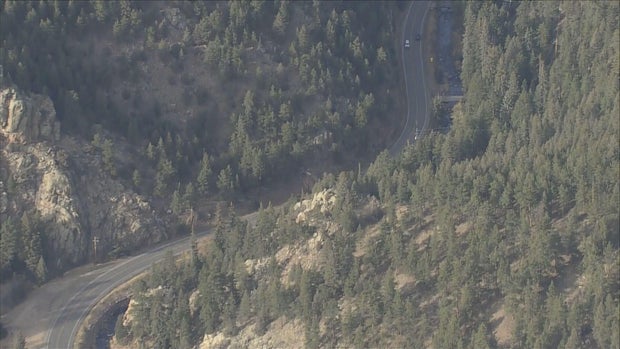
"A roadway used for evacuation can't just be a two track on a map," said Puffett.
The road, Castlewood Court, has a locked gate at its lowest point along Highway 103.
After the evacuation drill, Puffett says they will hold a meeting with participants to gather their feedback. They will identify areas requiring additional mitigation and bottlenecks. He notes that evacuation plans must include key elements, such as the right equipment.
"We have to have the right operational response plans. Our communication plans are all aligned with one another. And then we go through those drills," said Puffett.
He says they want people to plan exit options.
"We want people to use their familiar route that they go to work, they bring the kids to school. The road that they know. That's how we want them to exit the community," he explained.
Plans must be made, but experts know circumstances will change. Roads like Brook Forest could be so loaded up that people might drive on both sides of the road to exit in a real fire threat. That would keep fire equipment from going up the road.
"I'm not planning on getting out on this road. I know this road is going to be a dumpster fire," said Hanson. "So I'm planning a dirt road or a shelter in place in one of the grassy valleys or something like over here, because I just don't expect to safely get out on this road."
Fuels are heavy in the Evergreen area due to the lack of fires over the years. Mitigation is making a difference, but it's been only in recent years that there has been a more serious effort, Hanson said.
"There's not a lot of fault. It's the nature of the beast. We're living in a very dangerous area. All we can do is the little things that try to make it less dangerous," said Hanson.