New Denver report says city is in uniquely positioned in "new era" post-COVID

For many, if not most, cities in America, there's a pre-COVID period and a post-COVID period of existence, and most will never be the same again. But that's not necessarily a bad thing, and a new report shows how Denver is uniquely positioned to thrive in this era.
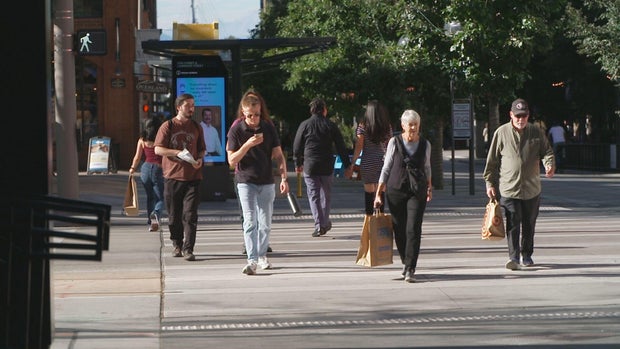
Meet Ruben Chavez from Texas, "I love the city; I wish I could move down here."
And Dean Leichtle from Wisconsin, "If I had an opportunity to move, it would probably be one of the places I would consider."
Like many of the people we spoke with downtown, they're visiting from out of state and share a similar affinity for the city.
"You can hear the music and kind of hear people walking by," Chavez pointed out. "I love it."
In recent years, this was hardly the case, and for several reasons - crime, homelessness, construction, to name a few.
But a new report made by world-renowned urbanist Richard Florida for the Downtown Denver Partnership says Denver's foot traffic has recovered immensely.
"Our overall foot traffic has been performing 90% or above since the fall of last year, and that's looking at Monday through Sunday, morning, noon, and night," said Kourtny Garrett, the president and CEO of Downtown Denver Partnership.
Traffic now looks different, with fewer people officing downtown, but more people coming to the city for fun.
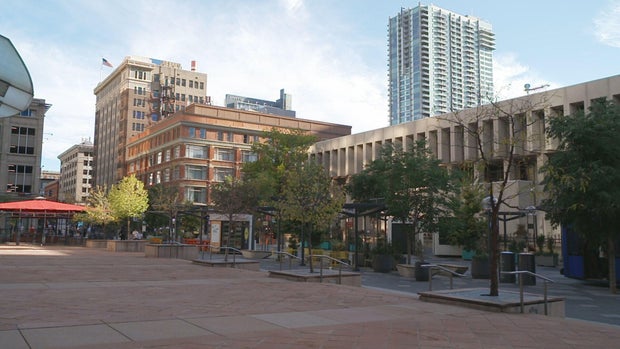
"Visitors, people going downtown to have fun, to work at a coffee shop, to collaborate with their colleagues to have dinner is 60-65% and in many ways, Denver's downtown is really well positioned there," said Florida.
That places a heavy emphasis on the new and improved 16th Street, Denver's arts culture, and sports teams that call the city home - which, again, Chavez reinforces.
"I've been a Broncos fan for as long as I can remember," he said.
Chavez got into town Thursday for the Broncos game and extended his stay through the weekend.
"In many other cities across the country, those stadiums are being pulled out of the urban center and built either in distant urban neighborhoods or in the suburbs entirely."
But this still doesn't change the fact that seemingly everywhere you turn, you can find empty retail space or office space. The Downtown Denver partnership is hoping we'll stop talking about it.
"Just looking at office vacancy as the number one signal of economic health in downtown is false," said Garrett.
While the city's leaders are working to find ways to repurpose commercial buildings and bring more people during business hours, there's optimism about the future of what the Mile High City will become.
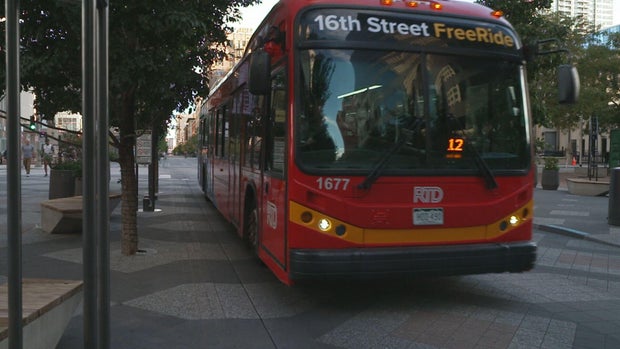
"Denver has continuously reinvented what downtown is," said Florida. And this is just the new period, but this is a big one."
Urbanists are calling it a shift from the "work city to the playground city," and Denver is right in the midst of the conversation.


