Mountain mutual aid system designed in Vail now helps firefighters respond faster across Colorado
As Colorado battles another dangerous wildfire season, getting firefighters to a growing fire quickly can mean the difference between stopping a fire and losing homes.
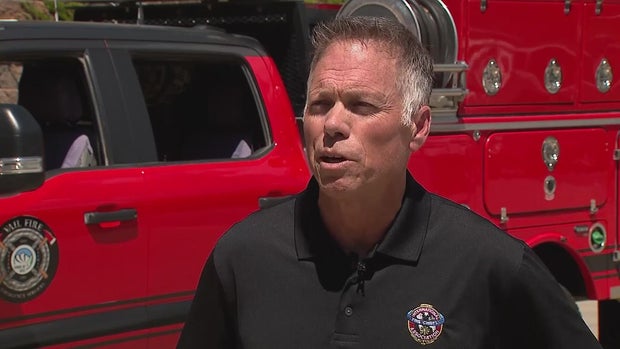
A mutual aid system that started in the Vail Valley is now helping departments across the state respond efficiently. Former Vail Fire Chief Mark Novak said the idea came from a simple question: If a major wildfire broke out in the mountains, who would actually come to help?
The answers Novak received weren't reassuring.
"People kind of gave me answers like, 'Well, we don't really have a system,' or 'We hope,'" Novak said. "Hope's not really a strategy."
At the time, there wasn't a formal statewide system that allowed local fire departments to rapidly send resources across jurisdictional boundaries. Novak began meeting with fire chiefs from northwest Colorado during the winter of 2018 to see if they could build something better. The result was the Mountain Area Mutual Aid System, an agreement among departments in counties including Eagle, Summit, Lake, Garfield, Pitkin, Routt and Grand that strips away much of the bureaucracy often associated with emergency assistance.
"We really just said, 'We're going to agree that when we need each other, we're going to help each other,'" Novak said.
That simple approach allows departments to request nearby engines and crews without waiting for lengthy agreements or paperwork. The need for that kind of speed has only grown as wildfires have become larger and more destructive. Novak pointed to the Buffalo Mountain Fire in Summit County as an example of why rapid response matters.
"Fire started really close to a community," Novak said. "Within a couple of hours, [it] had a lot of structures threatened, and we were able to move a lot of resources there quickly."
The regional system has since helped inspire the creation of a statewide mutual aid network, allowing departments to draw from a much larger pool of firefighters when local resources are stretched thin. Without those agreements, departments often have to request federal resources that may be hundreds of miles away.
"If you called through the interagency dispatch center for more resources, they would look for federal resources that might be a state away or two states away," Novak said. "Getting the closest appropriate resource is really important."
Even with those improvements, Novak believes emergency response still has room to modernize. He said firefighters often lack a real-time system showing where available crews and equipment are located.
"It's really kind of crazy in 2026," Novak said. "Uber has been around for two decades, and we're still using some pretty simplistic systems to track our resources."
Still, Novak stressed that firefighting alone cannot solve the growing wildfire problem. Homeowners and communities also need to reduce their own risk through defensible space, home hardening and forest management.
"If a homeowner is relying on a firefighter standing in their front yard to defend their home, they've chosen the wrong strategy because that may not happen," Novak said.
As Colorado faces another long wildfire season, Novak said the ability to quickly move firefighters across county lines gives mountain communities a stronger first line of defense when every minute counts.


