Colorado mother, daughter homeless following eviction from low-income housing after both became students

A mother and daughter in Douglas County say their efforts to gain an education led to them being evicted.
The pair lived in an Englewood apartment building called Apex Meridian West that is part of the federal Low-Income Housing Tax Credit program.
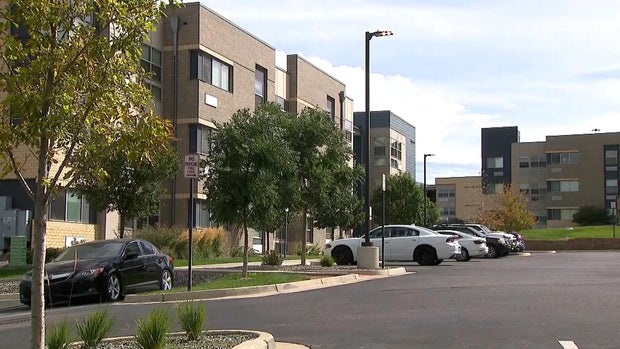
The Colorado Housing and Finance Authority, or CHFA, oversees the program in Colorado, but residents are subject to specific federal eligibility rules. And for this mother and daughter, their troubles came from "the student status rule." A federal rule designed to keep low-income housing from being used as a dorm.
Community College graduation was a proud moment
"Ania Parks!" commencement officials at Red Rocks Community College said. Video capturing the college's May 2025 graduation captured the loud cheers of Ania's mother, Diana.
It was Diana Parks' proudest moment as a mother, made even more special by her own accomplishment.
"That's my baby, that's my baby, you did it Nia!" Diana shouted, right before her own name was called. "Diana Parks," the official said.

Both women receiving their degrees is a major achievement for the mother and daughter, despite what it's cost them.
"We were homeless before we got into Apex," said Ania Parks, who is now 21.
In 2020, Diana Parks and her then 15-year-old daughter Ania moved into low-income tax credit housing at Apex Meridian West. The apartment is part of the Low-Income Housing Tax Credit program, meaning investors get a federal tax credit as long as they are compliant with low-income housing rules.
"Just doing the best I can as a single mom. My daughter's thriving," Diana said, "allowing her to take advantage of all the great opportunities that the state of Colorado has to give with the education system."
By 2024, Ania was a senior in high school, attending Colorado Early Colleges, and Diana, who's disabled and doesn't work, went back to school.
"I have stage four endometriosis, fibromyalgia, I have neuropathy, seizure disorder, bladder condition… as well as heart issues, had a pituitary tumor," Diana said, "I do have these physical disabilities, but I have to do something more."
"From being her caregiver to now, where she's at, I mean, she's been so much better now, health wise, and so I was like, you know, what? Now's the time to go to school," Ania said.
Student status leads to demand to leave housing
But when it came time to re-sign their lease, Diana says she was told they were no longer eligible to live there.
"She's like, you can't have two adult students living here, that's CHFA per student status rule," Diana said.
The student status rule says a household of entirely full-time students may not live in federal tax credit housing. The goal is to ensure low-income housing is not used as a dormitory.
"Like, did you want me to drop out of high school?" Ania Parks asked.
"I don't understand. We're not using it as a dorm," Diana said, "I'm a single disabled mom doing the best I can to further in my life, and that create opportunities for my daughter."
According to Colorado Housing and Finance Authority, or CHFA, the agency that oversees the program in Colorado, there are five exceptions to the student status rule.
CHFA said in a statement:
"Federal program regulations state that housing supported by federal Housing Tax Credits may not be occupied entirely by full-time students, unless at least one of the following exceptions is met:
- A household member receives assistance under Title IV of the Social Security Act.
- A household member was previously in foster care.
- A household member is enrolled in a qualifying government-funded job training program.
- The household consists of a single parent and one or more children, provided the parent is not a dependent of another individual and the children are not claimed as a dependent by a non-parent.
- The household consists of married students who file (or are entitled to file) a joint tax return.
To maintain eligibility, households consisting entirely of full-time students may be required to provide documentation to their property manager demonstrating that at least one of the above exceptions is met."
Diana says she met the exception for a household consisting of a single parent and child, provided the child is not claimed as a dependent by a non-parent.
Apex staff asked Diana to prove Ania is her dependent by sharing her tax return.
But Diana receives Social Security Disability Insurance and is not required to file taxes. Ania had filed her own return for the first time that year, but is not claimed as a dependent by anyone else.

In an email, Apex Meridian West's tax credit compliance manager told Diana they didn't qualify for the exception, saying, "This information is required by the state to be verified through providing a tax return. Because you stated that your daughter filed taxes as Single – she cannot be claimed as a dependent and this exception is not met based on the information you provided."
CHFA's compliance manual does not explicitly state that the child in this exception must be claimed as the parent's dependent. The wording used is "At least one student is a single parent with child(ren). Parent and children must not be claimed as dependents by any other person except the non-resident parent."
The compliance manual also states that third-party verification of this exemption is "Not required, but tax return is recommended."
CHFA said in a follow-up statement to CBS Colorado:
"Speaking generally, documentation is typically required by property managers for tenants wishing to demonstrate an exemption to the student status rule. A tax form is one recommended way to demonstrate an exemption, though not required. However, specific eviction cases are determined by the courts, taking into consideration all of the information and facts of a particular circumstance."
Diana claimed she also met another exception as a former foster child, but didn't provide the apartment documentation.
She did share redacted court documents seemingly confirming her time in the system with CBS Colorado, and says she provided these documents to the court.
As her email exchanges with Apex Meridian West became more heated, she accused the apartment of disability discrimination and declined to share any more personal information.
In a May 2024 email, Diana says, "I will not be providing anything further per our private information.! Requested information is invasive.! No thank you!"
The apartment told the Parkses to move out by late June 2024.
"What do you mean we have to just get up and move?" Diana said.
But they wouldn't leave.
For months, they went back and forth with Apex. Two mediations were unsuccessful.
"I'm like, okay, fine, we'll go to court," Diana said.
In March 2025, the eviction process began.
In court, Apex Meridian argued that both Diana and Ania had agreed to the student status rule in their lease and that they failed to re-certify compliance. The tax credit compliance manager testified that CHFA confirmed the Parkses didn't meet the exception. "Based on the information that was provided to us by Ms. Parks, that we relayed to CHFA, they would not qualify under the student status rule."
Diana couldn't afford a lawyer.
"If I just explain what happened and why we're here, everything will work out well," Diana said.
The judge would not accept the documents she tried to introduce because they were in the wrong format.
The court ruled in favor of Apex.
Diana appealed, and while they waited, she and Ania graduated from Red Rocks Community College. Ania got an associate's degree in Integrative Health Professions, while Diana got certificates in Integrated Healthcare, Energy Medicine and Phlebotomy.
"My name was called and hers was called right after, so we did it together, and I was like, we're gonna do this, and we finally did," Ania said.
After eviction, mother and daughter struggle
In September 2025, Diana's appeal was denied, and two months later, they were evicted.
"Two sheriffs knocked on the door, said, 'Yeah, you're getting evicted,'" Diana said, "Everybody is just grabbing, grabbing, grabbing, grabbing, grabbing, and taking it outside, throwing it out in the parking lot."
With no car, they soon found themselves homeless again.
"What are we going to do? What are we going to do?" Diana said.
For several weeks, they alternated between staying in hotels and walking on the streets.
"We were in a situation, we weren't eating, because we were paying for the hotel, we could barely afford soap," said Diana, "we don't have any more money. Then we don't have phones, because I didn't pay the phone bill, and we can't even call to try to get help."
"You can be at the library all day, you can huddle up, you know, and stay at the storage unit until they close, and you put on the clothes, and you sit, and you watch each other, and it is what it is," Ania said.
They eventually secured an apartment in Ania's name.
"Now we are able to have a safe place to live, a clean, a comfortable, a beautiful home here," Diana said.
But when Diana lost her disability benefits, they could no longer afford it.
For the last month, the mother and daughter have been on the streets again.
"There's a lot of nights we're just walking, just walking, just watching each other," Ania said.
Diana says having an eviction on her record has made it difficult to find housing.
Right now, both women are searching for jobs.
And on top of everything, Diana owes the apartment more than $14,000 in eviction fees and rent for the months they stayed there while the dispute played out, from February through November 2025. Diana says during that time, the apartment refused to accept her rent.
"I went there to the office to give them my rent check for February, and he handed me my check back. He said I can't accept this, and I said, Why not? He says upper management said that we are no longer accepting your rent," Diana said. "I paid my bills, we actually ate, I bought food."
She says she didn't realize she would still owe that money.
"This is unjust, I'm not paying this, you can't do this to me," Diana said.
Diana feels like every system failed her.
"One can't better themselves and move forward in their life and be penalized for that," Diana said, "they're trying to put me in such a space that there's no way from overcoming this, all because we went to school."
Shea Apartments, which owns and manages Apex Meridian West, shared the following statement with CBS Colorado on behalf of Peter Culshaw:
"The matter was thoroughly reviewed, including by CHFA, as well as through the court process, and the resulting decisions were upheld on appeal. Shea Apartments continues to administer its affordable housing programs fairly, consistently, and in compliance with all applicable regulations."
"This whole ordeal has made me question if we belong here, if there's a place for us here, not just in Colorado, but in this country," Diana said, "me and my daughter would want nothing more to close out this cycle and to just have justice, to just have victory, to have things rectified."
CHFA provided background on the Low-Income Housing Tax Credit program, but said it could not comment on the Parks case specifically:
"By way of further background, the federal Housing Tax Credit program was created by Congress in 1986 as Section 42 of the Federal Tax Reform Act. As the allocator and administrator of the Housing Tax Credit program in Colorado, CHFA's role is to serve as the monitoring agency to ensure properties in the program comply with rent and income restriction requirements, health and safety requirements, and other regulations and policies established by the program.
CHFA is unable to comment on any individual case, nor are we directly involved in evictions."
Read the full CHFA compliance manual below:


