Rocky Mountain National Park removing one species of trout in order to add a different species
Wildlife managers and volunteers will be closing more than 14 miles of stream and tributaries in Rocky Mountain National Park on Monday to start a weeklong operation meant to clear new habitat for Colorado's state fish.
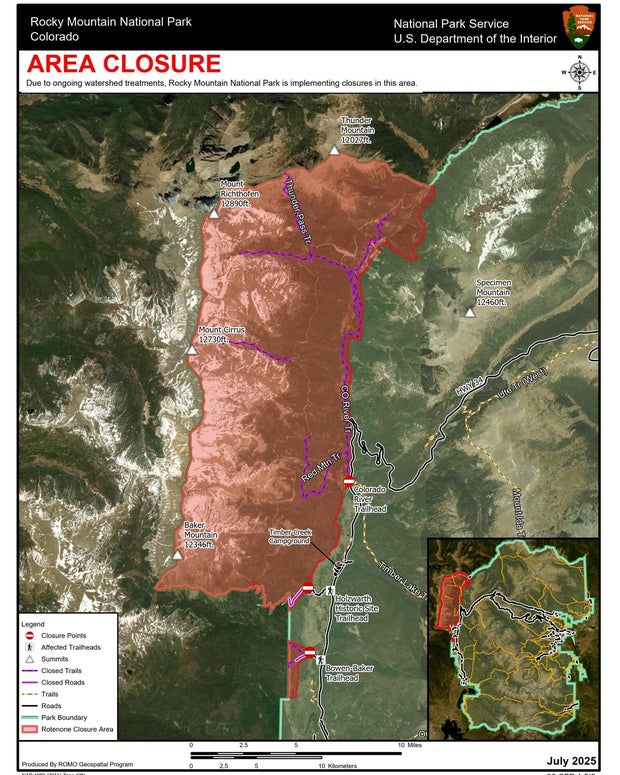
All areas and trails in the project zone -- between the Colorado River Trail and the summits of the Never Summer Range -- will be closed until Aug. 30. The Colorado River Trail is included in that closure.
It is the second phase of the Poudre Headwaters Project.

The goal is to remove brook trout from the Grand Ditch and its tributaries, both upstream and downstream. Aquatic biologists will apply a piscicide, or an organic poison, to the waters to kill the brook trout. Called rotenone, the poison is approved by the Environmental Protection Agency for this purpose and is commonly used by state and federal land management agencies, according to RMNP's press release. The substance degrades naturally over time.
Brook trout typically compete with greenback cutthroat trout, and even prey on the younger greenbacks.
At one point, greenback cutthroats were thought to be extinct. But a handful were discovered in natural habitat at the same time Colorado Parks and Wildlife was raising what it thought were the last remnants of the breed in hatcheries.
The species has been recovering in both settings and is now ready to take on more waterways.
Greenback cutthroat trout is still categorized by federal officials as a threatened species.
According to RMNP, fish stocking in the area began in 1886 to create recreational fishing opportunities. Most of these fish were nonnative trout species which were stocked into historically fishless waters. In 1968, fish stocking ceased inside RMNP. The Poudre Headwaters Project is working to restore greenback cutthroat trout to its native waterways in the Cache la Poudre watershed.
The first phase of the project was carried out a year ago. That operation was very successful, RMNP spokesperson Kyle Patterson told CBS Colorado, but research shows a small number of brook trout still remain.
"These projects can take at least two treatment cycles," Patterson stated.
The project will be led by biologists with the U.S. Forest Service, personnel from CPW and the U.S. Fish and Wildlife Service. This project is supported by Trout Unlimited and Rocky Mountain Conservancy.
The following trails will remain open during the project: East Inlet Trail, North Inlet/Tonohutu Trail, Green Mountain Trail, Coyote Valley Trail, Onahu Trail, and Timber Lake Trail. The Holzwarth Historic Site and Harbison Meadows Picnic Area will also remain open.
Fishing access will remain open in all areas along the Colorado River located south of the Colorado River Trailhead.


