Montezuma County orchard serves up century-old varieties of award winning apples in Colorado
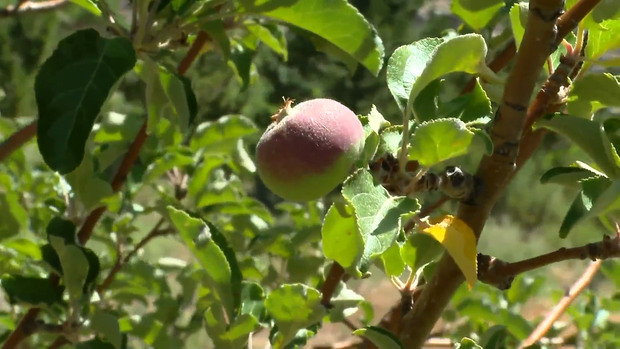
"We actually got some apples!" shouts Jude Shuenemeyer in surprise. Two golf ball-sized apples hang from the branch of a 12-year-old apple tree. A late April frost wiped out pretty much all the fruit which the Gold Medal Orchard just outside of Cortez might hope to produce this year.
"A year like this is rare where everything is knocked out," he said.
The fact that these trees are even here represents a major victory. Twelve years ago, this orchard sat nearly forgotten. A small handful of century-old trees still stood, but the glory days had long passed.
"We know from early county fair records from the 1900s what was grown here" explained Shuenemeyer.
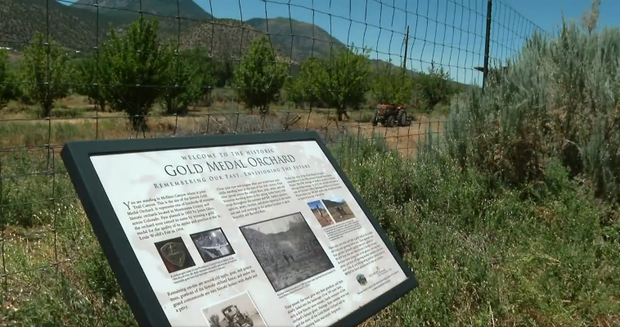
And what was grown here was good. Very good. The name "Gold Medal Orchard" was well-earned. It was first planted in 1890 by Montezuma County Commissioner Jimmy Giles. The orchard grew apples and peaches. Shortly after starting the orchard, he sold it to the Reverend Howard Antes. It was Antes who put the orchard "on the map" so to speak. He took his apples from this orchard to the St. Louis Worlds Fair in 1904. They won the coveted gold medal at the agricultural exhibition. And from then on, the orchard was known as the "Gold Medal Orchard."
Antes sold the orchard in 1920 William Vencil, who operated the orchard mostly by himself for the next 50 years. His daughter Vivian Kenyon recalls riding in her dad's pick-up truck taking the apples from this orchard to market.
CBS Colorado visited the Gold Medal Orchard in 2014 when the orchard was named to Colorado Preservation Incorporated's "Most Endangered Places" list. Kenyon partnered with Shuenemeyer -- a horticulturist with an eye for history and a tongue for unique tastes -- to try to repopulate the orchard with new trees grown from grafts of the few remiaing trees still growing in the orchard. Shuenemeyer readily accepted the challenge.
"It took a couple years to successfully graft and this was a graft of that tree" he said as he examined the two small apples on the tree he planted 12 years ago. "When we started to replant the orchard, this was the first tree we replanted."
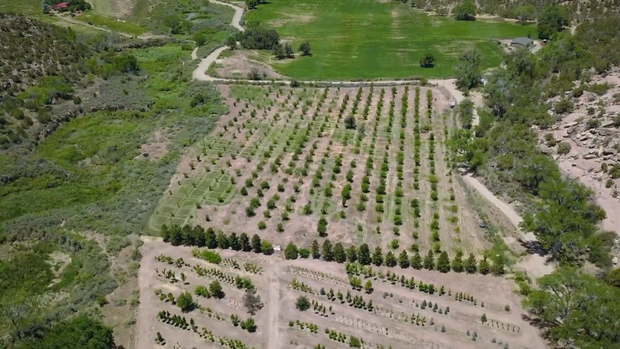
Since then, the orchard has grown to nearly 400 trees, all growing varieties of apples that were thought lost to history.
"There's probably 100 to 150 varieties of apples growing in here that are growing almost nowhere else knew we were finding some of the last of their kind down here and the more we did and the more of that we were finding, the more the realization this was a unique resource down here."
Shuenemeyer has taken these century-old varieties of apples high tech. Through this effort, he founded the Montezuma County Restoration Project, a nonprofit dedicated to discovering, documenting and preserving historical varieties of apples grown in Montezuma county. His restoration efforts can be tracked on an online database.
"If you go on Tree Registry and you can see every single tree growing here in the Gold Medal."
That effort has gone nationwide. Shuenemeyer regularly chats with other arborists from Maine to Washington, looking to identify and catalog historic varieties of apples.
"Every other week we're with a group of people from across the country on Zoom, the historic fruit tree working group of North America, trying to develop DNA profiles, historic pervaiance."
With the trees in the orchard now well-established, Shuenemeyer is turning his attention towards improving the entire ecosystem of the orchard. The trees are set 25 feet apart from each other, as they were when the orchard was first planted. This allows the trees to grow and not compete with each other for resources. The challenge now is to turn the dry, weed-infested ground between the rows of trees into a thriving meadow of native grasses which will help retain water and improve the health of the orchard.
"We want to create an entire meadow where these grasses are going down 10 feet into the soil and taking the water every time it rans down into the soil where it can be absorbed by the roots of the trees."
The goal is to create a model for sustainable, small-acrage orchards which can be grown on small family farms, which Shuenemeyer believes is critical to maintaining the agricultural industry in southwestern Colorado.
"If we're successful, there will be hundreds, thousands of little acres all across Colorado. Most of the fruit from those little acres will be going into farmers markets and produce stands."
He knows they'll never be able to compete with the large commercial growers elsewhere in the country, but that's not the point. "Colorado can grow some of the best quality apples anywhere on earth. We may not be able to grow as many, but we can grow better quality."
And the name -- "Gold Medal Orchard" shows that the quality is there.
"You get to taste something from a tree that someone got to taste a hundred and something years ago and quite possibly will get to eat a hundred and something years from now and all from that same tree."
Donations can help raise awareness of historic places across Colorado, such as the Gold Medal Orchard. More information is available at https://www.coloradopreservation.org/