Denver ambulances took more than 9 minutes to arrive nearly 8,000 times this year

Denver Health ambulances took more than nine minutes to arrive after being assigned to an emergency call 7,865 times during the first seven months of 2026, according to an analysis of ambulance response records obtained by CBS Colorado.
In 202 cases, the wait was more than 20 minutes.
The calls included reports of breathing problems, chest pain, strokes, falls, assaults, sexual assaults, overdoses and other medical emergencies.
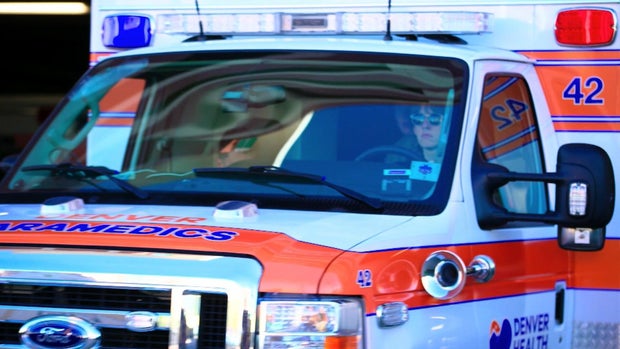
The findings come as Denver firefighters have been documenting their own concerns about lengthy waits for Denver Health ambulances — including instances in which firefighters reported that no Denver Health ambulances were available.
The records also provide a look at a broader effort by Denver officials and Denver Health to change how emergency medical resources are deployed throughout the city.
Denver's 9-minute standard
Denver's operating agreement with Denver Health uses a nine-minute response-time benchmark for Advanced Life Support, or ALS, responses.
The performance criterion calls for an ALS response to go from when an ambulance is assigned a call to when it arrives within nine minutes at least 90% of the time.
The nine-minute benchmark is rooted in the emergency-response framework used by the National Fire Protection Association.
Denver Health has fallen short of the 90% performance benchmark in 2023 and 2024. Its 2025 report to the city reported 82.1% compliance with the nine-minute response-time goal.
Denver Health and city officials have acknowledged that response times are a significant issue and have been working on changes to the emergency medical response system.
In an Aug. 17 letter to CBS Colorado, Denver Public Safety Executive Director Al Gardner II, Denver Fire Chief Desmond Fulton and Denver Health Chief Paramedic Justin Harper said addressing response times and meeting the metrics contained in the operating agreement between Denver Health and the city are among their highest priorities.
The three officials said the agencies have shifted toward a more coordinated approach through the Emergency Medical Response System Advisory Committee, which is led by the Department of Public Safety. They said their goal is to modernize Denver's emergency medical response system.
The officials also said response times remain an important metric but emphasized their goal of getting "the right resources to the right patient at the right time." They said they are consulting with other municipalities and first responders, running models and using data to develop changes.
They said additional solutions will roll out during the next year.
Nearly 8,000 delayed responses
After filing a records request, CBS Colorado obtained a spreadsheet from the city containing 7,865 Priority 1 ambulance responses from Jan. 1 through July 31, 2026. The spreadsheet records the time a first unit was assigned and the time that first unit arrived. A review of those records found that 7,865 took more than nine minutes from assignment to arrival.
Among the responses exceeding nine minutes:
- 3,552 took 10 to less than 13 minutes.
- 1,073 took 13 to less than 16 minutes.
- 342 took 16 to less than 19 minutes.
- 52 took 19 to 20 minutes.
- 202 took more than 20 minutes.
All ambulance responses in the spreadsheet were classified as Priority 1.
The 7,865 responses that strictly exceeded nine minutes amounted to about 18% of Denver Health ambulance responses this year. But factoring in the 90% equation, the number of non-compliant responses is about 8%.
Firefighters were keeping their own records
The ambulance-response records obtained by CBS Colorado are accompanied by something unusual: Denver firefighters were independently tracking ambulance delays.
Records from Denver Fire Station 30, in southwest Denver, show crews maintained their own monthly logs of delayed Denver Health ambulance responses.
The Station 30 logs for January, April and May document numerous delayed ambulance responses.
The April log, for example, includes:
- A 27-minute response to a chest-pain call
- A 26-minute response to an unknown medical emergency
- A 19-minute response to a hemorrhage/laceration call
- A 37-minute response to a lift-assist call
Denver Fire defines Code 10 as emergency movement using all installed emergency warning equipment.
The May Station 30 log includes:
- A 15-minute response to chest pain
- A 15-minute response to a diabetic problem
- A 13-minute response to chest pain
- A 15-minute response to a 93-year-old with a breathing problem
- A 22-minute response to an overdose
- A 17-minute response to a breathing problem
The January log also contains multiple delayed responses, including a 21-minute response to an 85-year-old man after a fall and a 21-minute response to chest pain.
Firefighters repeatedly reported long waits
The Station 30 records are not isolated.
CBS Colorado obtained a series of emails and reports from Denver firefighters documenting other delayed ambulance responses.
On May 13, Denver firefighters reported that a Denver Health ambulance took more than 20 minutes to respond to a Code 10 medical call.
A 27-minute response to an overdose
Another DFD report involved an overdose in which firefighters found the patient not breathing.
According to the firefighter's report, an ambulance was not assigned until 20 minutes into the incident.
The ambulance arrived 27 minutes and 30 seconds into the incident.
That incident was one of the examples Denver firefighters elevated through their chain of command as a concern about Denver Health ambulance response.
Firefighters reported a morning with no ambulances available
On June 21, Denver Fire Lt. Kevin Cain sent an email documenting what he described as a shortage of Denver Health ambulances in the city.
At about 6:30 that morning, Cain said, there were three Code 10-type responses with no Denver Health ambulances available.
"To summarize we had 3 separate calls needing a Code 10 (lights and siren) response and in all 3 instances no ambulance was available," wrote Cain.
Denver Health says the system is under pressure
Denver Health Chief Paramedic Justin Harper said traffic, congestion and construction affect ambulance response.
"Look at what's going on in the city -- the traffic, the congestion that we've seen, the construction that we deal with on a day-to-day basis. It changes how we respond," he said.
Harper said Denver Health is focused on getting resources to the most seriously ill and injured patients. Asked about concerns raised by Denver firefighters, Harper said the agencies could review them together.
"If there are concerns and things they want to look at we're happy to go through that together."
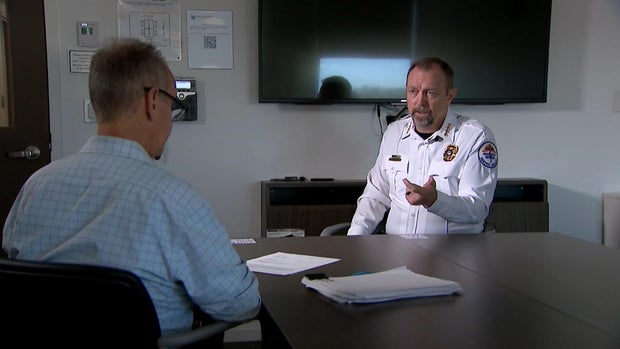
He said what was more important than the response time was the outcome for patients.
"What I'm saying in our system is that the validity of concerns is around patient care, the patient care we deliver."
Harper repeatedly emphasized the goal of matching resources to patients.
"When we measure success in the system it's about getting the right resource to the right patient at the right time."
He repeated that theme numerous times during the interview.
Denver is considering a new response model
The firefighter complaints come as Denver is considering a substantial change to its emergency medical response system.
Documents from the city's Emergency Medical Response System Advisory Committee show officials have been working for months on what they call the Denver Dynamic Response Model.
The proposed model would use the nature and acuity of a medical call to determine what type of response is appropriate.
The concept is to avoid automatically sending the highest level of emergency response to calls that may not require it, while preserving resources for the most serious emergencies.
The August letter from Gardner, Fulton and Harper says the agencies have consulted with other municipalities and first responders across North America, are running models and are using data and medical expertise to develop the future system.
A system in transition
In their August letter, the three agencies' leaders said Denver's emergency medical response system is dealing with staffing and resource needs and that the agencies are working to improve coordination and resource allocation across the city.
They said response times remain an important measure but argued that the system also needs to determine which resources are appropriate for which patients.
"Response times remain a critical metric to track," the officials wrote, while emphasizing their focus on getting the right resources to the right patient at the right time.
Harper said Denver is on the verge of major changes. "We are on the precipice of making major changes to the system that are going to help with exactly what you're talking about- our response times, our system compliance and how we respond."
He also said adding more ambulances is not necessarily the only solution. "To solve the problem of demand you're not necessarily just throwing more resources at it you need to utilize the resources you have more effectively.", observed Harper.
Denver's public-safety leaders say additional solutions will roll out over the next year.


