Colorado lawmakers question use of holding cells in Immigration and Customs Enforcement suboffices
Democratic lawmakers in Colorado are raising concerns about the extended use of holding cells in Immigration and Customs Enforcement suboffices across the state, but the Department of Homeland Security maintains that they serve as temporary holding areas, similar to other law enforcement offices.
Colorado Democratic Rep. Joe Neguse says he attempted to conduct a congressional oversight inspection of a facility at 100 Midland Avenue in Glenwood Springs on Wednesday due to what he called "concerning public reporting [that] U.S. Immigration and Customs Enforcement is maintaining at the unmarked location at least one of nine purported 'secret' facilities holding individuals detained by the agency in the state of Colorado. Neguse said no personnel answered at the doors or answered his calls to the facility, so they were unable to enter the building.
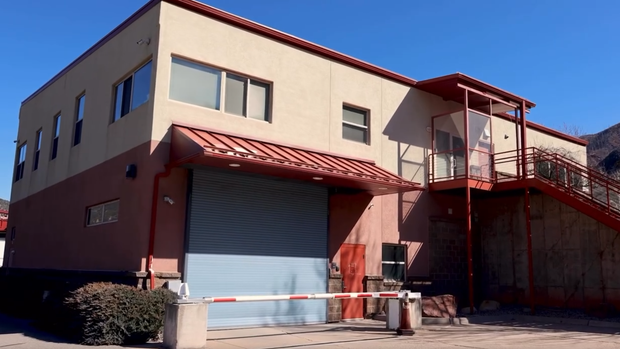
Immigration and Customs Enforcement rejected claims that it's maintaining "secret" sites, stating that the facilities are suboffices that operate similarly to a suboffice at a sheriff's office or police department. An ICE statement provided to CBS Colorado said:
These locations are not "hidden" or "black sites," they are ICE suboffices located throughout Colorado and the country. These offices are where aliens may be asked to check in for appointments and where our officers report for work, conduct investigations, process arrests and may temporarily hold detainees before transferring them to a detention center. Many of the offices have holding cells which conform to all national detention standards and are inspected regularly, they are akin to a sheriff's office or police department suboffice.
On occasion when a family unit is arrested they may temporarily pass through a suboffice before transportation is arranged for them to a detention center with a family housing unit. U.S. Immigration and Customs Enforcement does not separate families or deport U.S. citizens. Illegal alien parents — absent indications of abuse or neglect — can choose to take their children with them, regardless of the children's immigration statuses. Parents who choose to leave their children in the U.S. have the option to designate a third-party caregiver. This has always been the case, and this policy aligns with President Trump's executive orders. This directive simply standardizes the required forms for illegal alien parents.
Yes, suboffices are subject to congressional oversight.
Colorado's Democratic congressional delegation, which includes Neguse, Rep. Brittany Pettersen, Sen. Michael Bennett, Sen. John Hickenlooper, Rep. Diana DeGette, and Rep. Jason Crow, sent a letter to Acting ICE Director Todd Lyons on Friday, asking for information about the use of the holding cells and the specific site on Midland Avenue.
The delegation cited concerns about reports of detainees being held in temporary cells for extended periods without access to appropriate facilities. The letter states that an internal ICE policy allows detainees to be held for up to three days, but claims a person was held in one of those rooms for 39 days.
Read the full text of the letter below.
Dear Acting Director Lyons,
We write to express our deep concern regarding reports of Immigration and Customs Enforcement (ICE) expanding its detention capacity in Colorado by keeping detained individuals in "holding cells" in ICE field offices for days at a time. Detaining people for extended periods of time in small, confined rooms that are meant to be a temporary holding space goes against Department of Homeland Security (DHS) policy, and we demand these actions stop immediately.
In recent weeks, there have been growing reports of ICE keeping detained individuals in holding cells within ICE field offices, which don't have beds or adequate resources for long-term detention.1 Reporting indicates that an individual was kept in these rooms for as long as 39 days. According to data obtained by the Deportation Data Project through the Freedom of Information Act, between January and October 2025, more than 3,000 individuals were held in these locations.
DHS has recognized the safety risks of keeping individuals in these holding cells for extended periods of time. Prior to June 2025, ICE did not allow individuals to be left in these holding cells for more than 12 hours. In June, an internal policy was updated to allow individuals to be held for up to three days.2 We are deeply concerned about the reports that ICE kept an individual in the holding cells for as long as 39 days - well beyond the three-day limit established by the DHS in June, which we also view as unacceptable.
We strongly oppose the practice of detaining individuals for more than 12 hours in holding cells and demand your response to the following questions by March 27th.
1. Is ICE keeping individuals in holding cells in ICE field offices for more than 12 hours at a time? If so, please provide:
a) The number of individuals who have been detained in a holding cell for more than 12 hours, b) The countries of origin of those individuals,
c) The locations they were held at,
d) The length of time that those individuals were in a holding cell, and
e) If any US citizens were among those detained in the holding cells.2. If individuals are being held in ICE field office holding cells for more than 12 hours, what safety precautions are being taken to ensure that the detainee's nutritional, medical, and hygiene needs are being met? Please provide the record logs of when agents supplied food, water, and any necessary hygiene and medical assistance to individuals detained for more than 12 hours.
3. When an individual is held in a holding cell, what documentation procedures does ICE follow to ensure that the detainee's location is tracked?
4. When an individual is held in a holding cell, how does ICE ensure that their legal representation can access them?
5. Have any individuals in ICE custody in Colorado been held in a location that is not the Aurora Detention Facility or an ICE Field Office in Colorado? If yes, please provide the number of individuals held, the locations of the warehouses where individuals were held, and a copy of the contracts that ICE has with those locations.
6. Under Colorado HB23-1100, local government entities are authorized to provide health and safety resources and sanitation services to individuals held in detention. How is ICE ensuring that holding cells in field offices comply with local public health and environmental codes? Specifically, what is the protocol for allowing County Health Departments to conduct inspections for sanitation, food safety, and infectious disease control at these locations?