Colorado could be treated to a rare northern lights display Monday night. Here's how to capture photos of them.

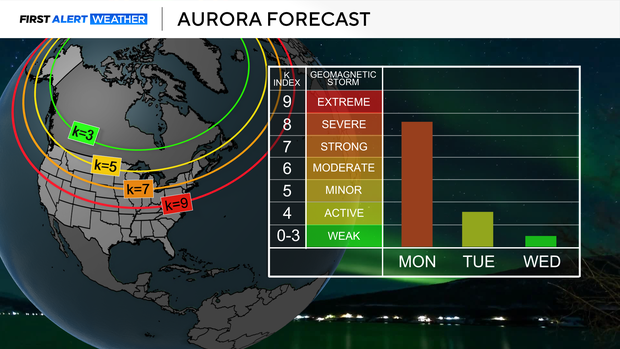
Skywatchers across Colorado may get a rare treat Monday night as increased solar activity could push the northern lights far enough south to become visible in parts of the state. The National Oceanic and Atmospheric Administration says it's "the largest solar radiation storm in over 20 years."
The northern lights, also known as the aurora borealis, occur when charged particles from the sun interact with Earth's magnetic field and upper atmosphere, creating glowing waves of green, red, and purple light. While the phenomenon is typically confined to areas closer to the Arctic Circle, space weather experts say conditions may allow the aurora to reach farther south than usual.
If everything comes together, residents in northern Colorado could catch glimpses of the colorful display late Monday evening and into the early hours of Tuesday.
Aurora forecasts are based in part on the Kp index, a scale from 0 to 9 that measures geomagnetic activity. The higher the number, the stronger the aurora and the farther south it can be seen. NOAA's Space Weather Prediction Center is forecasting Kp values as high as 8 for Monday night, which would be strong enough to bring the lights into regions that don't typically see them.
For the best chance of spotting the aurora, experts recommend heading away from city lights, finding a clear view of the northern horizon, and allowing your eyes time to adjust to the darkness. Even faint auroras can sometimes be captured using smartphones with night or long-exposure settings, or with traditional cameras.
Auroras, however, remain notoriously unpredictable. Clear skies are essential, and cloud cover could block any potential views, even if solar conditions are favorable.
Northern lights forecasts can be found on NOAA's Space Weather Prediction Center website.
Here's how to capture some colorful images:
- Set your camera up on a tripod or prop it up against something. Even the smallest movement, including from the wind, can make the photo blurry.
- Set your exposure to the longest possible setting. In ideal conditions, that could be about 10 seconds, during which you'll want your phone as still as possible.
- On an iPhone, when your camera is open, swipe up to show advanced settings (this may depend on which iOS your phone has), and hit the image of the moon with the horizontal lines, then swipe to the left so it says "Max." If there's light pollution from cities or cars, the maximum exposure could be more like three or five seconds.
- On an Android, in the camera app, swipe the camera mode "More," turn on "Pro," change the ISO to something around 50, and the shutter speed to at least eight seconds.
- It's also recommended that you use the button on a connected headphone or turn on timer mode so the phone doesn't shake when you hit the button to capture the image.
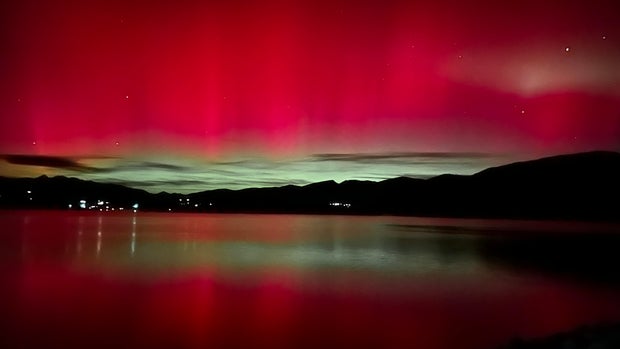
CBS News Colorado staff, readers, and viewers took some stunning photos of the northern lights in November. You can see those here:
If you have photos of the northern lights on Monday night that you'd like to share with CBS Colorado, please upload them here.