Colorado's first rainwater harvesting pilot moves to water court, researchers look to the practice amid drought

Amid Colorado's drought, researchers are hoping to make better use of the rain the state does get.
Coloradans may have heard about rain barrels that homeowners can use for yard irrigation, but the state has also authorized up to 10 pilot programs for large-scale rainwater harvesting.
One Douglas County community was the only one to apply to be a pilot site: Sterling Ranch. The community describes itself as the leader in water-conscious development in Colorado. Sterling Ranch was designed with efficient irrigation and xeriscaped landscapes featuring native plants.
But they're not the only ones exploring how rainwater harvesting could help solve Colorado's water problems.
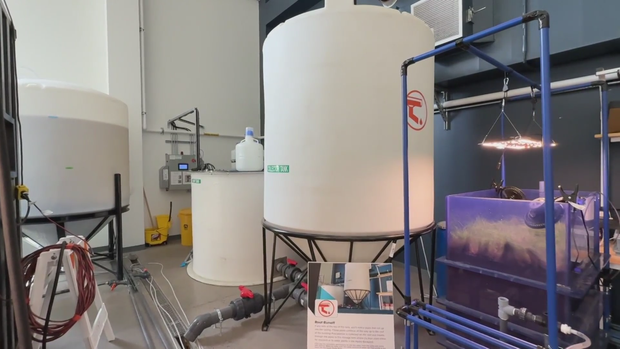
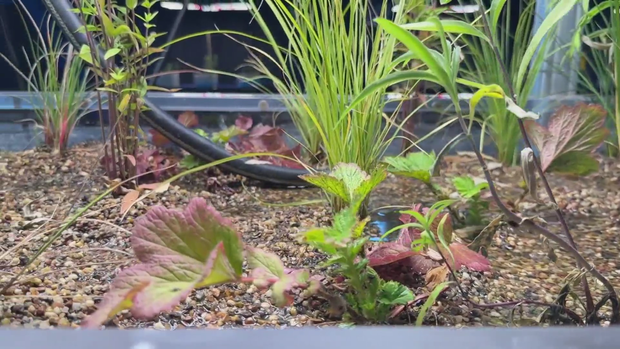
Colorado State University professor Sybil Sharvelle is using the roof of the Hydro Building at CSU Spur to capture rainwater and water native plants outside.
"Water from those roof drains drains down into those black pipes, comes into this tank, then gravity flows over to the next tank and is then, from there, pumped outdoors," said Sharvelle. "We so far have not had to use potable water to supplement the irrigation."
She's hoping to learn how much water can be saved this way and how to navigate challenges like contamination and downstream water rights.
"We've had to develop what's called a water augmentation plan. What that does is ensure that downstream water users are not impaired by our use of the roof runoff at this building. So what we have to do is actually track all of the water that comes into our storage tanks and how much we use for irrigation. We then report that to the Colorado Department of Water Resources, and then they report that to Denver Water," said Sharvelle. "So these projects have been really good for us to learn the processes for properly accounting for these water uses, so that we can be sure that we're not impacting the downstream users."
Sterling Ranch has been preparing to do the same thing on a neighborhood-wide scale for years.
"We're sitting right above what will be Colorado's very first rainwater harvesting basin," said Britta Strother, director of planning for Dominion Water and Sanitation District, which serves Sterling Ranch.
In 2010, Sterling Ranch became the site of the first rainwater harvesting pilot project in Colorado. For the last 15 years, Dominion Water and Sanitation has studied rainfall, runoff, soil infiltration and vegetation use in Sterling Gulch.
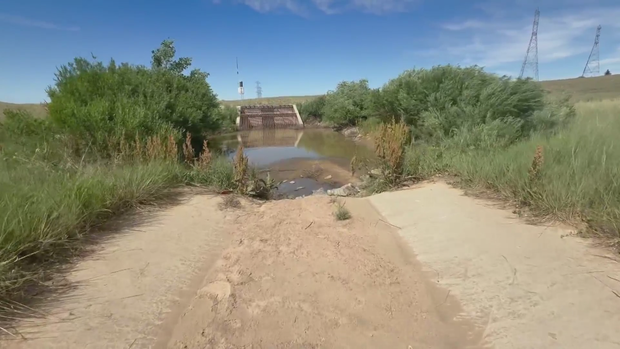
"There is an actual physical berm that goes across, and that is it. That is where the water will flow," said Strother.
Researchers determined that there is enough harvestable rainfall within the Sterling Gulch drainage to support a meaningful supplemental water supply. Now Dominion is in water court, seeking the green light to begin using that water for the irrigation of parks and common spaces in the community.
The pilot's project manager says Dominion's water court filing seeks authorization to harvest approximately 111 acre-feet of water annually.
"We're hoping that someday, when it rains, so not this year, there could be upwards of 400 acre-feet of water stored that will be used for outdoor irrigation," said Strother. "This is, or could be, one of the great solutions for the water supply shortage in Colorado."
Since 2024, CU professor Aditi Bhaskar has been studying runoff from Sterling Ranch, testing quantities of potentially dangerous nutrients like phosphorus and nitrogen to understand the impact of a largely xeriscaped community's runoff on downstream users.
"Sterling Ranch is the only one that's a neighborhood-wide thing, and I think that that's really unique about the project, and it's had a lot of impact because of that scale. I'd like to see a lot more projects at that scale start to come up, so that we can learn more about the potential," said Sharvelle.
Sharvelle wants to keep studying rainwater harvesting so more communities can get the most out of every precious drop.
"This provides another source of water, other than our potable drinking water, and allows us to make use of local water sources as our supplies become more and more diminished," said Sharvelle.
She says that, eventually, the practice may even be used to harvest drinking water. Right now, it is only legal to harvest rainwater for irrigation purposes.
"That is a first step, to use it for irrigation and maybe toilet flushing, like non-potable purposes. But I think there's a lot of movement toward thinking about how we could make use of these water sources for potable applications," said Sharvelle.
Unfortunately, the state's rainwater harvesting pilot program sunset last year.
So, while Sterling Ranch can move forward, other communities would likely need legislative action extending that program before they could start their own programs.


