'We Are On The Decline, Not At The Bottom': Colorado Doctor Looks At Life Beyond Pandemic, But Expresses Caution
AURORA, Colo. (CBS4) - Leaders in COVID research for the state of Colorado are looking at the virus beyond the pandemic but say it's still too soon to completely let our guard down.
"I personally wish we'd held onto mask mandates for a few more weeks, but that's being conservative and saying let's wait until we're really getting down towards the bottom," said Dr. Jonathan Samet.
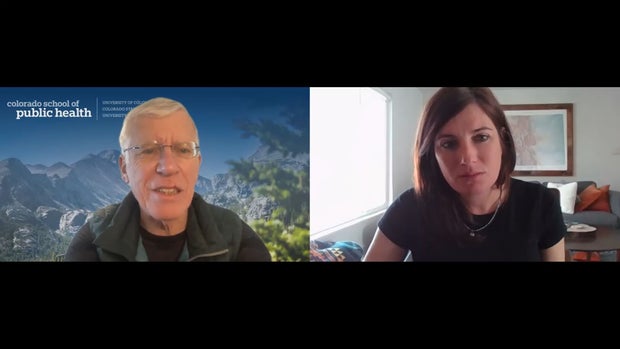
Samet is the Dean of the Colorado School of Public Health and has been leading the modeling efforts on the pandemic for the state. He says while numbers are on the decline, the drop could slow as people attempt to return to normal.
Eventually, he says we will reach the point of an endemic, where we are simply learning to live with the virus.
"How do we manage the virus if we reach that endemic point? I just wanna throw out a note of caution which is that how long the good times will last once we've reached such a high rate of immunity is still a question and we've certainly learned that this virus brings variants that can be nasty. We just lived through delta and now of course we have omicron, hopefully on the run," said Samet.
"The other critical unknown is what will the next vaccine be and when will need to receive it? Sometime in about the next 6 months after vaccination, or after infection, immunity begins to wane and I'm sure will be receiving what will now be the fourth dose and perhaps the fourth of many to come," Samet added.
So where are we now in terms of immunity? Samet believes it's likely more than half of our population has been infected, whether they know it or not.
"I think at this point a very large percentage of the state is immune and in a report we released two weeks ago at that time we estimated 42% of people in Colorado had had Omicron and that by mid-February, that figure would reach about 65%. That combined with vaccine-required immunity puts us in a pretty good place and with that, I'm confident the curve will keep coming down," said Samet.
Not only will the curve continue on a downward trend, but so will hospitalizations, hopefully taking pressure off hospitals in the midst of staffing shortages.
"The numbers in hospitals are dropping and that's what we have tracked very carefully for our modeling. So the number of people with confirmed COVID yesterday, I think was 945 across the state and that number with omicron has been as high as around 1,676, heading for 1,700 and before as high as 1,900, so that number is down," Samet said.
He still urges caution.
"I think that's a distinction that's been lost. I mean I understand everybody wants to say we think the pandemic is over, I mean that's a very conditional idea because we have whatever variants come along to contend with," said Samet.
Still, researchers are focused on that endemic stage, how do we live with the virus with continued surveillance? Samet says it likely won't be with the typical mechanisms in place. Things like wastewater surveillance could be more commonly used along with other types of technology.
"I think we may get other neutrals to track the virus, you know people are working things like how do you capture how much is in the air in different places for example that could be useful for monitoring, so I think we'll see evolution of monitoring technologies for sure," said Samet.