UChicago scientists discover semi-aquatic Jurassic-era otter that could chew and swallow

Scientists at the University of Chicago have revealed a Jurassic-era otter ancestor that appears to be the earliest animal they have ever observed with the ability to chew and swallow.
The creature has been dubbed Megacauda sungei, or "big tail."
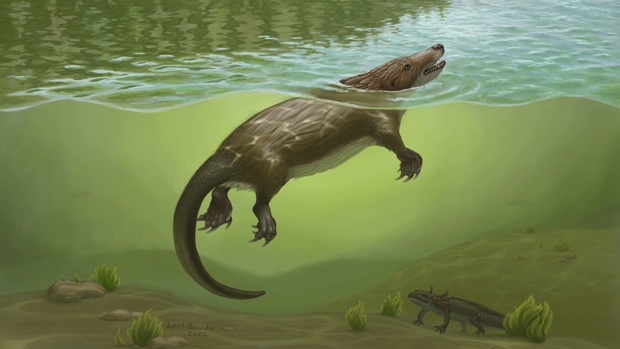
The 165-million-year-old mammal ancestor from China had hind limbs like a platypus and a broad, flat tail like a river otter — which may make it one of the oldest creatures adapted for swimming and aquatic hunting.
Th creature also has the earliest evidence of bony structures of a throat that would have allowed it to eat and swallow like modern mammals do.
"This is an incredibly important evolutionary innovation. After mammals chew their food, be it plants or meat, they all swallow it in the same efficient and effortless way," Zhe-Xi Luo, the Mila Pierce-Rhoads Professor of Organismal Biology and Anatomy at the University of Chicago and senior author of a new study describing the fossil in "Nature" said in a news release. "Once early mammals had this apparatus, each group could develop specialized teeth and diversify into a tremendous range of food resources. They could be carnivores, insectivores, herbivores, omnivores, or anywhere in between."
The U of C explained that all modern mammals, humans included, have hyoid bones linking the mouth and throat passage to the esophagus and larynx. These bones are arranged in a U-shaped saddle, and suspended to the skull by a chain of bony segments, the university explained.
This structure allows mammals to use their throat muscles to chew food one lump at a time, instead of having to gulp down enormous bites or even entire prey animals like an alligator might. The structure also allows baby mammals to suckle their mothers' milk.
UChicago explained that Megacauda comes from the extinct lineage of "docodonts," which are relatives of mammals from the Mesozoic era. Luo and his colleagues found a smaller docodont with similar hyoid bones in 2019, but Megacauda is a larger creature — 40 to 50 centimeters long and 1 to 2 kilograms in weight.
Its palatal and pharyngeal anatomy is similar to the throat muscles of a modern opossum, study co-author Peishu Li, who earned his Ph.D. in Integrative Biology at UChicago and is now on the faculty at Ohio University, was quoted in the release.
Meanwhile, the back legs had long outer digits like a platypus with wide, H-shaped vertebrae and a broad tail outline, indicating that Megacauda was a good swimmer with a "semi-aquatic" lifestyle. The skull and robust canine and shearing cheek teeth indicated that Megacauda could cut and chew meat in its mouth differently from most modern carnivorous mammals, UChicago said.
Megacauda even had bits of vertebrate bones in its stomach, which may have meant it could prey on small animals like salamanders, the university said.
The fossil was found in the Inner Mongolia region of China, and imaged with CT scanning and X-ray fluorescence photography amid the COVID-19 pandemic.
The fossil slab was separated into pieces for scanning, and UChicago scientific artist and CT imaging expert April Neander visualized the creature's structures in fine detail.