A tradition of tranquility and democratized space in Washington Park

At one time, Jackson Park and Washington Park were considered one big green space united by the Midway Plaisance — known respectively as the Eastern and Western divisions of South Park.
Like Jackson Park, and like Central Park in New York City, Washington Park was designed by celebrity landscape architects Frederick Law Olmsted and Calvert Vaux. Washington Park and the rest of the South Park system were designed in 1871, the same year that the Great Chicago Fire devastated downtown Chicago and the Near North Side miles away, and 22 years before the World's Columbian Exposition.
The plan for the layout of Washington Park was almost complete by the time the World's Fair started. When the World's Fair took over Jackson Park and the Midway Plaisance to the east, Olmsted did not want the fair taking over Washington Park too — and it did not.
"There was a period when they were trying to actually move, you know, have some of the fair attractions here," retired Chicago Park District historian and preservationist Julia Bachrach said on a recent visit to Washington Park. "[Olmsted] felt that that was really inappropriate to undo a beautiful finished landscape that took a lot of money and time and effort to create for a temporary fair."
Washington Park stretches from 51st Street on the north to 60th Street on the south, and from Cottage Grove Avenue on the east to Dr. Martin Luther King Jr. Drive on the west. From the beginning, the park has been known for its Open Green, or sheep meadow, where at one time, sheep could actually be found.
The sheep both kept the grass cut and brought some pastoral beauty to gritty, industrial Chicago.
"You know, the city was becoming more industrialized, and a lot of people worked in, you know, pretty intense jobs in factories, and you know, 12-hour workdays," Bachrach said. "[Olmsted] felt when you had time off from work, you really needed a time to really commune with nature and kind of get away from it all."
Spaces such as the sheep meadow were intended to be democratic — the opposite of stratified Victorian society, where classes were kept segregated. People of backgrounds, classes, and races could commune and be exposed to one another in the space, Bachrach explained.
The Washington Park Refectory, at 5531 S. Russell Dr., was designed by renowned architect Daniel H. Burnham and completed in 1881. Today, it hosts meetings, small weddings, and other such events.
But Bachrach said at one time, the South Park Commission met on the second floor of the Refectory and worked on plans for the World's Fair a jog to the east.
Burnham's firm also designed a Chicago Park District administration building in the park off 57th Street and Cottage Grove Avenue, which rose in 1910. This building also served as a police station for a while.
In 1973, the DuSable Black History Museum and Education Center moved into the former administration building. The museum had been founded by artist, educator, and activist Dr. Margaret Burroughs in her Bronzeville home in 1961.
The museum added another wing named for Mayor Harold Washington, Chicago's first Black mayor, in 1993. In the 2000s, the museum began converting a historic roundhouse that was once used as a horse stable into its current incarnation as an event and exhibition space.
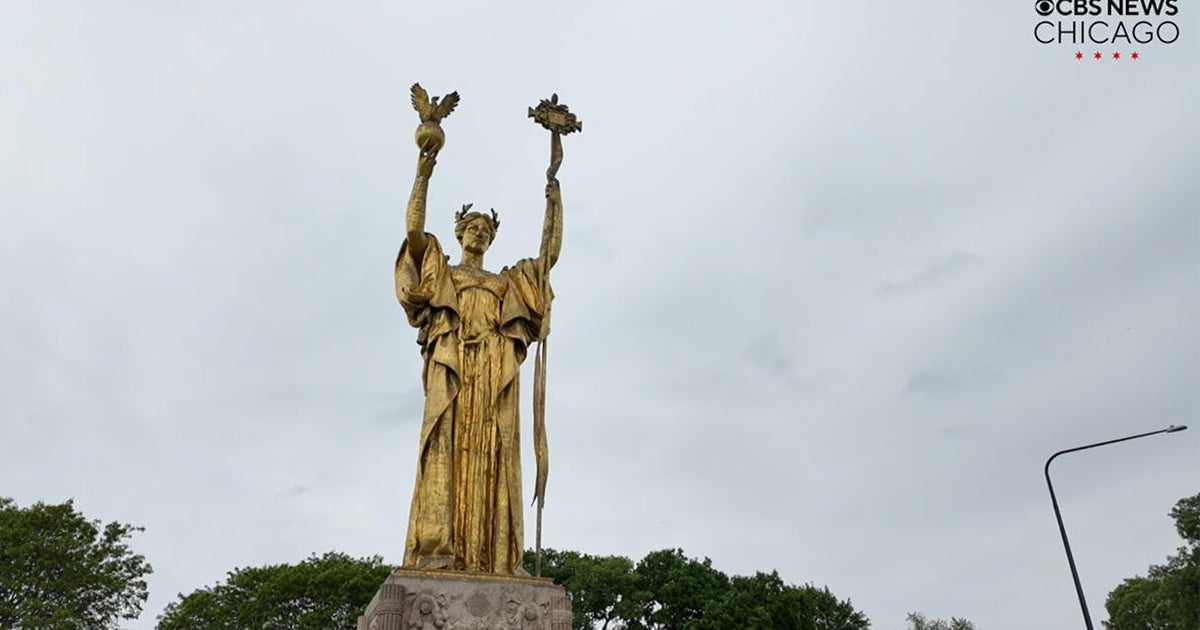
At the east edge of the park where it meets the Midway Plaisance, Lorado Taft's "Fountain of Time" sculpture rises over a reflecting pool, featuring figures that explore the relationship of humanity to time.
In the center of Washington Park is a lagoon, which once weaved in a crescent shape around a peninsula in a configuration that annoyed boaters, but now encircles a central island called Bynum Island.
Bynum Island was once home of Adventure Playland, designed by Chicago Park District landscape architects and featuring a variety of specialized play areas.
"As explained by a 1970 Chicago Tribune article entitled 'Streets Take Second Place to Playground,' its many features included a creativity construction area with large blocks and Lincoln Logs that kids could use to 'build their own forts and walls;' a moonscape with playground equipment emulating 'rockets, satellites, space capsules, and space vehicles;' a section for fishing; slides, glides, swings and ziplines; and a pre-school area with an amphitheater for storytelling and puppet shows," Bachrach wrote on her website.
Over time, the playground, which was expensive to staff, ended up falling into disrepair. Everything except the amphitheater was removed in 1990, but Bynum Island still hosts natural areas and is used for family camping and fishing programs, Bachrach wrote in 2021.
Had the International Olympic Committee made a different decision back in 2009, Washington Park would have been radically transformed — with a $400 million, 80,000-seat stadium for the 2016 Summer Olympics. But the 2016 Olympics were awarded to Rio de Janeiro, and the stadium was never built.
Instead, the park remains a place of tranquility with a proud history and many areas that look much the same as they might have a century ago.