Northwestern scientists find long-elusive wind emitting from Milky Way galaxy's central black hole

Scientists have understood for years that black holes should produce wind or streams of gas as they consume matter, but a search for such a wind around the central black hole of the Milky Way galaxy had been coming up fruitless for more than 50 years.
That shas now changed, and astrophysicists at Northwestern University are to credit for the discovery.
Black holes are enormous concentrations of matter packed into minuscule spaces, as NASA explains. The gravity beneath the surface of a black hole, or the event horizon, is so strong that nothing can escape — not even light.
Most black holes are composed of the condensed remnants of a star that has collapsed. NASA explains that contrary to popular perception, black holes are not "cosmic vacuum cleaners" that suck in other matter, but they do capture anything that passes too close — whether a wayward star or a photon of light, the National Science Foundation explains.
A long-accepted understanding of how galaxies evolve indicates that as black holes consume matter, they should emit wind or jets, Northwestern explained. Captured material spirals faster and faster inward in a black hole until nearly reaching the speed of light, creating energy that would fling some of the hot and fast-moving matter outward as wind or jets, Northwestern said.
Even if a small amount of gas falls into a black hole, the result should be the generation of energy sufficient to push material out.
But scientists were never able to confirm such wind coming out of Sagittarius A*, or Sgr A*, the black hole at the center of the Milky Way. Astronomers did spot evidence of past eruptions from Sgr A*, but had trouble detecting any current winds, Northwestern said.
Sgr A* would have been a unicorn among black holes without wind, and researchers said realistically, a black hole without wind is not possible at all.
"Unless a black hole exists in a perfect vacuum, it must blow a wind somehow," Northwestern research assistant professor Mark Gorski, who co-led the study on the topic, said in a news release. "And there is no perfect vacuum in the universe."
Scientists suspected that the reason wind wasn't being detected from Sgr A* was because it was in a quieter phase and just very hard to see.
But Northwestern scientists were nevertheless able to get a closer look. Gorski and his colleague, Northwestern physics and astronomy professor Elena Murchikova, used five years' worth of extremely deep observations from the Atacama Large Millimeter/Submillimeter Array (ALMA) radio telescopes in Chile.
"To observe our own black hole, we have to look through the plane of our galaxy," Murchikova said in the release. "That means we have to peer through gas, dust and ionized structures, and you can't really see through all of that easily."
But the ALMA telescope observations were up to the task. The image of Sgr A* reflected gas located within just one parsec, or around three light-years, of the black hole.
Gorski and Murchikova then used a calibration method to remove interference from the black hole's radio signals, resulting in an image 100 times deeper and 80 times sharper than past maps. This revealed features that could not be seen at all before.
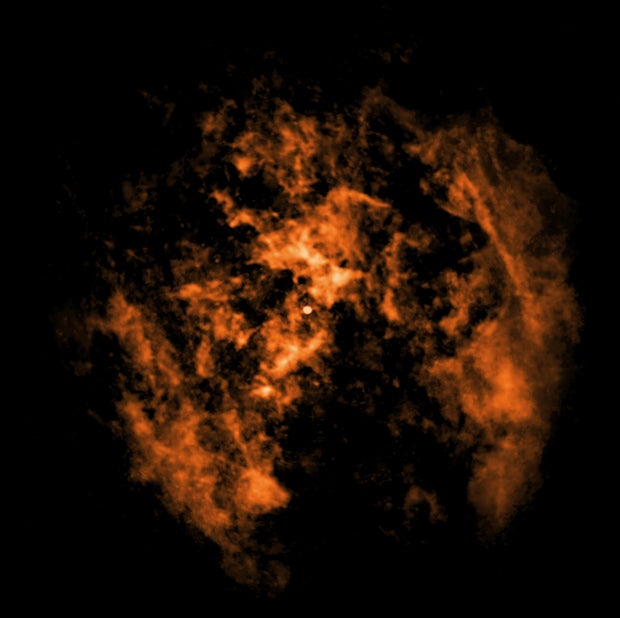
One of those features left Gorski and Murchikova "gobsmacked," Northwestern said. It was a cone-shaped cavity about one parsec long and 45 degrees wide with no cold molecular gas to be found.
Only a hot, energetic wind — exactly what the researchers were trying to find — could have created such a cavity, Northwestern said. When the hot wind blows, it either sweeps away or heats up the cold molecular gas that was absent from the cavity.
"If you blow hot material from the black hole, it's not going to want to exist with the cold material," Gorski said in the release. "It's either going to push the cold material out or heat it up. And, if it's too hot, you will no longer see the cold gas."
Other sources, such as stellar winds, would not have the energy sufficient to carve out such a cleanly-swept cavity, Northwestern said. Even all the combined power of the stars in the area would not have been able to do it. It had to be a black hole, scientists said.
But this observation and set of deductions was not enough for Gorski and Murchikova to conclude they had solved the 50-year-old mystery of the wind of Sgr A*. They looked at other data to confirm their results, noting that NASA's Chandra X-ray Observatory had in the past pinpointed bright X-ray emissions where the molecular gas-free cavity was — which was another layer of evidence of the wind they thought they'd found.
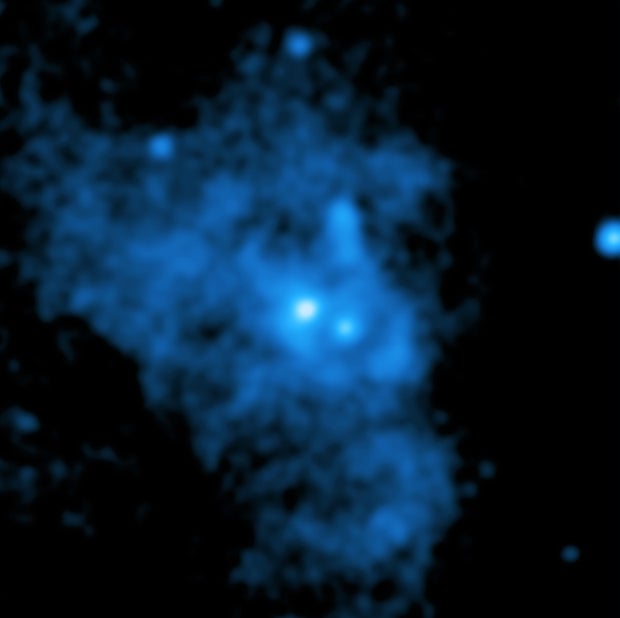
"When you find something that no one has seen before, the first thought that runs through your mind is not 'Oh my god, we made a discovery,'" Murchikova said in the release. "It's 'Oh my god, what's wrong with my analysis?' But when we overlaid our image with the X-ray image, it started to make sense."
Gorski and Murchikova believe the wind stream from Sgr A* has been active for at least 20,000 years. They said it is also relatively quiet compared with the supermassive black holes at the center of other galaxies.
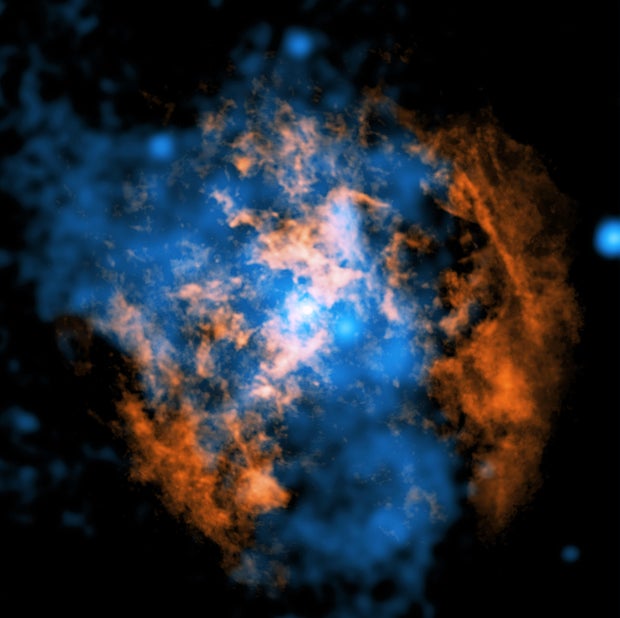
The study, "The discovery of a large active wind from the Milky Way's central black hole," was published Thursday in The Astrophysical Journal Letters. The study was supported by Northwestern's Weinberg College of Arts and Sciences and the Center for Interdisciplinary Exploration and Research in Astrophysics (CIERA).


