Northwestern astrophysicists develop method for detecting distant planets in space telescope images

A team of astrophysicists from Northwestern University has developed a new method to cut through the bright glare of starlight that blocks some distant planets from the view of NASA's James Webb Space Telescope.
The method combines physics-based modeling and techniques used in machine learning. It corrects for minuscule imperfections in the telescope that make it difficult to find faint objects in space, Northwestern said.
The team of Northwestern researchers applied their method to existing images from the James Webb Space Telescope and improved its sensitivity by as much as 15 times, Northwestern said. The result was the sight of a giant exoplanet that could not be seen without the method being used.
The method could be used to find other planets that are small, cold, or faint, Northwestern said.
"Planets are a million times fainter than their stars," Northwestern's Rodrigo Ferrer-Chavez, who led the study, said in a news release. "So, to image exoplanets, we need to remove that glare. That is a very tricky problem because even the tiniest changes in the telescope can affect how that glare appears. Slight shifts or tilts — even on the scale of just a few nanometers — can change the pattern of light. Our method models how light travels through the telescope and accounts for those tiny changes, allowing us to remove the glare much more precisely."
Northwestern explained that unlike stars, planets outside our solar system are hard to photograph. The university compared the process to "trying to spot a firefly hovering next to a blazing floodlight."
The James Webb Space Telescope and other high-power telescopes use specialized instruments called coronagraphs, which block starlight to detect faint objects. But even this is not sufficient for everything, as the starlight is not completely blocked and the hazy pattern that results can still obscure distant planets.
Astronomers thus must use image-processing techniques to remove the glare.
"For the past 20 years, astronomers have tackled this problem by observing a different star and using its image as a reference," Jason Wang, an assistant professor of physics and astronomy at Weinberg, said in the release. "Then, they subtract that reference image from the original observation to remove the unwanted glare to reveal faint planets that otherwise might be hidden."
But even this results in something less than perfect. Telescopes do not stay perfectly still, so nearly imperceptible changes caused by wobbling alter the resulting images of starlight. As a result, the reference image used in the image processing techniques used for the past 20 years never quite matches the original observation.
"We try to make telescopes extremely stable, but there are extreme engineering challenges that we haven't quite solved yet," Wang said in the release. "There are known causes of instability and unknown causes. Small thermal changes could cause a mirror to expand or contract by a picometer. Telescopes like JWST have cryocoolers to keep the instrument super cold. Those coolers have little motors that can cause the mirrors to vibrate. So, there are issues like those but also issues that we still don't understand as we learn how to build these complex telescopes."
The Northwestern team worked to correct for these problems by making it so reference photographs don't have to be relied upon alone. The team's method is called Physics-based Learning for Imaging Planets — FLIP for short — and it creates a "digital twin" of the telescope that simulates how starlight travels through the real telescope's mirrors and gets to its detectors, the university said.
To fine-tune the parameters in the digital twin so as to account for those minuscule wobbles and distortions in the real telescope, the method uses computational techniques similar to those for training AI models — though it does not actually use AI.
Researchers repeatedly adjusted the digital twin telescope until it closely matched the observation from the real thing, intrusive starlight and all. Afterward, the researchers removed the simulated glare.
The researchers tested their approach using past images from the James Webb Space Telescope. They looked at images of two stars with known planets in orbit — HIP 65486 and 51 Erdani — and a third star with no known planets, TYC 5899.
The researchers discovered 51 Erdani b, a giant planet beyond the solar system that had previously been undetected in two-year-old James Webb Space Telescope data. 51 Erdani b was not unknown — it had been spotted before with ground-based telescopes — but conventional image processing from the James Webb Space Telescope could not make it detectable, Northwestern said.
The FLIP method changed all this.
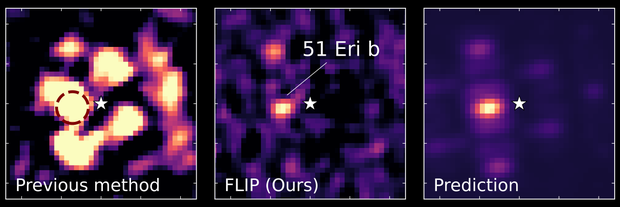
Researchers hope FLIP will lead to more discoveries of planets that have been hiding in existing observations. It could even help shape the next generation of telescopes for searching for planets, Northwestern said.
NASA's proposed Habitable Worlds Observatory seeks to photograph Earth-like planets orbiting distant stars that are similar to the sun. To make that work, the telescope may need to be kept from wobbling at the picometer scale. A picometer is a trillionth of a meter.
The FLIP method could make it so that engineering solutions to prevent wobble are not necessary.
"We know of no planets around other stars that are like those in our own solar system," Ferrer-Chavez said in the release. "It's not that they don't exist. It's that we cannot see them. Every time we improve our techniques, we discover new types of planets. By finding more planets, we can better understand how planetary systems form and evolve, and ultimately how typical our own solar system truly is."
The study, "Imaging exoplanets below the telescope stability limit," was published Wednesday in the journal Nature.


