"Little Pac-Man" capsules can gobble up particles in turbulent systems, UChicago-NYU team finds

Back 45 years ago, video arcades around the country were places of turbulence and chaos, as young people with pockets full of quarters flocked to the Pac-Man machines and maneuvered the joystick until (with apologies to Buckner & Garcia) they had calluses on their fingers and their shoulders were hurting too.
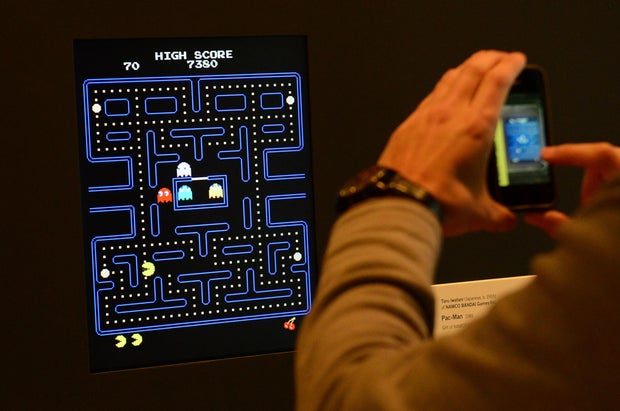
Today, in 2026, a study by a team that included scientists from the University of Chicago has created some minuscule capsules that behave a little like Pac-Man — gobbling up specific particles as they are guided by the natural motion of turbulent fluids.
The study, released last week, stands as an example of creating order in a chaotic system.
As the U of C noted, turbulence involves chaos and uncertainty by its very nature. Physicists and engineers have mastered their understanding of many forms of movement, but have always had a hard time with the swirling motions of turbulent fluids.
Examples of those hard-to-understand turbulent fluid motions include water in a raging rapid, magma in an erupting volcano, cream being stirred into coffee, and our own blood passing through our veins.
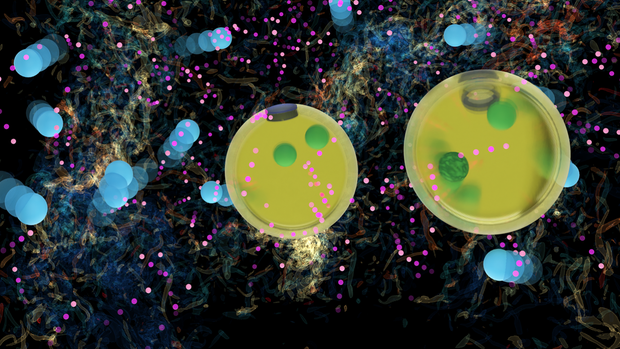
But the capsules created by scientists from UChicago and New York University are engineered to benefit from the turbulence, as they are propelled along to capture particles.
"We see them become amazingly selective filters," William Irvine, a professor of physics at UChicago and one of the two senior authors on the study, said in a news release. "That got us hooked, but the more we thought about it, the more we realized this opens up a whole world of possibilities."
The U of C noted that the "little Pac-Mans" could represent a new method for cleaning liquids. They can also release what they have captured on command, whether immediately or minutes to months later, which the university noted could be useful in applications such as drug delivery.
"Turbulence is usually thought of as pure chaos: it mixes, scatters and wastes energy," co-senior author Prof. Stefano Sacanna of NYU said in the release. "We asked whether that chaos could be put to work—and the trick turned out to be surprisingly simple."
In studying the single-hole "little Pac-Man" capsules, the researchers found that they gobbled up not only particles right in their vicinity, but could pick up each and every particle nearby.
The researchers also found they could selectively choose one size of particle. The "little Pac-Man" capsules could be dropped into a jar containing particles of all different sizes, but only consume the ones that matched the size of their own holes.
"This was very precise. They can differentiate between particles that are 700 nanometers across and 900 nanometers across," Irvine said in the release.
For perspective, the U of C noted, a nanometer is how long a fingernail grows in a second.
"Because the hungry ones look like little Pac-Mans, we call this the Pac-Man effect," Sacanna said in the release.
The researchers also learned they could design their capsules to spit out particles at a fixed rate. One experiment ran nine months and disgorged particles at a rate of a few each week, the university said. The researchers also learned they could get the capsules to release their particles within a fraction of a second by just adding salts.
"Normally, to move, you must expend energy—a bird must flap its wings or a fish move its tail," Irvine said in the release. "But here, by engineering a specific particle shape, we can leverage the ambient energy that is flowing around us all the time. You're essentially getting order out of chaos."
The university noted that the new study followed an observation by scientists working with the capsules for unrelated reasons.
"It took us that long to figure out what the hell was going on," Irvine said in the release. "At first, every experiment we tried showed the opposite of what we thought would happen."
In observing the capsules gobble up particles, scientists figured out that they were creating a gradient, where quantities of a substance changes within a system. For an everyday example of a gradient, UChicago explained that an open window on a cold day will send heat rushing out of a warm room until the temperature is equalized inside and outside.
The "little Pac-Man" capsules have a similar effect of creating an unequal environment in the jar, with the capsules themselves being calm and orderly inside, but the environment being a raging mess on the outside.
"This creates a gradient, so particles flow, and functions emerge," Irvine said in the release.
The filtering effect of the "little Pac-Man" capsules is also a property of turbulence, which amounts to a series of eddies, or swirls, that split into smaller and smaller units with any movement. When the capsules are introduced, only eddies the same size as the capsules' holes carrying particles of the same size can enter.
The researchers experimented with several variables, including changing the shape of the capsules' holes and the thickness of their walls, and using capsules as small as five microns across — approximately the diameter of spider silk — and as large as two centimeters, the university said.
The capsules themselves can be made of anything that has a hole in it, the university said.
But while learning science through comparison to classic video games is fun, the U of C noted that the study may be applied down the road to far more, from filtering water to delivering drugs to a targeted location in the body.
UChicago graduate student researchers Matteo Sabato and and Yaocheng Li, and NYU graduate student researcher Sarah Chong, were co-first authors of the study. UChicago graduate student researcher Daqian Gao and postdoctoral researcher Martin Falk, and as NYU's Zhe Xu, were also co-authors.
The study was published in the journal Science on Tuesday, Nov. 17.


