Northern lights could be visible in Illinois Monday night amid G4 solar storm


If you can brave the freezing cold, you might be able to glimpse the northern lights in Illinois Monday night.
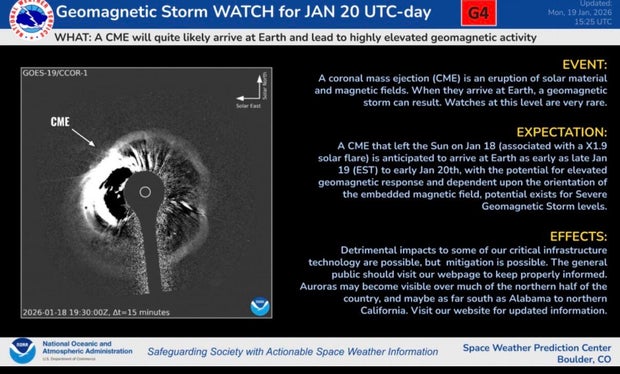
A rare severe, or G4, geomagnetic storm watch has been issued by the National Weather Service for Monday night.
While the greatest chance to see the aurora borealis will be in the central to northern parts of Wisconsin, the view line for the northern lights extends all the way to Central Illinois for Monday night. Your chances of spotting the geomagnetic phenomenon will increase the further north toward the Illinois-Wisconsin border you go.

CBS News Chicago Meteorologist Laura Bannon said if the solar storm hits at the right time, the northern lights could be visible across much of the northern U.S. after sunset. Bannon said in northern Illinois the skies are expected to clear out before midnight for the best view.
The northern lights are caused when charged particles from the sun flow toward Earth and get caught in our magnetic field.
The sun can "erupt" and create coronal mass ejections, (CME) which is matter from the sun, which one was released on the 18th of January and expected to impact earth tonight.... therefore creating a g4 storm watch for tonight into tomorrow morning.
As this solar energy impacts Earth's magnetic field, it can create geomagnetic storms and the particles interact with gasses in the atmosphere creating the beautiful display which can drift southward from the poles.
The real danger for aurora hunters is the extreme cold that has moved into the Chicago area. Overnight, wind chills could make it feel as cold as -15 degrees Fahrenheit. Official lows are in the single digits. So if you're going out to find the northern lights, make sure you're dressed appropriately with plenty of gas in your car and a fully charged cell phone in case you need help.
If you want to see the northern lights, you should look to the northern hemisphere, get away from city lights, and try to use your phone camera to capture the colors; the lens may be able to see them better than the naked eye.