Full remarks from Chicago Mayor Brandon Johnson at Rev. Jesse Jackson's funeral

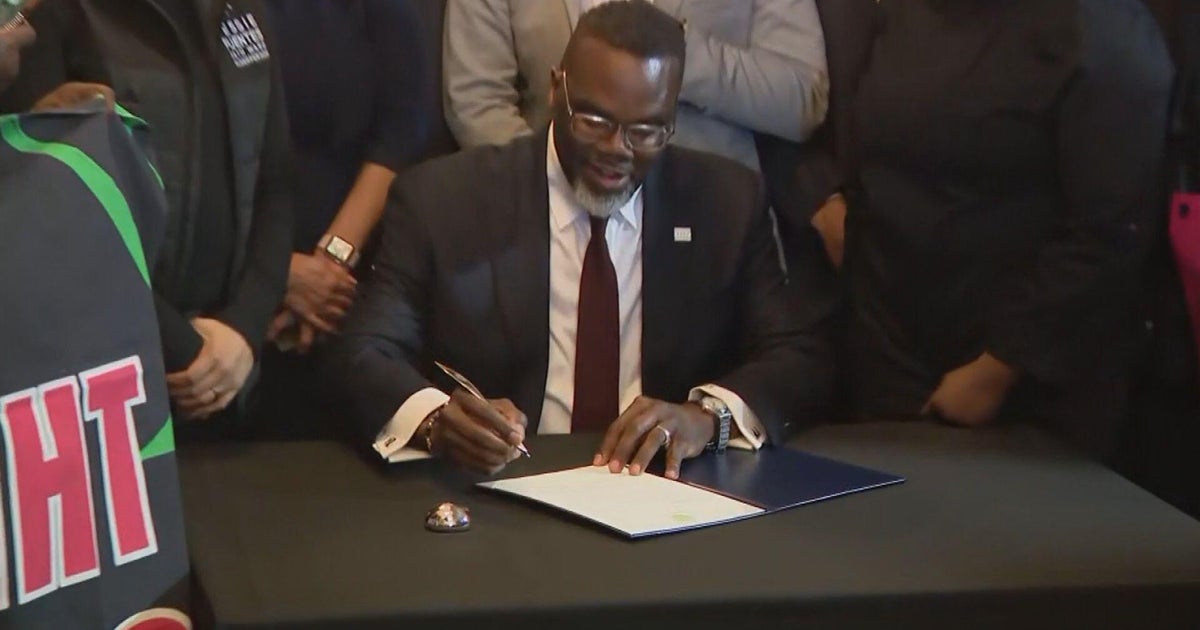
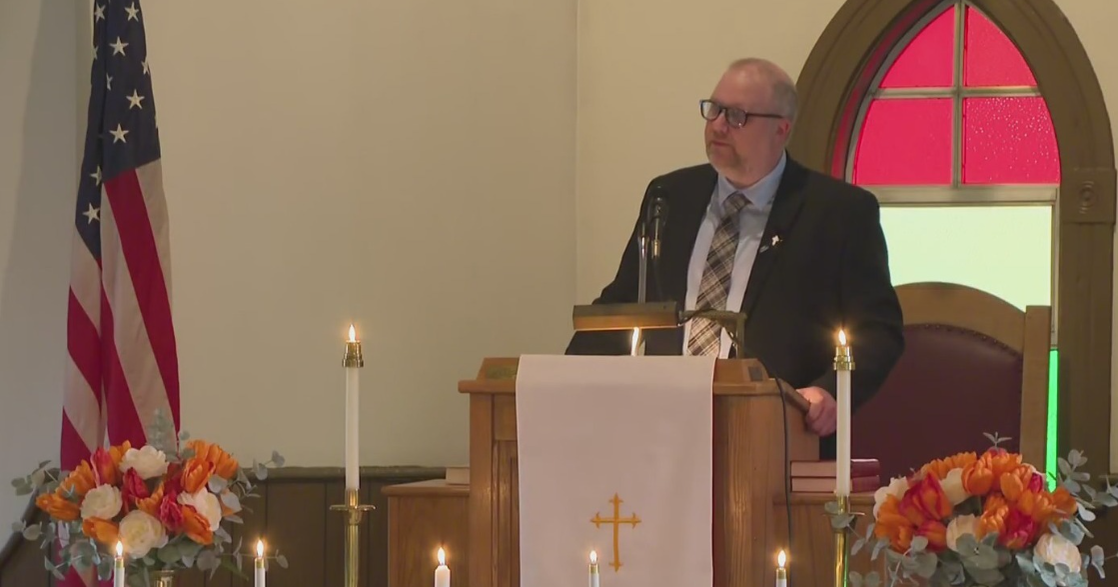
Chicago Mayor Brandon Johnson delivered remarks at Rev. Jesse Jackson's funeral at House of Hope in Chicago Friday. His speech wove together the personal and political, as he shared his own memories of Jackson as well as the impact of his work.
Here is a full transcript of Johnson's remarks.
Thank you for that introduction and good morning everyone.
It is truly my honor to be here today as Mayor of the City of Chicago to celebrate a man who was my dear friend, a mentor and a source of inspiration, Reverend Jesse Lewis Jackson, Sr.
Thank you to Mother Jackson, the entire Jackson family, for the grace and the courage that you all exude. And Mother Jackson, we don't mourn and grieve as the world, because we are not ignorant to what has happened. You will see him again.
That's not a promise from a politician, but from the Word. And he said, "If it weren't true, I would not have told you."
So now, to the Jackson family, I'm not trying to start any trouble, but I looked at the program and I didn't see any West Side representation. I didn't see nobody from the Church of God in Christ on the program. So I know I represent the city of Chicago, but, God bless you Bishop Shears, I guess they wanted us to get out on time.
But on behalf of my wife and my entire family, I say thank you for the care that you have shown us from one first family to another. We love you. And by evidence in this audience, the city of Chicago, state of Illinois, and the world, the country agrees.
One quick story. Reverend Jackson may have been the most competitive individual that I've ever met.
So, a few years ago, we were wrapping up a meeting on the West Side of Chicago at Reverend Johnny Miller's church, and we started talking about football. And at the time, Lamar Jackson was on his way to becoming the MVP of the National Football League. And I looked at Reverend, and I said, now there's a Jackson that's really making a name for himself.
And, you know, Reverend did not like that. And he looked at me, and he said, "You know, I played that position."
And he said, he said, "You know, I was better than Lamar Jackson."
True story. He said, "He might be taller, faster and stronger, but I'm better than them." And I said, "Reverend, well that doesn't leave too many more categories to determine greatness."
And I said, "In all seriousness, what makes you better?" He said, "Because of my instincts."
See, in sports, you hear about how athletes have a good feel for the game, something innate that can't be coached, that allows them to read the field and make split second decisions that ultimately position their team to win.
Reverend will be remembered certainly as an incredible oratory champion, but to the people in Chicago, we knew him as a brilliant strategist, a master negotiator, an organizing savant. His instincts, see, he didn't shy away from the painful realities of racism and hatred, but he had a God given ability to bring people in, to encourage them in, and to enlist them into the fight of our collective liberation.
It was his instincts that understood that labor and faith were one and the same, as Dr. King prophesized. It was his instincts to stand up against school closures and the shuttering of mental health clinics. It was his instincts that led protests down Michigan Avenue when a boy's life was taken by a police officer and then government decided to cover it up. It was his instincts.
It was his instincts to run in '84 and '88 but not in '92 to make way for somebody in the Deep South and a brother on the South Side to become president of these United States. It was his instincts.
See, I had the privilege to accompany Reverend to Selma one year, and while we were there, he recounted the days and weeks that were spent organizing to get folks to walk with them across the Edmund Pettus Bridge. And he said now that history has proven us to be right, he said that everybody and their mama was on that bridge.
But he knew the struggle from going town to town, and he was calling people out of isolation and into community, understanding that the bridge is a symbol that burdens all of us. It's what connected us. It's what was waiting for us on the other side.
He had a feel; his instincts understood that that bridge was a representation of the cross. See was the bull counters of the world and state sanctioned violence that they unleashed on our people. It was a cross brought to bear by the most egregious alignment that can materialize in a fight against inequality.
Reverend Jackson's instincts understood the words of James Baldwin, who said that ignorance and power alive is the most ferocious enemy of justice. But his instincts understood that if there's a cross to bear, we need a symbol of a promise. And that's when he formed the Rainbow Coalition that said that whosoever will let them come. It would be necessary for the movement to build the future that he saw where America could finally live up to her ideals.
And when I think of Selma and that storied march across the Edmund Pettus Bridge, I know that Reverend Jackson knew exactly how much wickedness and hatred waited for them on that bridge, beaten, abused, intimidated. They marched anyway. They bore the cross because they understood that on the other side of the bridge, his instinct said there's a win.
You see, in America, we find ourselves at a bridge, and we are confronted in this moment, and that bridge is now described as borders, where borders get to determine how human dignity is determined by which side of the border you live on.
He understood the bridge, and so now we are in the midst of a choice to choose hope over despair, light over darkness, love over hate, because he knew there was too much to gain on the other side of the bridge, Bishop Sheared, I think I feel my help coming.
Because on the other side of the bridge, Rodney, housing as a human right. On the other side of the bridge, health care for all. On the other side of the bridge, safe and affordable cities, accessible transportation, finally fully funding our public education system. It is time to cross the bridge. You all to build an economy that works for all: Black, brown, white, Asian, young, old. It is time for the ultra rich to pay their fair share in taxes on the other side of the bridge.
Reverend, you've crossed your bridge. We know our assignment. We see you on the other side. God bless you.