Depiction of turbulent particles in water wins University of Chicago's Science as Art contest

The University of Chicago last week unveiled the winners of its Science as Art competition.
Science and art are often held up as opposites — the logical and analytical versus the creative and emotional, the domain of the left brain hemisphere versus the right, the yang versus the yin. But UChicago notes that the disciplines are, in fact, intertwined — and not just in an abstract philosophical sense.
Indeed, the university said, scientific research can often result in striking images that might appear in simulations, under microscopes, or in photographs.
"These images can offer a window into the process of scientific research to the public, as well as inspiring a moment to step back and consider the beauty of the world," wrote UChicago News' Louise Lerner in February.
Contestants for the Art in Science competition began entering artistic submissions from their scientific research in February. The submission period ended Friday, March 13, and the winners were announced this past Thursday.
The grand prize winner was "Yin and Yang: Harmony in Chaos," by Takumi Matsuzawa, who earned a Ph.D. from the U of C in 2023.
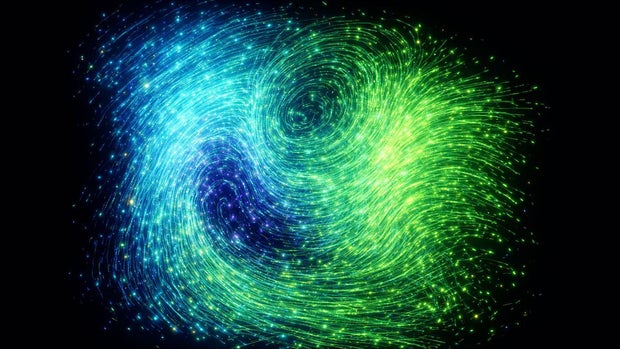
Matsuzawa studies turbulence, or the chaotic motions of swirling fluids. The image Matsuzawa submitted, which could be mistaken for a firework, shows trajectories of particles in water as turbulence diminishes in a specially designed tank, the university said.
The color, ranging from light blue to bright green, represents the speed of the particles.
"The image also shows that turbulence can persist for surprisingly long times," Matsuzawa wrote, as quoted in a UChicago news release. "When this image was taken, the particles were barely moving, yet long-exposure measurements still reveal the characteristic vortex structure of turbulence."
The winner for audience favorite, chosen in an NCAA Tournament-style bracket on the UChicago Instagram page, was "Cartography of the Mouse," by staff scientist Margrette Clevenger and Professor Nicolas Chevrier.
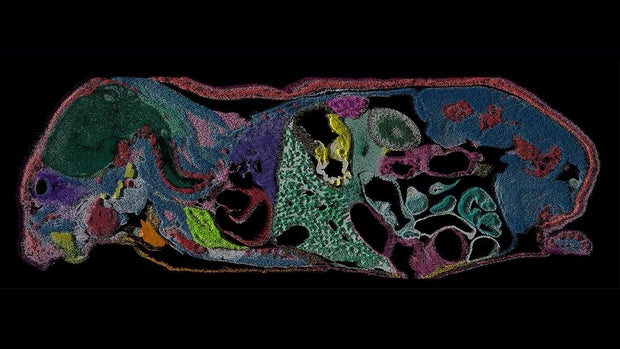
This image mapped gene expression patterns across a mouse's organ system, using a gene sequencing platform developed by Chevrier's Lab.
The university also acknowledged two submissions that won honorable mentions.
"Turquoise," by anthropology graduate student Aqiil Gopee, shows a fragment of turquoise alkaline-glazed earthenware that Gopee unearthed during the University of Chicago Institute for the Study of Ancient Cultures' excavations in Sohar, Oman, this year.
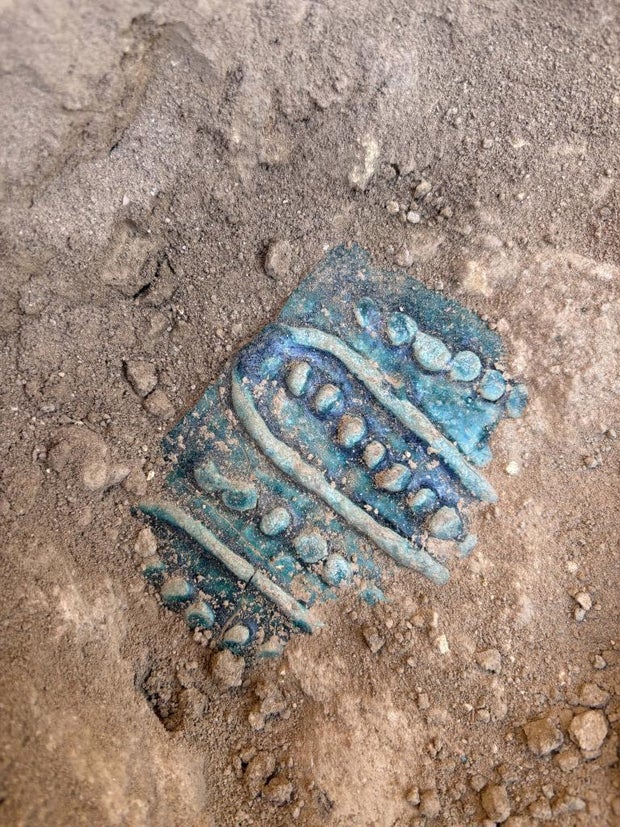
Gopee wrote that the fragment was likely dated back to the Abbasid caliphate, or the third Islamic caliphate, and was likely produced in Iraq around the 9th century C.E.
"As I brushed the sand away, the relief with appliqué decoration and vivid turquoise glaze gradually appeared, revealing the contrast between the ceramic's preserved surface and the sand in which it had remained buried for over a millennium," he wrote.
"Plasma Turbulence," by postdoctoral researcher Ludwig Boess, is the product of Boess' study of turbulent plasmas. Plasma is a state of superheated matter composed of charged particles.
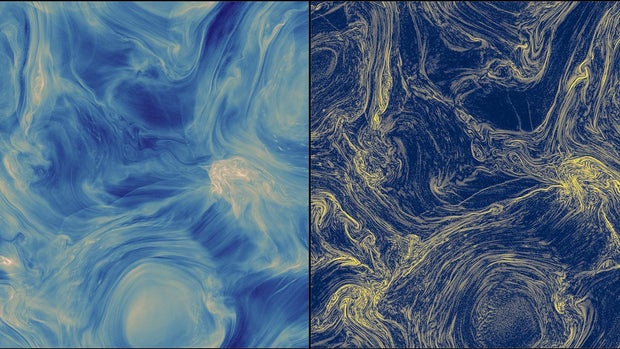
While running a simulation of a turbulent plasma, Boess noticed the shape of the structures. The image on the left shows the number density of electrons and protons in the plasma, while the image on the right shows their electrical density.
The grand prize winner won $300, while the audience favorite won $150. The images will be shown on UChicago's main website, on social media, and in exhibitions on campus.
The rules of the contest were that the images had to be the result of research affiliated with the University of Chicago and had to be original images by the creators. A.I. generation tools were not allowed for the creation of the images.
The contest launched in 2022.