Chicago Vocational Career Academy, West Side Frank Lloyd Wright House make Landmarks Illinois endangered list

Landmarks Illinois has released its annual lost of the 10 Most Endangered Landmarks — which includes a sprawling high school and an outdoor theater on Chicago's South Side, and a Frank Lloyd Wright house on Chicago's West.
Chicago Vocational Career Academy, Chicago
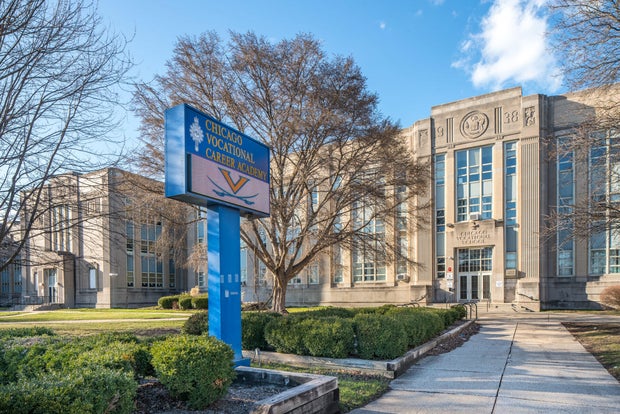
Chicago Vocational Career Academy — originally called Chicago Vocational High School and known as CVS for short — is at the top of the list this year. The school is a complex of four buildings — a main school building constructed between 1938 and 1940, an aircraft hangar built in 1941, and two outbuildings of the World War II era.
When the school was completed in August 1940, the Chicago Tribune called it "the most modern and best equipped trade school in the United States."
Chicago Vocational opened in 1941. The U.S. Navy used the school as a training facility for aircraft repair between 1941 and 1946, and afterward, the school resumed civilian training and operated up to 30 programs, Landmarks Illinois said.
Famous alumni of Chicago vocational include Chicago Bears great Dick Butkus and comedy legend Bernie Mac.
Landmarks Illinois warned that while CVS was constructed to serve up to 6,000 students, fewer than 900 attend the school now. The 2018 Chicago Public Schools Educational Facilities Master Plan calls the school underutilized.
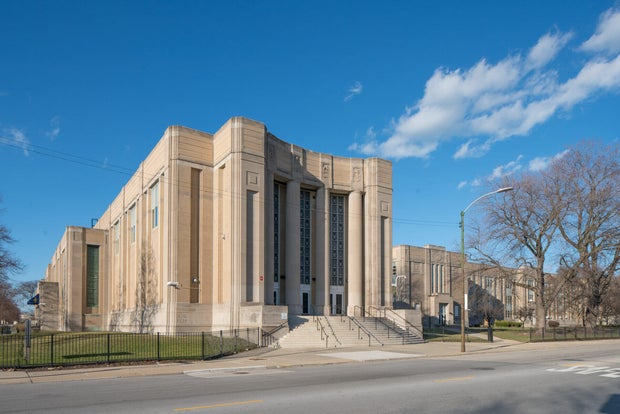
A wing of the school along Anthony Avenue that was completed in 1943 to house heavy industry vocational programs, is now completely unused, Landmarks Illinois said. But a previous proposal to have this wing torn down has never gone ahead due to lack of funds, Landmarks Illinois said.
CPS invested $56 million in CVS in 2015, and the school was listed on the National Register of Historic Places in 2022, Landmarks Illinois noted. But the organization said low enrollment continues to raise concerns about its future.
Landmarks Illinois would like to see CVS declared a Chicago landmark, and thus protected from being torn down in the future. The organization noted that the CVS main building is the largest non-skyscraper example of Art Deco design in the city.
John Jacob Walser House, Chicago
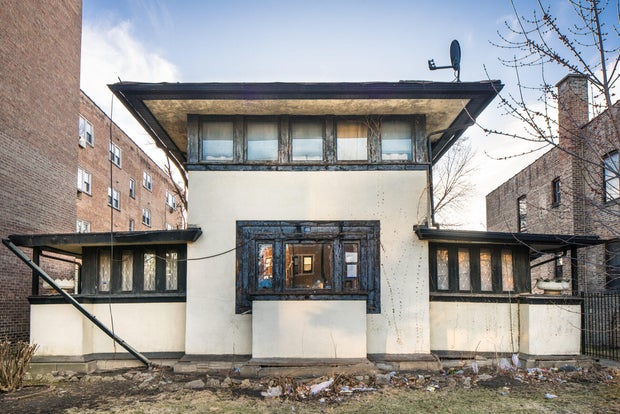
Also on the list is the Joseph Jacob Walser Jr. House, a Frank Lloyd Wright house in the South Austin neighborhood on Chicago's West Side. The house also made the Preservation Chicago seven most endangered list this year.
The house, at 42 N. Central Ave., is one of only five standing Prairie School structures designed by Frank Lloyd Wright within the city — a list that also includes the Frederick C. Robie House in Hyde Park and the Emil Bach House in Rogers Park. The Walser House is also the only single-family Frank Lloyd Wright house on the West Side.
J.J. Walser and his wife, Grace, bought the property in 1903 and commissioned Wright for the house, Preservation Chicago noted earlier this year. The Walser house is not as well-known as some Wright structures such as the Robie or the Wright home and studio not far away in Oak Park, but Preservation Chicago noted that it still incorporates the aesthetic beauty of the Prairie Style.
The Walsers sold the house in 1910, and it was sold 11 different times over the next 60 years, Preservation Chicago said. Hurley and Anne Teague bought it in 1970, and their stewardship ensured it remained standing, according to Landmarks Illinois.
Hurley Teague kept the house in good repair until he died in 1997, Landmarks Illinois said. After that, Anne Teague obtained a reverse mortgage for the house to cover maintenance.
Anne Teague died in 2019, and the interest on the reverse mortgage became unaffordable for her heirs, Landmarks Illinois said. The house is now vacant and facing foreclosure, and photos shared by Landmarks Illinois show the interior in horrible shape.
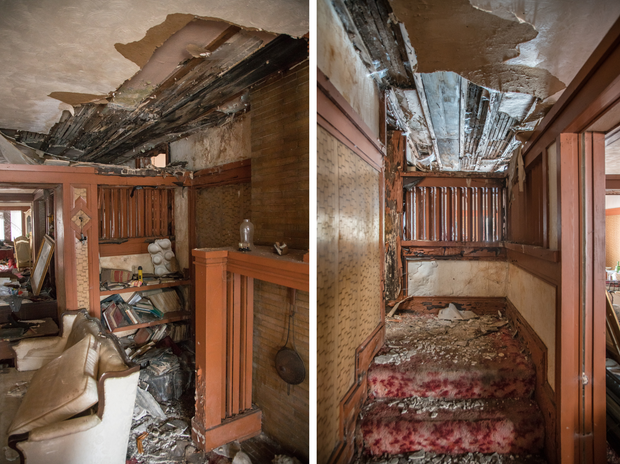
Holes in the foundation and roof have led to deterioration and water damage, and trespassers have made a mess of the interior, Landmarks Illinois noted.
"When my grandparents purchased the Walser home, it represented upwardly mobile Black people establishing legacies for their families and creating a blueprint for home ownership in the Black community. My grandfather was a builder. He made sure he maintained our home as well as our neighbors' [homes] if they needed assistance, taking pride in how he could serve this community better," Teague heirs Charisse J. Grossley and Johnny Teague said in a statement published by Landmarks Illinois. "This home serves as a tangible link to our past, offering insight into the lives of those who came before us and the events that shaped our community. The preservation of this landmark is essential not only for its historical value to the community but also for its potential to educate future generations."
Landmarks Illinois called for a resolution of concerns about property control for the reverse mortgage, and noted that the community group Austin Coming Together would like to see the Walser House as part of a revitalized Central Avenue corridor.
South Shore Country Club outdoor theater, Chicago
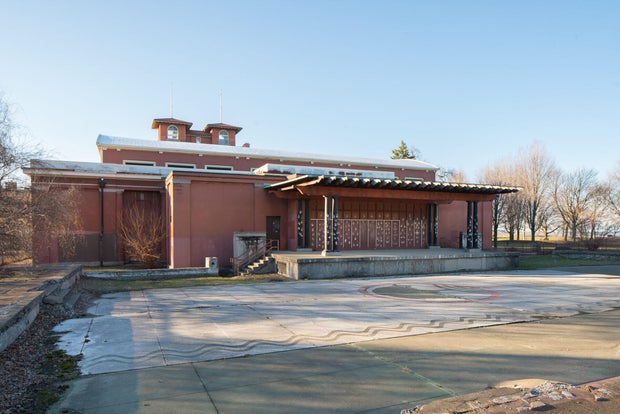
Landmarks Illinois also listed the outdoor theater at the South Shore Cultural Center, at 7059 S. South Shore Dr. The South Shore Cultural Center itself is thriving, but the theater is not.
The South Shore Country Club was founded in 1905, when Chicago Athletic Club president Lawrence Heyworth envisioned an exclusive club in a "country setting." The land he picked had been used for fishing and duck hunting, the Chicago Park District said.
Architects Marshall and Fox, who designed the Drake Hotel and other luxurious buildings, were brought on as architects for the country club. The club quickly outgrew its first facility, and Marshall and Fox were also the architects behind the second clubhouse, which was built in 1916 and incorporated the ballroom from the original facility, the Park District said.
Both the original and the second and current clubhouses were constructed in the Mediterranean Revival style. The club's membership peaked in the 1950s, only to fall as many African Americans moved to South Shore while the club went on excluding Black members, the Park District said. This policy led to the closure of the club in 1973, the Park District said.
The Park District bought the property in 1974. It had planned to have the deteriorating clubhouse torn down, but community members rallied to save and restore it.
However, the outdoor theater adjacent to the clubhouse has not fared so well.
The theater opened in 1920, and features a small stage and terrazzo dance floor with the logo for the old country club on it, Landmarks Illinois said. While the rest of what is now the South Shore Cultural Center has undergone several renovation projects since the Park District took over, the theater was only stabilized and was never fully restored, Landmarks Illinois said.
Today, the outdoor theater is deteriorated with broken concrete to the point where it cannot be used. It does not have the needed lighting and sound systems, and does not meet Americans with Disabilities Act standards, Landmarks Illinois said.
The 2018 Chicago Park District South Lakefront Framework called for restoring the outdoor theater, but this never happened due to a lack of funds, Landmarks Illinois said.
Fordon Horse Barn, Oak Brook
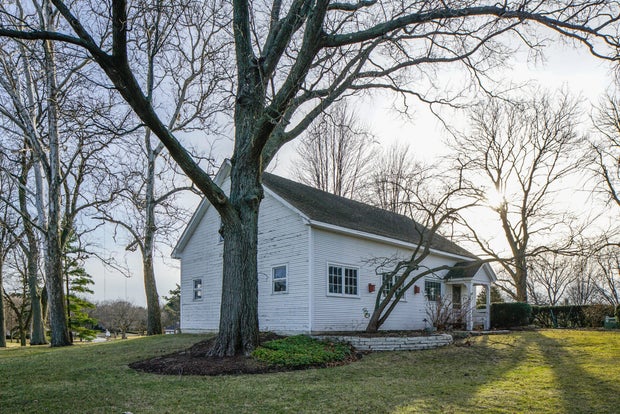
In the suburbs, the list includes the historic Fordon Horse Barn in Oak Brook — built when the western suburb was the polo capital of the United States. The Oak Brook Polo Club was founded in 1922, and club member and competitive polo player Jerry Fordon bought the barn for his polo ponies in 1941, Landmarks Illinois said.
The Saddle Brook Development Company gave the barn and the nearby park land to the Oak Brook Park District in 1975. The polo club itself closed just this past March, Landmarks Illinois said.
As for the barn, Landmarks Illinois said the Oak Brook Park District is planning to have it torn down. It was used for storage, but is no longer needed for that purpose, and the park district wanted it torn down by the end of April, Landmarks Illinois said.
Landmarks Illinois said the Oak Brook Park District could renovate the barn as a programmable space, and the Saddle Brook Community Association has expressed interest in taking it over.
Pushback from the community has delayed demolition, but the Park District 2025-2026 budget still identifies demolition of the barn as a capital project for the fiscal year to come, Landmarks Illinois said.
William A. McConnell farmstead, Richmond, Illinois
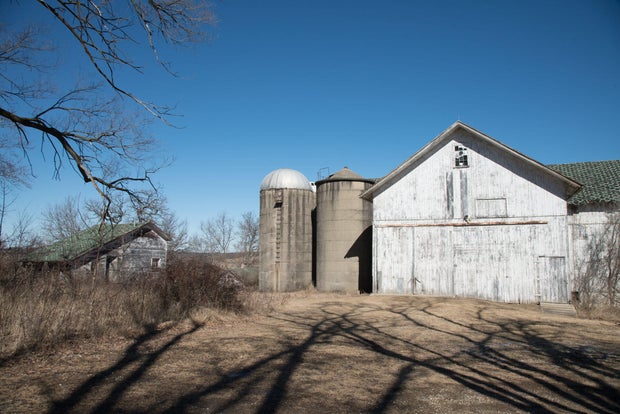
In the McHenry County community of Richmond, Landmarks Illinois lists the William A. McConnell Farmstead, at 6102 Broadway Rd. McConnell was the first non-Indigenous settler in present-day Richmond, Illinois, Landmarks Illinois said. The Pennsylvania carpenter arrived in 1837 — the same year Chicago to the southeast was incorporated as a city.
McConnell first built a log cabin, and when other families came to the site, his farmstead became home to the first school of the area. McConnell built a Greek Revival-style house on the property in 1852, and another in 1868, Landmarks Illinois said. Meanwhile, he became county postmaster, commissioner, and judge.
The Farmstead and its eight structures — a house, a granary, and several barns — are owned by the McHenry County Conservation District, Landmarks Illinois said. The 1852 house is privately owned and occupied, but the 1868 house, barn, and outbuildings are not in such good shape, Landmarks Illinois said. The barn roofs are "in dire need of repair," and funding has not been allocated to protect the structures.
Judge William D. Barry House, St. Charles
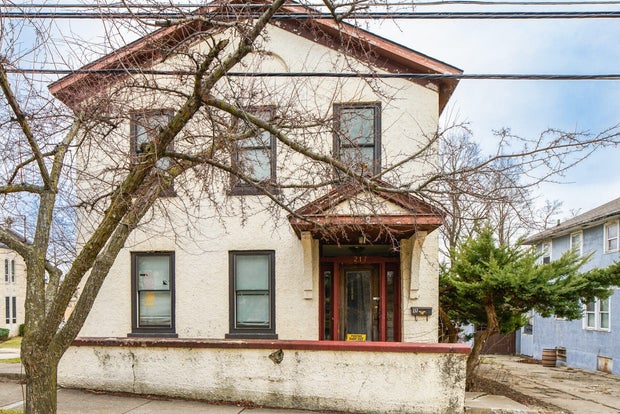
In St. Charles, the Judge William D. Barry House at 217 Cedar Ave., dating back to 1844, is on the list. The Green Revival-style house was built by Barry, who was an accomplished attorney before being elected judge in 1851, according to Landmarks Illinois.
Barry managed Union Civil War Gen. John F. Farnsworth's successful runs for Congress, Landmarks Illinois said.
The house is now owned by the Baker Memorial United Methodist Church, which plans it to have it torn down for a parking lot, Landmarks Illinois said. The church bought the house in 1993 to provide housing for those in need, but has not used if for anything since at least 2017, Landmarks Illinois said.
The church's most recent request for demolition, filed this past October