Taking the temperature of theater in Chicago: Distress as venues fall, but optimism driven by a vibrant community

Three different times over the past year, popular and longstanding Chicago stage theater spaces have made headlines for their demise.
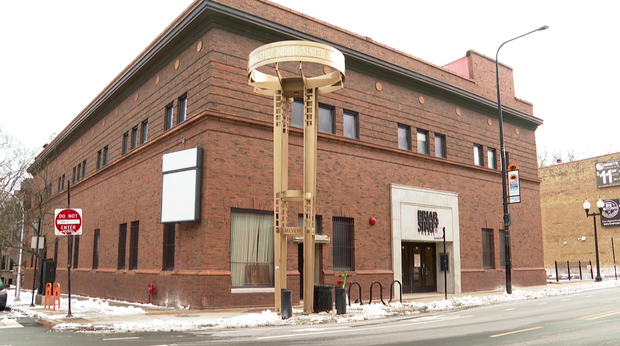
At the dawn of 2025, "Blue Man Group" said goodbye to the Briar Street Theatre in East Lakeview after nearly 30 years. It was to the point where many had never known Briar Street, at 3133 N. Halsted St., as anything other than the venue for "Blue Man Group." But between 1985 and 1997, before that acclaimed production took over, productions there included "Driving Miss Daisy" before the stage show was adapted for the big screen, and Neil Simon's "Laughter on the 23rd Floor," among many others.
But there was no going back after Blue Man Group left. The former Marshall Field's delivery horse carriage house that housed the Briar Street Theatre isn't being torn down, but plans unveiled in May will see it turned into a mixed-use development with housing units in a new addition on top, joined by a new building on the footprint of the parking lot.
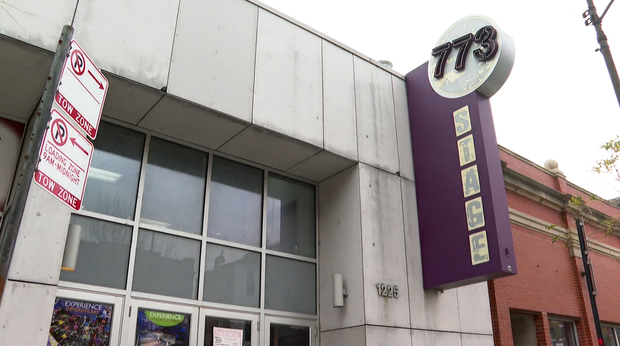
Meanwhile, a little over half a mile away on Belmont Avenue, the Theatre Building with its three separate stages first opened in 1977, serving as an incubator for small theater companies while also staging its own new musicals. The Chicago Reader reported that as of 2009, the Theatre Building, 1225 W. Belmont Ave., had staged more than 800 plays and 500 theater companies.
The Theatre Building hosted the first show staged within the Chicago city limits by the Steppenwolf Theatre Company — "Say Goodnight, Gracie," with John Malkovich — in 1979. David Schwimmer took the stage there for Lookingglass Theatre Company. Chicago favorites, such as "Hellcab," took up residence at the Theatre Building, and it hosted the Chicago Sketch Comedy Festival.
Today? The Theatre Building, which changed names to Stage 773 upon being bought out in 2010 and turned into a bar and art space in 2022, is slated to be torn down for a housing development after closing altogether.
A couple of miles to the south, the Royal George Theatre, at 1641 N. Halsted St. and right across the street from the venerable Steppenwolf Theatre, opened in 1984 with four stages ranging in size from a 452-seat main stage to an intimate 50-seat space. The Royal George hosted some of Chicago's most beloved shows: the long-running cabaret show "Forever Plaid," the one-woman religious comedy "Late Nite Catechism," and Hershey Felder's depictions of great composers.
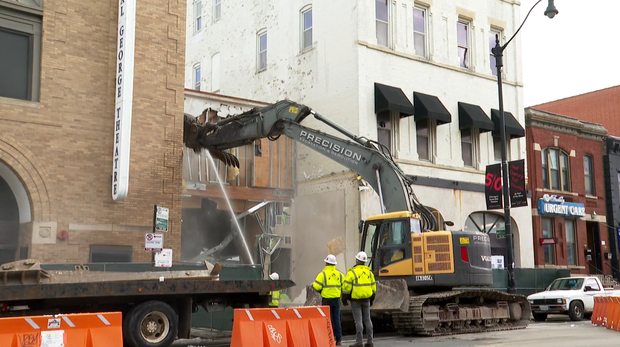
Today? The wrecking ball has arrived. The Royal George shut down like most everything else upon the arrival of the COVID-19 pandemic, and never reopened. In the fall, the former Balena restaurant space next door was first to come down, and the Royal George itself is expected to follow soon. A nine-story apartment building with retail on the ground floor will be built on its footprint.
The losses affecting the Chicago theater scene are not only a matter of spaces closing and being repurposed or torn down.
This past April, the lights were on again at the Victory Gardens Theater — around since 1974 and located in the historic Biograph Theatre building in Lincoln Park since 2006 — for David Mamet's "Henry Johnson," by Relentless Theatre Group. Victory Gardens also touts plans for a "vibrant 2026 season" and an "exciting new chapter of productions and partnerships" on its website, and is hosting a writers' workshop with award-winning playwright Yolanda Nieves in November and December.
But the historic venue has otherwise been largely dark in the wake of a series of controversies, resignations, and dismissals between 2020 and 2022, after which Victory Gardens stopped producing its own shows.
Meanwhile, despite announcing that it was closing permanently at the height of the COVID-19 pandemic in June 2020, the Mercury Theater, at 3745 N. Southport Ave. in Lakeview, reopened the following year under new leadership and went on to thrive again. The Mercury saw its production of "Jersey Boys" win a prestigious Jeff Award in 2024.
But nothing has been happening at the Mercury for about a year now. A message left on the Mercury Theater voicemail inquiring about plans for the future was not immediately returned.
The state of Chicago theater — sounding alarms
What does all this say about the state of theater in Chicago? Chicago Tribune theater critic Chris Jones, who also used to review stage productions for CBS News Chicago, sounded the alarm on a number of crises in an August 2023 column.
In addition to venues closing and going dormant, Jones pointed out in the column that the heavy-hitters of nonprofit theatre in Chicago — including the Steppenwolf and the Chicago Shakespeare — had seen their leadership change over since 2019. He also identified 34 theater companies that had gone out of business between 2019 and 2023 in what he called "not even a complete list," and noted that the number of shows and the length of those shows' runs was falling at even the big-name nonprofit theaters.
Jones attributed the issues to several specific factors. These included an audience that failed to return to nonprofit stage venues after the COVID pandemic receded, despite other entertainment such as concerts coming roaring back. Other culprits: competition from big tech, a business model rooted in subscription seasons that Jones called "outdated," internal squabbles going public, and critics, who took aim at the compensation for artistic directors while accusing those directors' companies of staging "tired revivals," though Jones wrote that those were actually rarer than new works.
Jones also pointed out that some of Chicago's largest and most established nonprofit theaters had opened new buildings over the prior several years — a $28 million new venue for the Writers Theatre in Glencoe designed by celebrity architect Jeanne Gang in 2016, the $35 million Yard space at the Chicago Shakespeare Theater on Navy Pier in 2017, and most recently the $54 million Liz & Eric Lefkofsky Art & Education Center with its theatre-in-the-round at the Steppenwolf, which was unveiled in 2021.
Soon to join these venues is a $32 million new home for the 51-year-old Northlight Theatre in Evanston, which broke ground in March. A $46 million new home is also in the works in Uptown for the TimeLine Theatre Company, which for several years has made its home in a space in a church building in East Lakeview.
But while new buildings may seem like signs of hope, Jones also noted a disconnect between the priorities of the theater companies that commission the pricey structures and the actors and other artists who take the stages in those buildings. He noted that the combined $117 million that went into the new Writers Theatre, Chicago Shakespeare, and Steppenwolf buildings could have gone to artists' salaries, while conceding that this is "not how the real world works."
Furthermore, Jones wrote, theater artists work on a freelance basis and don't feel a great deal of loyalty to the theater institutions that employ them.
A changing theater marketplace in Chicago
While those in the know agree that theater in Chicago and well beyond is in a state of transition, if nothing else, the trend of venues vanishing isn't new. Playwright Vicki Quade, the owner of Nuns4Fun Entertainment, created the aforementioned "Late Nite Catechism" in 1993 with Maripat Donovan, who played the starring nun.
Quade noted that all the theater venues that hosted "Late Nite Catechism" from 1993 until the start of the COVID pandemic are gone. The show started at the Live Bait Theatre, 3914 N. Clark St., whose namesake company closed many years ago; the retro entertainment venue Stars & Garters recently took over the space. Among past homes for "Late Nite Catechism," the Clark Street space is almost unique inasmuch as the venue — albeit in different hands — actually still exists.
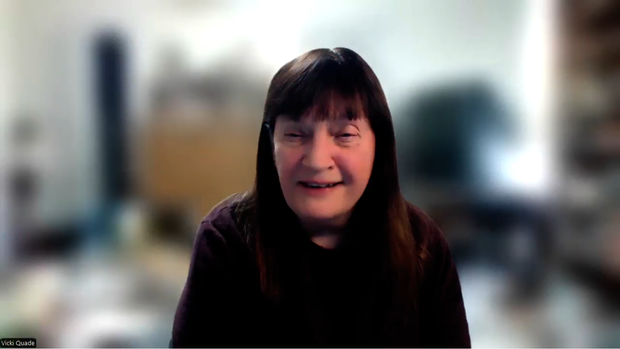
"We went to the Organic. That's gone. We were at Zebra Crossing. That's gone. The Ivanhoe was four years. That's a liquor store," said Quade. "We went to Royal George. We were there for 20 years, and that was sold. You know, the joke in our family is, my son called me after it was announced the Royal George was being sold, and he said, 'Well Mom, it took you 20 years, but you closed another theater.'"
At one time, numerous Chicago neighborhoods — particularly those along the north lakefront — had not only a variety of live theater venues, but entire theater districts unto themselves. For instance, back in the 1990s, when storefront theater in Chicago was still a thriving enterprise, the mighty Steppenwolf and its across-the-street neighbor the Royal George were joined by the Remains Theatre, of which Gary Cole of "Office Space" fame and William Petersen of "CSI" were founding ensemble members, two blocks away in a space in the long-gone 1800 Clybourn mall.
Meanwhile, in Uptown, the National Pastime Theater and the Red Bones Theatre were once found in separate storefronts in the same building on, appropriately, Broadway. Both spaces were later taken over by the Profiles Theatre, which shuttered amid a sexual harassment scandal. Later still, the two spaces became the home of PrideArts Chicago, which has since moved to the Center on Halsted.
A short distance to the south, along and off Broadway between Irving Park Road and Halsted and Grace streets, the Mary-Arrchie, Strawdog, and Oracle theaters were all found within a stone's throw of each other as late as the 2010s. Of these, only the Strawdog is still in operation today, having moved to the Ravenswood neighborhood.
Farther to the north, Rogers Park didn't have one compact district, but smaller-scale stage theaters were scattered throughout the community — the Lifeline, the Factory, the Center Theater Ensemble, the Wisdom Bridge, the Heartland Studio Theatre in a storefront alongside the since-demolished Heartland Café.
Neighborhood theater districts are not completely gone, Quade pointed out. The Lifeline is still going in Rogers Park in its longtime space on Glenwood Avenue, while The Factory found a permanent home on Howard Street in 2016 after moving around between buildings and neighborhoods over many years. While the former Theatre Building/Stage 773 is gone, its neighbor on Belmont Avenue, Theater Wit, is still around in the former Bailiwick Repertory Theatre space — and has made an effort to keep pricing access low so its venue remains accessible to fledgling theater companies. The Annoyance Theatre relocated to a space just opposite the "L" tracks on Belmont Avenue in 2013.
Nevertheless, Quade agreed that the audience for stage productions is changing in Chicago, and the market for the kind of show she launched more than three decades ago is not there anymore.
"When 'Late Nite Catechism' started in 1993, it was very common to go to a late-night performance of a show. That's why it's called 'Late Nite Catechism' — it started at 11 o'clock — and there were lots of late-night shows you could go see, and it was fun," Quade said. "You could go to dinner. You could go to an 11 o'clock show. That is gone. That is largely missing now."
Quade also said the shows with the kind of run "Late Nite Catechism" has boasted are a thing of the past, too.
"I think that, you saw Late Nite Catechism — it's in its 33rd year — you'll never see that again. You look at Blue Man Group, which ran for 20-some years. Again, I just don't think you're going to see that," she said. "You're going to see a lot more shows coming into the city two weekends, three weekends, maybe. When you see a six-week run now, you're just like: 'Holy cow! I hope they can make the full six weeks.'"
While Jones' 2023 assessment focused on problems within the theater industry, Quade noted that audience behavior and preferences are changing, too. Among other factors, Quade noted that audiences from the suburbs seem less interested in coming into Chicago to see a play, in part because of worries about crime.
"I just did one of my shows, 'Late Nite Catechism' was just out in Chicago Ridge, and I talked with some people there and said, 'Oh, I've got shows in the city if you want to come see them.' They just said, 'Oh no, we never go into the city,'" she said. "That's what's missing. It's that constant fear."
Quade also said fewer tourists from outside the Chicago area and the U.S. are turning out to see plays. She said action needs to be taken to stem all the audience erosion.
"So there's this whole mix of, How are we going to keep theater in Chicago going?'" Quade said. "It's got to be local support. It has to be suburban support. It has to be tourism."
Quade also noted that the COVID pandemic "did a real big number" on theater in Chicago, as people got used to staying home and watching streaming television at the expense of live plays.
"What you miss is that opportunity to be in a live theater venue watching someone onstage — something you're never going to see again, because every performance is different. Every performance has a little bit of something that's different," Quade said, "and you're seeing it with other people, with an audience where you can enjoy, you can laugh, you can be stunned, and you're participating in a social event, and you don't get that by sitting at home watching TV."
A strong Chicago theater community keeps the scene viable and vibrant
The demise of old and beloved venues notwithstanding, finding success stories in today's Chicago theater scene doesn't require looking very far.
In January, David Schwimmer and Illinois Gov. JB Pritzker were on hand as the Lookingglass Theatre Company unveiled its newly renovated space at the Water Tower Waterworks off the Magnificent Mile. Lookingglass returned to the stage under new leadership after an 18-month hiatus amid post-pandemic financial struggles, and has a new season on tap featuring stage ensemble member Matthew C. Yee's "White Rooster," and fellow ensemble member Kevin Douglas' "Untitled Vampire Play."
The Goodman Theatre downtown celebrated its centennial this year and just began its annual run of dramaturg Tom Creamer's adaptation of "A Christmas Carol." Highlights at the Goodman this year have also included a production of the 1978 Harold Pinter play "Betrayal" featuring Helen Hunt, Ian Barford, and Robert Sean Leonard, and the Chicago-centric play "Ashland Avenue," starring Francis Guinan as the owner of a struggling mom-and-pop TV shop and Jenna Fischer of "The Office" fame as his daughter.
In October, the Court Theatre in Hyde Park was among 19 performing arts organizations to receive a $125,000 two-year grant from the Walder Foundation to benefit its engagement department, fostering connections with teens, educators, and residents of the city's South Side. Onstage at the Court, Marti Lyons' adaptation of Shakespeare's "The Taming of the Shrew" runs through Dec. 14.
Meanwhile, it hasn't just been the heavy hitters like Steppenwolf and the Chicago Shakespeare that have celebrated the opening of new buildings in recent years.
In 2018, Theo Ubique Cabaret Theatre — a smaller company founded in 1997 — opened a new space at 721 Howard St. in Evanston after years of staging plays in the old No Exit Café coffeehouse, now Le Piano, in Rogers Park. The musical "Urinetown" is now onstage at Theo Ubique, and has been extended through Jan. 4.
In 2023, the American Blues Theater — which was connected with the American Theater Co. that staged numerous acclaimed productions at a North Center neighborhood space before closing in 2018 — moved into its first permanent home in a building at Lincoln and Talman avenues that had once housed a Walgreens and later a Dollar General. The new space for American Blues brought live theater to a neighborhood where residents previously would have had to get in the car and go to another community to find it. The annual run of "It's a Wonderful Life: Live in Chicago" has begun at American Blues.
The Chopin Theatre, a standby in Wicker Park since 1990, stages a roster of plays along with musical and cultural events. Quade said she was "blown away" by the Chopin's Jeff-recommended production of "Jekyll & Hyde: The Musical," which has been extended into January.
Other theater companies and venues large and small around the city also continue to draw crowds. To name a few, the Greenhouse Theater Center in Lincoln Park is simultaneously staging productions of the Tony Award-winning family musical "A Year with Frog and Toad," Tennessee Williams' "A Two Character Play," and Jeffrey Hatcher's "A Picasso." At A Red Orchid Theatre in Old Town, now in its 33rd season, the Chicago premiere of Anna Ouyang Moench's "Birds of North America" takes the stage in January. At the avant-garde Trap Door Theatre in Bucktown, a stage adaptation of Paolo Maurensig's novel "A Devil Comes to Town" has been extended through Dec. 6.
Newer theater companies are also seeing success. For one, the Invictus Theatre Company, incorporated in January 2017 and operating from the Windy City Playhouse in the Irving Park neighborhood, earned a Jeff Recommendation for Chicago playwright Marcus Gardley's "The House That Will Not Stand," which runs through Dec. 14. Invictus also put on a highly regarded production of Tony Kushner's "Angels in America" that ran for three months this past summer.
And downtown, the Studebaker Theater, located in the Fine Arts Building at 410 S. Michigan Ave., has seen great success since its grand reopening in 2022.
The Studebaker is hardly a new venue. It opened in 1898 as a Vaudeville-style opera house, and the Shubert Organization of Broadway notoriety took over in 1917 and turned it into a touring house. The space was used as a TV studio for a time in the 1950s, and then went on to host A-list touring productions for a quarter century, including Eartha Kitt in "The Owl and the Pussycat" in 1964, and Henry Fonda in "Time of Your Life" in 1973.
But in 1982, the Studebaker became a movie multiplex. In 2000, the multiplex closed, and the space went dark and sat vacant for years.
But today, the Studebaker is back with a variety of events onstage, offering a space for new musicals with commercial aspirations and a home for local companies such as the Chicago Opera Theatre. The Studebaker is also a venue for the Chicago International Puppet Festival, and plays host to the Peabody Award-winning live NPR game show "Wait Wait… Don't Tell Me."
"It's not lost on me that when I started working in the Fine Arts Building and the Studebaker, and we started renovation on the Studebaker, it was right as the Royal George had closed," said Jacob Harvey, managing artistic director of theaters at the Fine Arts Building. "And so we were looking at that as an opportunity to sort of fill a gap that Chicago sorely needed for a space of that high, mid-range size for shows... and theater companies, not only in Chicago, but as a viable venue for shows from out of town to be able to bring their show to Chicago, and engage Chicago theater artists as well."
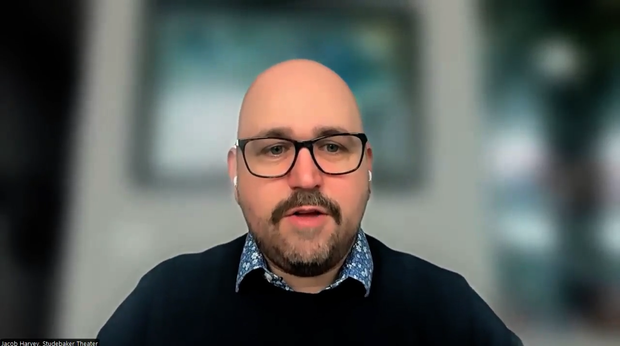
With the Studebaker standing as an example of success, Harvey emphasized that the loss of venues like the Royal George, Briar Street, and the old Theatre Building should not be taken as an epitaph for theater in Chicago.
"I'm not sure that the losing of the spaces is a reflection of the vibrancy or the viability of theater in Chicago, and I think those distinctions are important and interesting to make," Harvey said.
Harvey explained that the niche that Chicago occupies in the theater universe might not support long, open-ended runs. But he said what Chicago does provide is a space for producers coming in with plays or musicals and development, or starting a tour after a successful commercial moment in perhaps New York or London.
"I think there's a reason why producers that I talk to are targeting Chicago as a place to bring their show — whether it be to launch a tour here, or it be to develop their play or their musical here," Harvey said. "We have the talent. We have the infrastructure. We have the community for it."
Noting that the Studebaker is experiencing a renaissance, Harvey expressed optimism for a renaissance for "Chicago theater by and large," given the cooperative and collaborative spirit of the Chicago theatre community.
"We are uniquely situated in Chicago, and our theater community is just that," Harvey said. "We stand on each other's shoulders. We help each other out. We share resources. We pool resources. And I think we're going to see a lot more really interesting and creative collaboration among theater artists and theater companies to help buoy (us) through this moment of transition."
Harvey said it is undeniable that theater companies are struggling, and many have lost funding. But he said this should not at all be taken as a prophecy of doom.
"The thing that I think is unique to Chicago theater and the Chicago theater community is that we're able to hold space for that as an opportunity, and work together, and collaborate together, as an opportunity to get through moments like this," Harvey said.
In the meantime, Quade urged everyone to get out and enjoy a play in Chicago, which she said remains one of the best cities in the country for theater.
"You've got to take a chance," she said. "Don't sit home and just watch Netflix — that's what I tell people."