President Barack Obama's speech at Chicago presidential center opening shows "hope" is still at his core

When Barack Obama first ran for president in 2008, a poster by street artist Shepard Fairey became an icon of his campaign. Stenciled using only shades of red, white and blue, the image showed a young and contemplative U.S. Senator from Illinois looking off into the distance, and across the bottom in bold, capital letters, it simply read "HOPE."
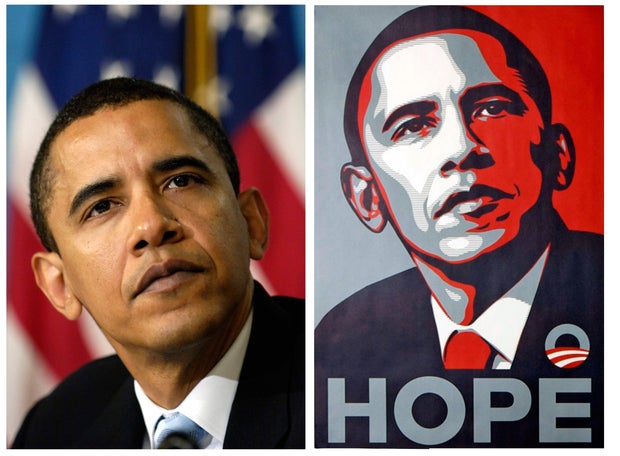
Delivering the keynote address at the opening of the Obama Presidential Center in Chicago on Thursday, 18 years after that first campaign, it was clear that "hope" is still at the core of President Obama's mission and legacy.
In a speech that lasted more than half an hour, Obama thanked his family, his supporters, his foundation, and everyone who helped him during his political career and who helped build the sprawling campus that now houses his legacy. He recounted the story of his move to Chicago and his fast-rising political star.
But as his wife also emphasized in her speech, the purpose of the Obama Presidential Center is not as a tribute to him or even a monument to his administration. It is a repository for the history and leaders that inspired him and for the work he often had to leave unfinished, and a resource for generations of future leaders who he declared would continue to turn the United States into the "more perfect union" described in our Constitution.
"It is our greatest inheritance, the story of America at its best, because it reflects a basic faith in the decency of our fellow citizens, and the possibility that, despite all of our differences, we can see each other and understand one another and make common cause together," Obama said.
Echoing his 2008 election victory speech in which he declared, "We have never been a collection red states and blue states; we are, and always will be, the United States of America," Obama said his museum and the entire presidential center complex was built not to focus on politics or policy, but on the shared values that underpin American democracy: character, honesty, kindness, compassion, a sense of duty and honor.
"These are the values and traditions I believe in, and they are not Republican or Democratic values. They are American values we can all share, regardless of party," he said.
He ended his speech by recounting the story of Rev. Theodore Parker, a 19th century abolitionist preacher in Boston who, in despair as the cause of abolition seemed lost, still held fast to his faith that – as Dr. Martin Luther King, Jr., so famously paraphrased – "the arc of the moral universe is long, but it bends toward justice."
"His was a declaration of faith. A defiant call not to abandon hope or give way to fear, but to stay true to our better selves and true to one another. And to keep fighting to fulfill the promise of this nation, even in the face of cruelty and bitter disappointment. Even in the face of impossible odds," Obama said. "It is that spirit that we open this center today. The same spirit that so many of you showed all those years ago. The same spirit that inspired generations of Americans to meet the challenges of their time. The same spirit that is alive and well here on the South Side of Chicago. The same spirit that will see America and the world through its present trials."
Read President Obama's full speech
Hello, Chicago! Sweet home, Chicago. Please have a seat. Thank you, Punihei, for that outstanding introduction.
President and Mrs. Bush, President and Secretary Clinton, thank you for being with us today and for your devotion to our country. Thank you.
And President and Dr. Biden, thank you for your steadfast partnership for eight years. Joe, we started as running mates and ended as family, and we would not be here without you. And we are grateful.
To our amazing foundation staff and our amazing board, to Governor Pritzker, Mayor Johnson, thank you for making this center possible.
To congressional leaders and foreign dignitaries who have made the trip, I cherish our partnership together and all we got accomplished together. Thank you.
To Michelle: she did me wrong. She wouldn't let me see her speech! She knew she was going to mess me up, and she did it anyway. But she's always made me better, and I could not be more grateful. And to Sasha and Malia, what can I say? You mean everything to me.
More than 40 years ago, on a late summer afternoon in 1985, I arrived here in Chicago, entering the city through the very spot where this center now stands, I can still picture myself heading down what was then Cornell Drive in a janky used car that I'd bought in New York with all my worldly possessions stuffed in the trunk and the back seat, so I really couldn't see out of the rearview mirror and I was a safety hazard.
I was 23 years old. I'd just been hired by a group of churches on the South Side to help organize a part of the city that had been battered by steel plant closings and chronic neglect. I didn't have much organizing experience, didn't know anybody in Chicago. But I had been inspired by the Civil Rights Movement, and I knew I wanted to make a difference. And although I wasn't sure exactly how I was going to do that, I was possessed with this abiding faith that if we could give people more of a say in the forces that govern their lives, if we could bridge some of the differences that drove us apart, then we could build an America where everyone counts, and everyone has a fair shot, and everyone belongs.
Even a mixed-race kid with a weird back story and a name nobody could pronounce.
And it was here in this city, a city of broad shoulders, that I found what I was looking for. Day by day, block by block, I got to know the people who lived here. Their hopes, their dreams, their tragedies and their triumphs. I witnessed their resilience in the face of hardship and the quiet heroism of a single mom raising her kids and sending them to college on a secretary's salary. Or the priest electing to stay in the city and open his doors to at-risk youths even as most of his flock had fled to the suburbs.
I learned that leadership has less to do with titles or rank or chasing attention than with helping others find their voice, reaching their potential, and sitting around people's kitchen tables or on their back porches, spending time in church basements, in barber shops.
I was reminded that everyone has a story to tell if you just care to listen. Sacred stories full of courage and humor and grace, and that each of those stories in some way connected to my own. In other words, I found my purpose here, and I fortified my faith here, and I found my community here, friendships that would last a lifetime. And I found a girl from the South Side who has been my greatest blessing.
Michelle and I, our wedding reception was over at South Shore Cultural Center. You could walk from here. Our daughters were born right down the street. This is where we bought our first home. This is where our kids took their first steps.
This is where I launched my candidacy for the Illinois state Senate over at the Ramada Inn on Lake Shore Drive, serving pretzels and soda, embarking on the path that ultimately and improbably led to this day,
So, for me this center could not be anyplace else. It is an expression of thanks, an acknowledgement that so much of what I hold most dear I owe to the people of this city and the people of these surrounding neighborhoods.
And it's why we designed the center not to be some lifeless mausoleum — I am too young for that. Not just a place to see Michelle's dresses, though I understand that will be the top attraction.
We wanted it to be a vibrant living celebration of community, where we can learn together and share the joys of art and music and sport and play. Because it's in those moments that we're reminded of our common humanity and strengthen the bonds of trust that not only make our lives richer but make our democracy stronger.
We also wanted this center to be a celebration of the extraordinary public servants, many of whom are here today that made this journey possible. Some of you helped get me elected, some of you I had to talk into joining my administration, some of you were seasoned veterans who helped show a rookie president the ropes. But a lot of you were younger than I was when I first drove into this city.
We're all a bit older now, many of you have children of your own, even grandchildren, you. But the passage of time has only deepened my admiration for your talent and your dedication and your skill. It's only deepened my gratitude for how much you and your families sacrificed to make this country better. So, when you visit this center today, or in days to come, I hope you see yourselves and your hard work reflected in every exhibit, and I hope you take pride in what we accomplished together. You made that happen.
Of course we did not accomplish everything we set out to do. No administration does. Some of the exhibits reflect unfinished business, in some cases my own shortcomings and mistakes. In some cases, because, as a sign I kept on the Resolute Desk read, hard things are hard. And that's especially true in a big, raucous, diverse, argumentative democracy like the United States of America. Everybody's got an opinion. And that means getting stuff done involves reconciling the demands of a couple of 100 million people.
Democracy can be frustrating, it can be slow, it can be inefficient. And yet more than anything, I hope this center will serve as an affirmation of just how special, how precious our democracy truly is, and remind us what we can achieve when we embrace our shared responsibilities as citizens.
And since we're a few weeks away from America's 250th birthday, it is worth remembering just how radical the whole idea of self-government really was back in 1776. To that point, human history was a tale of conquest and caste and rigid hierarchies. A world where the strong dominated the weak, where power and wealth and status flowed through lineage and the many were ruled by the few.
But out of the fire and steel of a revolution a different story took flight on this continent: a declaration that we are all created equal, endowed by our Creator with certain unalienable rights, and that in the newly independent United States, there will be no kings or lords, no serfs or subjects, but only citizens, each of us free to pursue our own version of happiness and able to determine our collective fate through an elected representative government.
It had not been done! And because it hadn't been done before, the success of this experiment was never a given.
In forming our union, the founders fell terribly short of the declaration's promise, leaving slavery intact, allowing states to restrict the franchise to white men who own property, but in drafting a Constitution and a Bill of Rights, they did have the foresight, the genius, to provide us with a framework that allows each generation to make our union more perfect.
And over more than two centuries, through petitions and protests, marches and strikes, moral appeals from the pulpit, and conversations at the family dinner table, men and women from all walks of life, of every color, every faith, every region took up the cause of democracy and made it their own until "we the people" came to include not just some of us, but all of us.
That's why the story we tell in this building begins not with Michelle's origins or my origins, but with our nation's. With the founding-era print of the Declaration of Independence, and a pen and inkstand used by Frederick Douglass, Lincoln's Bible, and a pamphlet by Ida B. Wells, suffragist buttons, and a hard hat worn by FDR Labor Secretary Frances Perkins.
And it's why the exhibits here focus not just on policies but on the shared values that make democracy possible. A belief in the intrinsic dignity and worth of all people, and that no one is above the law or beneath its protection. A belief in checks and balances in our government, and an accountability that comes with an independent judiciary, and a robust free press. A belief that our military and law enforcement owe allegiance not to any president or political party, but to the people and our Constitution. A belief in the peaceful transfer of power after the people have spoken in fair and free elections, recognizing that in a large, complicated society like ours, no group or faction gets its way 100% of the time. And a belief that qualities of character, honesty, integrity, kindness, compassion, a sense of duty and honor, those things matter in our public dealings, just as they do in our private lives.
These are the values and traditions I believe in, and they are not Republican or Democratic values. They are American values we can all share, regardless of party. Values every president here today, as different as we are, has tried our best to uphold. Values that John McCain and Mitt Romney believed in no less than I did.
It is our greatest inheritance, the story of America at its best, because it reflects a basic faith in the decency of our fellow citizens, and the possibility that, despite all of our differences, we can see each other and understand one another and make common cause together.
That's what I hope every visitor to this center takes away from their experience. And that's why, if you come for a day and you don't have time to see everything, I would urge you to skip the clips of my speeches — you have heard them all before — in favor of the stories of those ordinary citizens who helped make that change happen.
The cancer survivor, who feared rising premiums would force her out of her home and was brave enough to speak out about it. She's why we pushed so hard for health care reform. The small business owner trying to keep the lights on. The teenage girl who told me she was worried her dad might lose his job in the auto crisis. They're why we focused so relentlessly on pulling our economy back from the Great Recession.
The wounded warrior overcoming debilitating injuries. The gay Air Force major serving her country, even when forced to hide who she was. They're why we worked to end Don't Ask, Don't Tell, and care for those who've worn our country's uniform and do right by our military families. It's their voices that led to our successes.
And, while going through the exhibits, I'd also ask you listen to the voices of people around the world who've been inspired by American ideas. Yes, America has made its share of foreign policy mistakes. Our actions have not always matched our rhetoric. We've learned that we can't solve every conflict or solve or stop every atrocity around the globe, but at our best the United States has been an undeniable force for good in the world. And what I heard on every continent as president is that when America, when American foreign policy lives up to our highest ideals — when we champion human rights and democracy and the sound stewardship of our planet, when we take the lead in eradicating disease and feeding the hungry and educating children, when we encourage cooperation between nations instead of trying to dominate and bully and squeeze every advantage just because we can, and most of all, when we show through our example here at home, that even a country as big and diverse as ours can make democracy work — it turns out all nations, including ours, become more prosperous and secure, and the world gets a little bit brighter.
I recognize it's been almost a decade since I left office. In that time, we have lived through more war and a terrible pandemic, economic disruptions, mass protests, backlash against mass protests, political conflicts that have shaken the very foundation of our democracy. We witnessed a technological revolution that promises remarkable discoveries, could revolutionize medicine, but is also accelerating inequality. That puts all the world's information in the palm of our hands, but somehow makes it harder for us to tell a truth from a lie. That connects us instantly like never before, even as it makes us more distrustful, and more withdrawn, and more fearful and more isolated from each other.
It's a lot. For millions of people in this country and around the world, the future feels uncertain, the ground unstable beneath our feet. And as algorithms keep feeding us a steady stream of distraction and outrage — as only the loudest, most extreme voices get attention, fanning our prejudices, appealing to our basest, most tribal instincts — It's tempting to give in to cynicism and even despair. To stop trying. We start thinking that appeals to democracy and civic participation are corny and old-fashioned and boring and naïve. That the very idea of working on behalf of the common good is a sucker's bet, and that in order for us to win, somebody else has got to lose.
I get it. I am not immune to anger or doubt. But I do know this: When we lose faith in each other — when we stop believing that voting matters, that citizenship matters, that our collective voices matter, that how we treat each other no longer matters — then we give away our power to decide our own futures. We open the door to the most ruthless or the most careless or the most fearful among us, who see some groups and some people as more equal than others and see government as nothing more than a way to divvy up the spoils, and punish enemies and keep those who are different in their place.
I do not believe that is the story of America that prevails in the end. I don't believe it, because for us to give up, for us to give in now, after all this country has been through to cynicism and division, would be a betrayal of our founding ideals. A betrayal of our faith. And I remain convinced that the overwhelming majority of Americans feel the same way. That as unsettled as we are, people aren't looking for perpetual anger and division. They are looking for fairness and common sense and mutual respect. That deep in our gut we want to find a way to turn towards each other again, not further away.
I believe this because I've seen it all across our country. In cities that have worked together to reclaim their streets from crime, in rural communities that have rebuilt their economy, in businesses that are finding new ways to make housing affordable, in those ordinary people in the Twin Cities who brave frigid temperatures, risk their own safety, standing shoulder to shoulder to look out for their neighbors, and sometimes look out for strangers because they knew that was the right thing to do. I've seen it.
And I've seen it in a new generation of leaders, here and around the world. In Punihei and Addison, leaders who are determined to make our governments and our economies and our societies work for everyone. Obama Foundational leaders like Hannah, a Food Corps member from rural Ohio who's helping ensure every child has access to at least one nourishing meal. Or George, an entrepreneur whose nonprofit helps get unused, unexpired medicine — often at no cost — to people who need it. Or Zuzana, a human rights lawyer in Poland who's won more than 30 landmark cases.
There are thousands, tens of thousands, hundreds of thousands of these young people out there making a difference right now. This center is devoted to lifting up their stories, giving them the tools and support they need to expand their impact.
For while our work is nonpartisan, we are not values-neutral. We have a point of view. The exhibits in the center are not meant to evoke nostalgia for some gauzy bygone era, some unattainable past that we can dream about, and say, "Oh, we miss you, Barack."
They're meant to remind us of who we can be. To remind us of what's possible, so we can forge ahead, clear-eyed and confident, and do the work that still needs to be done.
We can learn from the past, but America's story isn't frozen in the past. It has chapters yet to be written, not by one person or a few people, not by Barack or Michelle or anybody with a fancy title or a high office, but by all of us.
You know, one of the things a lot of presidential libraries now have in common is a replica of the Oval Office, and if you take a peek at the one inside this building, you will see some objects that carried some special meaning for me during the time that I was in office. There's a program that a friend from the South Side gave me that he had retrieved from the 1963 March on Washington. He was there. There's a Norman Rockwell painting of the Statue of Liberty with workers hanging on ropes, burnishing the torch that she holds aloft. And on the rug, you'll read words from some of America's greatest leaders, including a quote that inspired that arch that you see right there at the south end of the plaza by Martin Puryear.
"The arc of the moral universe is long, but it bends towards justice," is a quote that was often invoked by Dr. Martin Luther King Jr., but it originally comes from a Boston minister's sermon more than 170 years ago. At the time the abolitionist cause seemed lost. The compromise of 1850 had made harboring fugitive slaves a crime under federal law, even if, even in those states that had abolished slavery. And in a case that garnered national attention, a young fugitive in Boston had been seized and tried and marched to the wharf by hundreds of armed officers where he was summarily put on a ship bound for the South, where he would remain in shackles and chains. And it was a moment of profound uncertainty and despair, a moment the minister called darker than any New England had witnessed.
We do not see, as Reverend Theodore Parker observed, that justice is always done on Earth. Many a knave is rich, sleek, and honored, while the just man is poor, hated, and in torment.
"I do not pretend," the preacher said, "to understand the moral universe. The arc is a long one. My reach is but little ways I cannot calculate the curve and complete the figure by the experience of sight. I can divide it by conscience. But from what I see, I am sure it bends towards justice."
The good reverend was under no illusions about the perils and obstacles facing the abolitionist cause. His words offered no easy answers, no comforting assurances that he or his congregation would live to see the progress they so desperately sought.
Rather, his was a declaration of faith. A defiant call not to abandon hope or give way to fear, but to stay true to our better selves and true to one another. And to keep fighting to fulfill the promise of this nation, even in the face of cruelty and bitter disappointment. Even in the face of impossible odds. It is in that spirit that we open this center today. The same spirit that so many of you showed all those years ago. The same spirit that inspired generations of Americans to meet the challenges of their time. The same spirit that is alive and well here on the South Side of Chicago. The same spirit that will see America and the world through its present trials.
There is a new generation out there ready to write the next chapter of our story. We intend to help them do it, and we ask that you join us.
Thank you. God bless you. God bless the United States of America.


