Some Boston neighborhoods are actually hotter than others. Here's why.

A new detailed analysis of Boston's neighborhoods has identified several highly localized "hot spots" where warm temperatures are more intense.
Residents of the South End and Fenway are experiencing harsher heat than others just blocks away. On the hottest days of summer, some spots can run 15 degrees warmer than others.
There is technology available right now that can cool us down, and the city of Boston is embracing it.
"Here in Boston, we're experiencing hotter summers and more intense rainstorms. As that happens, we want to make sure that we're keeping people safe and our community is healthy," said Chris Osgood, the Director of the Office of Climate Resilience in Boston. He's working on ways to mitigate urban heating.
How to make Boston cooler
Part of that vision involves city planners designing Boston's streets, parks, and buildings differently over the next decade.
"We're actually making investments that have the co-benefits of a more beautiful city and a healthier environment, and that is why investments in green infrastructure, be it trees or planting beds, are really critical to the work that we're doing," Osgood explained.
That's where the idea of "smart surfaces" comes into play. You can think of it in three main categories: reflective, permeable, and green. For example, replacing a dark roof with a lighter, reflective surface is an example of a smart surface. Or adding a tree canopy to absorb heat.
When implemented together, these strategies can make a meaningful impact to fight urban heating, according to Jacob Miller, a senior project manager at the Smart Surfaces Coalition, a non-profit on a mission to cool down cities.
Miller and his team use a very sophisticated meteorological model to identify neighborhoods that suffer most from urban heating. They provided this analysis to Boston and other cities across the country, free of charge.
Boston's "hot spots"
Through their modeling tools and the provided map, you can see there are clear "hot spots" in the deeper blue areas.
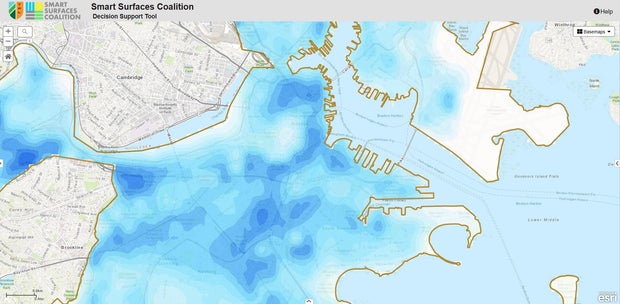
There's one between Brookline Avenue and Beacon Street in the Fenway. Another obvious spot is in the North End near Salem and Parmenter streets. There's another in the South End, at Malden Street and Harrison Avenue.
All of these locations have higher concentrations of black roofs and pavement, along with fewer trees to provide shade.
"What we've seen in our analysis is that if the city were to take an action like that, to adopt cool roofs citywide, we could generate four or five degrees of cooling in some of these pockets where there are a lot of dark roofs in one place," said Miller.
Benefits of a cooler city
The changes could be life-saving in the peak summer months, according to Miller.
"If you pair that with some of the other strategies that we've seen, cool pavement coatings, increased tree planting, that cooling goes up to six, seven, eight degrees even in some of the key neighborhoods across the city," he said.
"That includes the health benefits associated with improved air quality or reduced heat-related mortality. And that includes savings in the infrastructure space from reduced maintenance and longer material lifespans. It includes energy cost reductions," Miller said.
In addition to identifying hot zones in the city, the high-resolution modeling provided by the Smart Surfaces Coalition also has the ability to layer that information with health data. They can identify residents suffering from heart conditions and other issues like asthma, where many of the highest concentrations of these health problems fall within the hot zones.


